On this page
The federal refrigerant transition does not force owners to replace an existing air conditioner or heat pump simply because it uses a higher-global-warming-potential refrigerant. EPA says existing systems may continue to be used and repaired through their useful life.
The rules primarily affect new products and systems entering the market. A May 26, 2026 final rule, effective July 27, removed one installation cutoff for qualifying pre-2025 residential and light-commercial inventory. The exception concerns systems using refrigerants with a global warming potential (GWP) of 700 or greater; it is not a general exemption for all HVAC equipment.
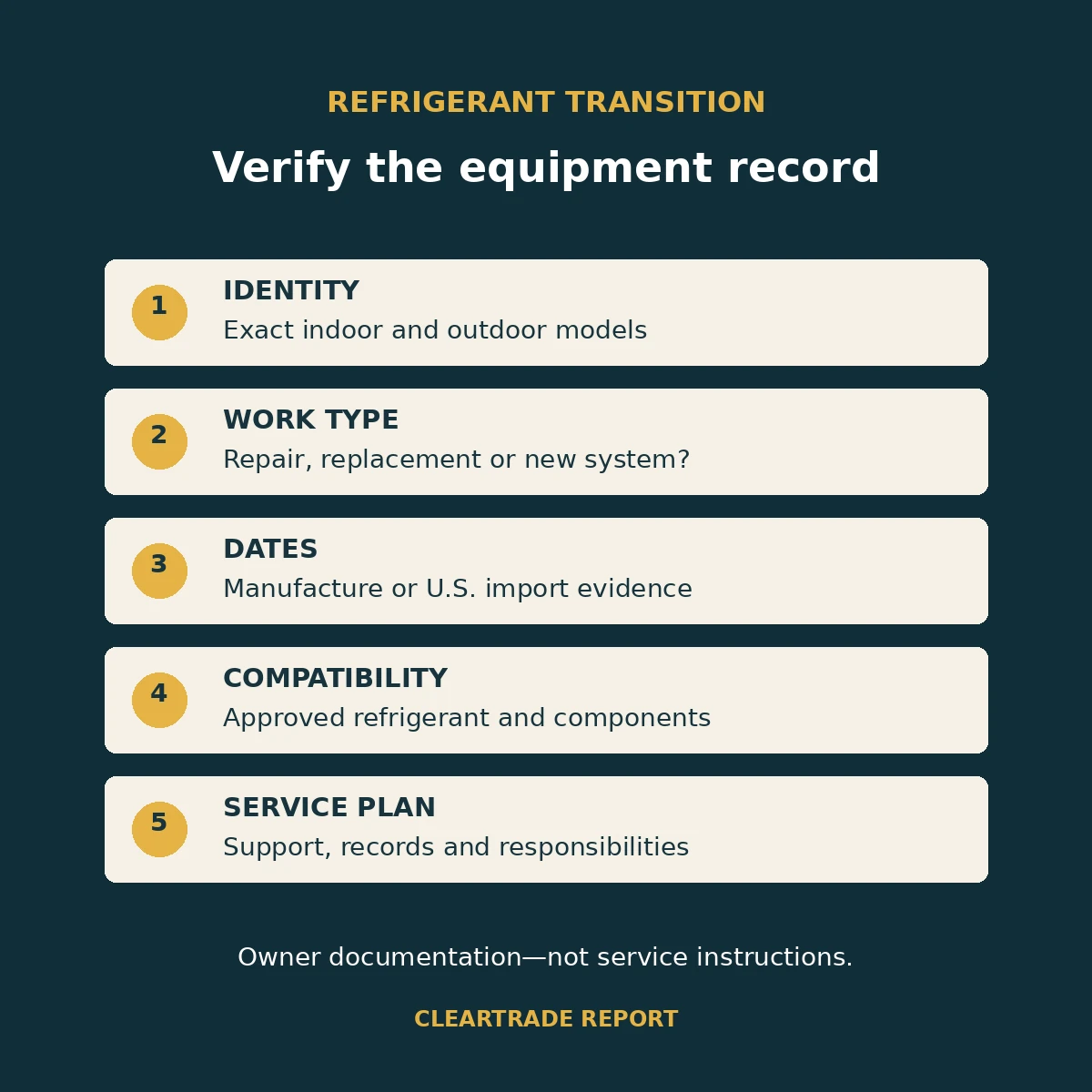
For an owner, the practical task is not to memorize every refrigerant deadline. It is to verify the exact equipment, refrigerant, manufacturing or import date, whether the work is a repair or a new system, and the documentation supporting the contractor’s recommendation.
What changed in May 2026
Under 40 CFR 84.54(c)(1), qualifying non-VRF residential and light-commercial systems may still be installed when every specified component was manufactured in the United States or imported into the United States before January 1, 2025.
That change lets qualifying pre-2025 inventory be installed until supply runs out. It does not make every older component eligible, erase product labeling requirements, or turn mixed components into an approved system.
Variable refrigerant flow (VRF) systems have separate provisions; do not apply this exception to them. A foreign manufacture date alone also does not establish timely U.S. import.
Use the effective regulatory text, EPA’s current sector table and equipment records. An older EPA FAQ subsection still states the former January 2026 cutoff; that wording does not override the later final rule. This article uses the current regulation for the inventory exception.
What did not change for existing systems
EPA’s current FAQ says owners may continue to use and repair existing refrigeration, air-conditioning, and heat-pump systems. A repair can include replacement of a major component such as a condensing unit or compressor, and components may continue to be made or imported to maintain legacy systems.
That does not guarantee that every part or refrigerant will remain inexpensive or available. It means the Technology Transitions rule itself is not a blanket order to retire an operating system.
Repair-versus-replace decisions still depend on condition, efficiency, comfort performance, part availability, total cost, and the owner’s plans for the building.
The five facts to collect before approving work
1. Exact equipment identity
Photograph or record the outdoor-unit and indoor-unit nameplates. Capture the manufacturer, model, serial number, refrigerant, electrical ratings, and manufacturing date if shown.
For a split system, treat the indoor and outdoor components as a matched system question. A refrigerant name alone is not enough to establish compatibility.
2. Repair or new-system classification
Ask the contractor to state whether the proposal is:
- service of an existing system;
- replacement of a component in an existing system;
- installation of a new complete system; or
- a retrofit or conversion.
Those are not interchangeable under manufacturer instructions or the federal transition rules.
3. Manufacturing or import date
If a proposal relies on the May 2026 pre-2025-inventory flexibility, request documentation that all specified components were manufactured domestically or imported before January 1, 2025.
A warehouse label or sales description should not substitute for traceable product documentation.
4. Approved refrigerant and component match
Verify the refrigerant and equipment combination against the manufacturer’s current instructions and EPA’s current SNAP listing and use conditions.
Do not treat similar pressure, fitting size, or physical fit as proof that components or refrigerants are interchangeable. Refrigerant substitutions can change safety classifications, controls, service procedures, and equipment approval.
5. Service and ownership plan
Before choosing equipment, ask:
- Who can service this model locally?
- What training and tools does the manufacturer require?
- How long are parts and refrigerant expected to be supported?
- What warranty applies to the exact matched system?
- What labeling and records will remain with the building?
- Are permits, commissioning records, or code inspections required locally?
This is especially important for facilities teams managing multiple systems over different refrigerant generations.
Do not shop by refrigerant alone
A lower-GWP refrigerant is one attribute, not a complete equipment recommendation. Capacity, load matching, efficiency, sound, electrical requirements, controls, ventilation, climate, maintenance access, and manufacturer support still matter.
Some newer residential and light-commercial equipment uses refrigerants with different flammability classifications and required use conditions. That is a reason to use listed equipment, follow manufacturer instructions, and hire properly qualified technicians—not a reason for an owner to improvise installation or service decisions.
Questions to put in the contractor proposal
Ask the proposal to identify:
- the exact indoor and outdoor models;
- the refrigerant and factory charge;
- whether the job is repair, component replacement, or new-system installation;
- the manufacturing or import dates when pre-2025 inventory is involved;
- the matched-system documentation;
- efficiency ratings for the proposed combination;
- permit and inspection responsibilities;
- warranty terms;
- commissioning and startup records; and
- the plan for recovering and handling refrigerant removed from the existing system.
A clear proposal lets the owner compare scope and documentation rather than comparing only refrigerant names or equipment prices.
Related reading: heat-pump proposal checks.
Frequently asked questions
Do I have to replace an existing R-410A system in 2026?
No. EPA says the Technology Transitions rule does not limit continued use of existing systems and allows them to be repaired through their useful life.
Can a contractor still install an R-410A residential system?
Potentially. The non-VRF exception requires every specified component to meet the pre-January 1, 2025 U.S. manufacture or import condition. The contractor must verify the exact system and applicable rule; VRF has separate provisions.
Is every lower-GWP refrigerant interchangeable?
No. Use only the refrigerant and components approved for the equipment and application under current manufacturer instructions and applicable requirements.
Does the rule tell me whether repair or replacement is cheaper?
No. The rule sets market-transition requirements. Repair-versus-replace economics depend on the specific system, condition, availability, efficiency, and ownership plan.
Sources
Regulation, final rule, EPA sector table, continued-use/repair FAQ answers and SNAP references rechecked October 26, 2026. The older FAQ installation-cutoff wording is superseded by the later rule for qualifying inventory.
- 40 CFR 84.54(c)(1)–(2) — current non-VRF inventory exception and separate VRF provisions.
- Federal Register: May 26, 2026 final rule — effective July 27, 2026; sections III.H/IV.H and amendatory text.
- EPA: Regulatory Actions for Technology Transitions
- EPA: Technology Transitions HFC Restrictions by Sector
- EPA: Frequent Questions on the Phasedown of HFCs
- EPA: Residential and Light-Commercial AC/Heat-Pump SNAP Substitutes
- EPA: Transitioning to Low-GWP Alternatives
Need a qualified professional?
Trusted Pros uses visible license-verification states and never ranks paid listings above unpaid listings.