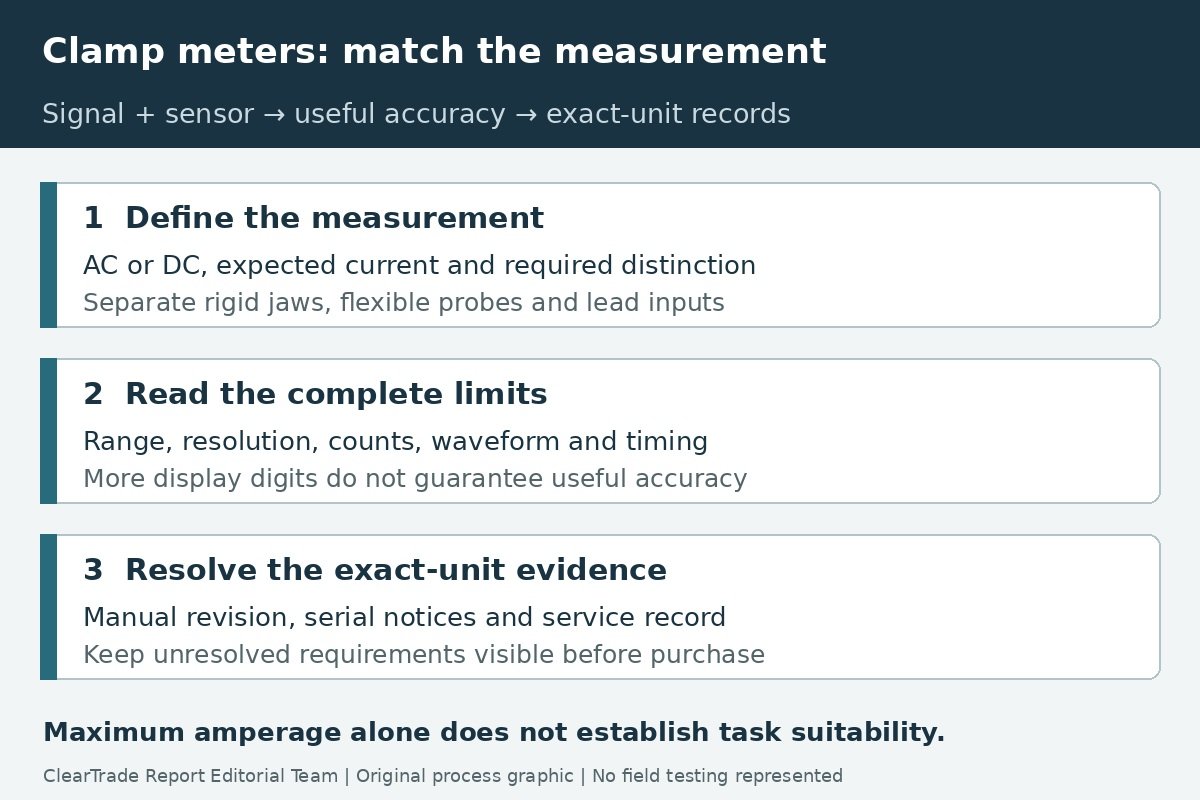
Choose a clamp meter by the current you need to measure, the smallest change you need to distinguish, the waveform and the measurement environment. Maximum amperage is only one line in that decision. A large-current clamp can be unsuitable for small currents, and a meter that measures DC voltage does not necessarily measure DC current through its jaws.
Evidence label: specification/documentation-based evaluation and comparative research. ClearTrade Report Editorial Team reviewed manufacturer documents and public safety notices on October 27, 2026 Pacific. No hands-on measurements, professional-use assessment or outside trade review was performed. The named instruments below illustrate how to read documentation; they are not ranked recommendations. No affiliate purchase links are used.
Start with a measurement brief
Write down three representative jobs before comparing catalogs. For each, record AC or DC, expected normal current, the largest plausible current, frequency or equipment type, required tolerance, conductor access and operating conditions. Add the decision the reading must support: confirming a running load is different from comparing a small standby draw or capturing a motor start.
Separate must-have capabilities from conveniences. A readable display and remote logging can matter in daily work, but they cannot compensate for an unsuitable range or unresolved safety documentation. A feature you cannot connect to an actual job is a weak reason to accept a larger, more expensive instrument.
Use this comparison register to make omissions visible. An unanswered item remains a question for the manufacturer or supplier, rather than an assumed pass.
| Measurement need | Evidence to put in the comparison |
|---|---|
| AC running current | Clamp range, frequency limits and full accuracy expression at the expected reading. |
| DC current | Explicit DC-current capability through the selected sensor, including zero/offset requirements. |
| Small current or small change | Resolution, accuracy floor, minimum specified signal and a suitable dedicated instrument category if needed. |
| Starting current | Actual inrush function, trigger threshold, capture interval and supported sensor. |
| Non-sinusoidal load | True-RMS function with applicable bandwidth, crest-factor and filtering limits. |
| Physical access | Jaw opening or flexible-probe dimensions and the positioning assumptions in the manual. |
| Work environment | Applicable category/voltage rating, accessories, environmental limits and complete safety instructions. |
| Long-term ownership | Exact model/manual revision, serial-specific notices, service route and calibration records. |
Keep AC, DC and sensor paths separate
Read the current function for the exact input you intend to use. Do not transfer a voltage specification to the clamp, or a rigid-jaw specification to a flexible accessory. The Fluke 374 FC/375 FC/376 FC manual, revision 3, April 2023 describes DC current through the meter and an iFlex accessory extending the AC-current range. That is a useful example of why the accessory name and signal type belong in separate comparison fields.
Likewise, a microamp function may use test leads instead of the jaws. The manufacturer-linked Klein CL810 instructions distinguish clamp current from lead-based DC microamps. A microamp symbol on a multipurpose instrument is therefore not evidence that it can clamp around a conductor and resolve that current.
For the buying brief, ask the supplier to identify the exact sensor, input and mode for each proposed task. Record an accessory as part of the measurement system, with its own limitations. Do not assume that every feature works through every input.
Resolution is not accuracy
Resolution describes the displayed increment. Accuracy describes a stated error bound under specified conditions. A display that changes by 0.01 A does not promise that a 0.01 A change is meaningful or that the reading is within 0.01 A of the actual current.
Here is a hypothetical arithmetic example, not a test result or a specification for either named product. Suppose a range has 0.01 A resolution and an accuracy expression of ±(2% of reading + 8 counts). At a displayed 0.50 A, the percentage term is 0.01 A and the count term is 0.08 A. The resulting stated bound is ±0.09 A before any additional conditions. At 20.00 A on the same hypothetical range, the corresponding sum is ±0.48 A.
The fixed count term explains why an impressive maximum range or fine display can coexist with an unhelpful low-current uncertainty. Compare the absolute error at your expected reading, not just the headline percentage. Keep range changes in the calculation because the value of one count can change.
For a small standby-current question, specify the change that would alter the decision. If the candidate’s documented limits cannot distinguish it, put that candidate aside for that task. Do not turn a general clamp into a leakage-current or process-loop instrument by assuming more digits solve the problem.
Inrush and true RMS answer different questions
An inrush feature is intended to capture a starting event under a defined method. A generic maximum-hold feature is not enough evidence of the same measurement. Ask for trigger level, timing, supported frequencies and the selected sensor’s limits; compare those conditions across candidates.
The CL810 documentation illustrates why revision control matters. The PDF linked from the current product page gives a different inrush threshold and accuracy from the older, still-accessible CL810 Manual_web PDF. We did not combine their more favorable figures into one product specification. Ask Klein which document applies to the exact unit before relying on a numerical inrush comparison.
True RMS concerns the reported effective value of a waveform, subject to the instrument’s limits. It does not mean unlimited waveform compatibility. Fluke’s 376 FC documentation lists frequency and crest-factor conditions, including additional error conditions. A label alone cannot establish performance on every drive output or distorted signal.
Make the test question explicit when requesting advice: which signal, on which side of which equipment, in which mode? A filtered reading and an unfiltered reading may address different questions. This guide does not prescribe energized measurements or validate a particular meter on a particular drive.
Normalize the documents before comparing models
Save the source file, its revision and access date with the quote. Manufacturer pages are useful starting points; manuals provide the function-specific qualifications that catalog summaries can omit. When the page and manual disagree, retain both and obtain clarification instead of silently choosing a number.
| Documentation example checked | What it demonstrates |
|---|---|
| Fluke 376 FC and the April 2023 revision-3 family manual | Record jaw and flexible-probe capability separately. Do not describe the AC flexible probe as a DC-current accessory. |
| Klein CL810 and product-linked CL810-1390756ART instructions | Record the exact linked file. An older CL810 PDF differs on inrush details; model name alone does not settle document applicability. |
| A hypothetical ±(% reading + counts) calculation | Convert the full expression to an absolute bound at the intended reading. This is an arithmetic illustration, not observed performance. |
These examples are not a complete market survey. Milwaukee and other linked planning candidates were not evaluated for a recommendation in this article. Price, stock, seller authenticity, exact-unit certification and warranty eligibility were not established. A document comparison should not become a purchase ranking while those gates remain unresolved.
Treat safety notices as an exact-unit check
Before buying or retaining a used instrument, match its full model and serial information to manufacturer notices and the relevant recall authority. Do not assume that a familiar brand, a calibration sticker or a functioning display resolves a recall.
The Fluke FC recall notice includes certain 376 FC units alongside other FC models. It directs owners of affected products to stop using them and obtain repair; its serial identification and corrected-unit information matter. This article does not clear any individual meter or reproduce a substitute serial-checking procedure.
The Klein clamp-meter notice concerns specified CL110, CL210, CL310 and CL110KIT products. That scope should not be casually relabeled as a CL810 recall. Conversely, not seeing a model in one notice is not proof that a particular unit is safe or free from other notices. Start with the current CPSC recall directory and manufacturer records.
A category/voltage label also belongs to the complete documented measurement setup, including applicable leads and accessories. Have the responsible qualified person resolve suitability for the installation and work method. This buying guide does not authorize energized work or replace the exact instrument’s safety instructions. Zero measured current is not proof that equipment is de-energized.
Build a purchase and service record
Keep a compact evidence packet that another technician or purchaser can understand without reconstructing the shopping process. Distinguish verified information from information still requested. For an existing fleet, use the same fields when deciding whether a meter needs service, replacement or a different instrument for a new task.
- Identity: exact model, kit/accessory numbers, serial number, supplier and purchase date.
- Task fit: the measurement brief, chosen ranges and the uncertainty calculation at representative readings.
- Documents: applicable user and safety manuals, revisions, source links and supplier clarifications.
- Safety: applicable notice search, exact-unit disposition and verification of material certification claims through primary records.
- Service: calibration scope/results, repair history, damage events and the next review decision under the owner’s program.
- Commercial terms: the actual warranty and service route for that seller, region and unit, rather than an assumed brand-wide promise.
Calibration is a separate evidence item from buying a suitable instrument. The record should show what was checked and whether that scope covers the functions you rely on. A general certificate description is less useful than traceable results tied to the serial number. For a related documentation framework, see torque-tool range, accuracy and calibration records; its tool-specific requirements should not be substituted for a clamp-meter manual.
Use the completed brief to request a documented shortlist. If a supplier cannot resolve a must-have function or contradictory manual, preserve that gap and compare another candidate. The useful outcome is a defensible match between a job and a documented measurement system.
Frequently asked questions
Does a clamp meter that measures DC voltage also measure DC current?
No. Check the exact current function and sensor. Voltage capability, rigid-jaw capability, flexible-probe capability and lead-based microamp functions are separate specifications.
Does 0.01 A resolution mean 0.01 A accuracy?
No. Resolution is the display increment. Evaluate the complete accuracy expression, including counts, at the intended reading and under the manufacturer’s stated conditions.
Is maximum hold the same as inrush measurement?
Do not assume equivalence. Compare the documented trigger, capture method, interval, frequency and sensor limitations for the starting event you need to evaluate.
Does this guide recommend a particular model or clear a recalled unit?
No. Named models illustrate document-reading questions. No hands-on test, product ranking, exact-unit recall clearance or installation-specific safety assessment was performed.
Sources and scope
Primary documents were checked October 27, 2026 Pacific. The Fluke product page, revision-3 manual and FC recall notice were reviewed separately. The Klein product page linked the CL810-1390756ART manual; the older CL810 Manual_web PDF was retained solely to document the discrepancy. Manufacturer declarations were read, but no issuer-database certification of a particular unit was completed. Public recall records were reviewed as scoped notices, not a universal no-recall finding. Recheck current manuals, notices and exact-unit documentation before purchase or use.
AI tools assisted with drafting. ClearTrade Report Editorial Team checked the cited sources and edited this guide. No hands-on inspection or testing was performed.
Need a qualified professional?
Trusted Pros uses visible license-verification states and never ranks paid listings above unpaid listings.