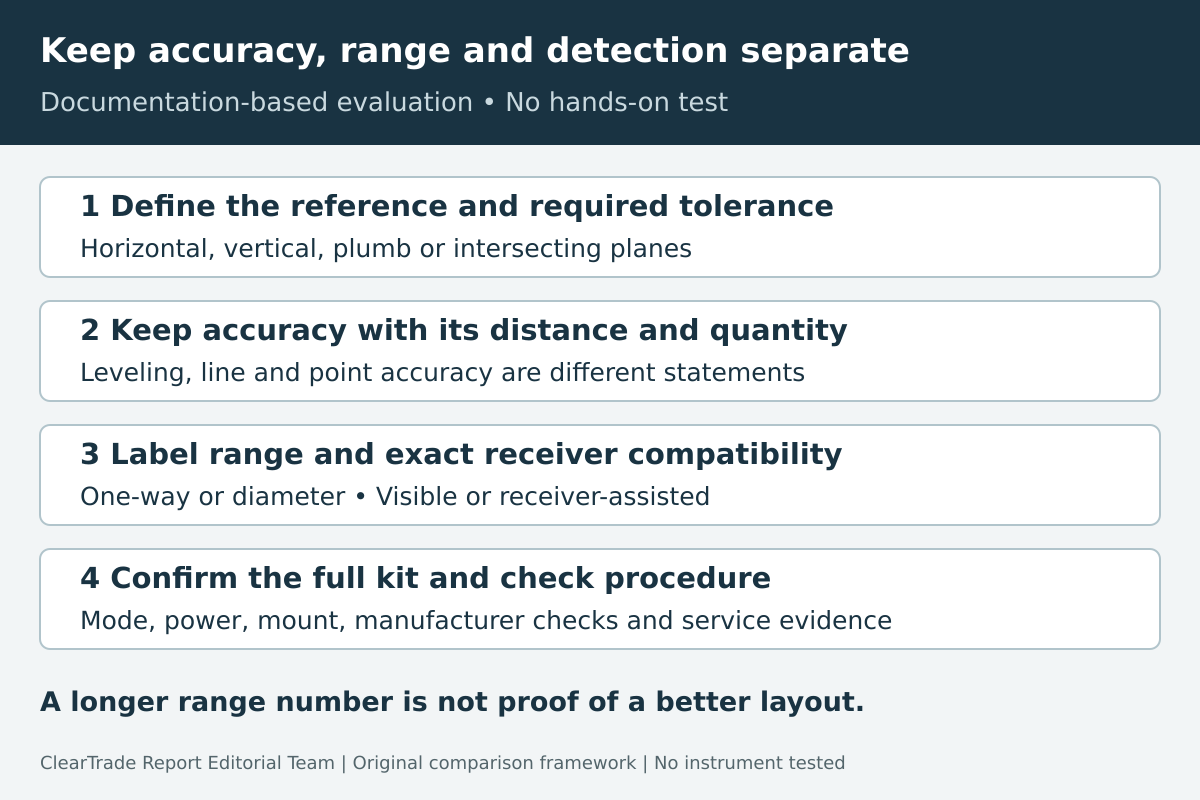
Choose a laser level by the reference it must establish, the required tolerance at the working distance, and how the beam will be detected in the actual lighting. Visible-beam range, receiver-assisted range and accuracy describe different capabilities. A larger range number does not establish a more accurate layout.
Evidence label: Specification/documentation-based evaluation and comparative research. ClearTrade Report Editorial Team checked manufacturer documents October 28, 2026. No hands-on testing, professional-use trial or outside professional review was performed. The named instruments below are documentation examples, not recommended purchases or a ranked shortlist. No product was supplied for this article, and this guide contains no affiliate links.
Define the layout task and its acceptance requirement
Identify whether the task needs a horizontal reference, a vertical line, a plumb point, intersecting planes or a reference detectable over an outdoor work area. Establish the working distance and the project’s required tolerance with the responsible person before shopping by a headline specification.
A cross-line instrument, a three-plane line laser and a rotary system should not be treated as interchangeable merely because each is called a laser level. Record the needed geometry, receiver use and mounting arrangement. Ask the manufacturer whether the proposed equipment and accessories support that exact task.
Keep the instrument specification separate from the acceptance requirement for the finished work. The work can also depend on the reference selected, setup stability, target interpretation and transfer of marks. An instrument that meets its own published rating does not certify an entire installation.
Read accuracy with its distance, quantity and conditions
Copy the exact accuracy statement from the applicable model documentation. Keep the sign, units, reference distance and the named quantity together. Leveling accuracy, horizontal/vertical line accuracy and point accuracy may be separate entries; do not substitute one for another.
For example, the manufacturer-linked Bosch GLL3-330C/GLL3-330CG manual, document 2610050360, lists typical leveling accuracy of ±3/32 inch at 30 feet. That is an instrument statement at a stated distance, not a guarantee for every setup or a tolerance for the completed construction.
The Leica Lino L6G US technical sheet separately lists leveling accuracy of ±0.002 inch per foot and horizontal/vertical line accuracy of ±0.004 inch per foot. Preserve the different labels. This guide does not turn those published numbers into a field-performance ranking against the Bosch example.
If a document gives a rate per unit distance, confirm the intended interpretation and applicable conditions before using it in a job decision. If a value is specified only at one distance, do not extrapolate it to any distance without manufacturer support. Ask for clarification when regional sheets, units or revisions disagree.
Separate one-way range from diameter
A diameter generally describes the full span across the instrument, while one-way reach describes the distance from the instrument to a target. When a manufacturer supplies both, retain both labels. Confusing a diameter with one-way reach can double the apparent coverage.
The Bosch GLL3-330CG product page describes up to 200 feet of diameter without the receiver and up to 330 feet of diameter in receiver mode with the optional LR8. Those are not 200-foot and 330-foot one-way claims.
The Leica US sheet states a range/diameter pair of 115/230 feet, and 230/460 feet with the specified RGR 200 receiver. It also makes range dependent on lighting conditions. A manufacturer’s receiver-assisted range is not a promise that the line remains visibly readable at that distance.
| Documentation example | Published range wording | What the comparison must preserve |
|---|---|---|
| Bosch GLL3-330CG | Up to 200 ft diameter; up to 330 ft diameter with optional LR8 in receiver mode | Diameter, mode and exact receiver |
| Leica Lino L6G US sheet | 115 ft range / 230 ft diameter; 230 ft / 460 ft with RGR 200 | One-way range versus diameter, receiver and lighting footnote |
These two examples demonstrate how to read documentation. They are not an exhaustive market survey, proof of current retail stock, a comparison under identical test conditions or an award for the longer published range.
Verify the exact receiver and operating mode
Obtain compatibility evidence for the exact laser and receiver models. Beam color alone does not establish compatibility. Confirm the required mode, supported laser type, detection range and any accessory or regional restrictions.
The Bosch LR8 page lists specific compatible instruments, including GLL3-330CG and GLL3-330C, and gives different system ranges for different lasers. Its ability to detect red and green lines is not a statement that it works with every red or green instrument.
The currently linked Leica L6R/L6G user manual identifies receiver options in its setup section. Use that current model documentation rather than assuming a generic detector will work. Check the particular range footnote separately: the manual’s stated receiver-range example refers to RGR200.
Ask whether the needed receiver, clamp, rod or mounting adapter is included in the quoted kit. Confirm the laser and receiver together with the supplier before purchasing accessories. A listing that says “receiver ready” may still leave a required accessory and its cost outside the package.
Treat outdoor detection as a system requirement
Tell the provider about daylight, the working distance, the target, the reference height and whether the instrument can be positioned appropriately. A bright-looking line in a product photograph does not establish that the same line will be visible on an outdoor surface.
A compatible receiver can provide a way to locate a supported beam when visual detection is difficult. It does not change the instrument’s underlying leveling accuracy into the receiver’s detection setting, and it does not resolve an unstable support or an incorrect reference.
Record receiver fine/coarse settings and their documented meaning where relevant. A detector’s on-grade indication and the instrument’s accuracy statement belong in separate fields. Ask the responsible person how the combined method will satisfy the task; this guide supplies no universal tolerance stack or acceptance rule.
Do not treat green-beam marketing, brightness ratios or maximum range as proof of outdoor performance. Those claims may have different conditions and comparison bases. This article makes no measured brightness, visibility, sunlight or distance finding for either example.
Confirm setup behavior and check procedures
Identify the self-leveling range, out-of-level indication and behavior when the pendulum is locked or a manual/slope mode is selected. Self-leveling operates within defined conditions; the presence of a projected line does not necessarily mean the instrument is establishing a level reference.
Use the exact model’s documented accuracy-check procedure and acceptance criterion. The Leica manual includes a dedicated accuracy-check section and calls for checks regularly and particularly before important measuring tasks. Do not replace that procedure with a generic wall test copied from a different instrument.
Keep checks separate from calibration or repair. An observed check result records what was checked under its stated conditions; a service or calibration claim needs its own actual evidence. A monitoring feature, app notification or transport lock should not be presented as proof that a unit is currently within specification.
For a purchased, rented or used unit, ask about the relevant identification, manual, condition, service history and the available check or service process. If the required criterion is not met, follow the manufacturer’s service instructions rather than adjusting internal parts based on this article.
Compare the usable kit and support arrangement
Evaluate the complete kit needed for the work: instrument, power source, charging arrangement, receiver, mount, tripod or pole, target and transport case as applicable. Keep included items separate from optional accessories and consumables.
Compare runtime under the maker’s stated beam count, power setting, battery and temperature conditions. A runtime for one active beam is not directly comparable with a rating for three planes. This guide makes no battery-life or durability ranking.
Review the published environmental limits, storage instructions and protection rating for each exact model. A rating does not authorize use beyond its stated scope or establish that a dropped unit remains accurate. Retain the manual’s instructions for transport and checks after events that could affect measurement.
Ask for the applicable regional warranty, registration conditions, service location and repair process in writing. A product-page summary is not a substitute for the actual warranty terms. No warranty entitlement or service turnaround is established by this article.
Use a specification record before comparing prices
The following original editorial worksheet makes gaps visible without assigning a score or a winner.
| Record field | Evidence to keep |
|---|---|
| Task and tolerance | Required reference, distance and responsible acceptance decision |
| Instrument identity | Exact model, regional variant, manual and source date |
| Accuracy | Named quantity, ± value, units, distance and conditions |
| Range | One-way or diameter, visibility or receiver mode, and footnotes |
| Receiver system | Exact compatibility, operating mode, setting and included accessories |
| Setup and checking | Self-leveling limits, warning behavior and manufacturer check procedure |
| Support | Power, mount, environmental limits, warranty and service evidence |
Consider a hypothetical owner comparing a line laser advertised with a 330-foot receiver-assisted diameter and another offer promising a 200-foot visible diameter. The larger number alone does not settle the choice: it describes another detection arrangement, and the needed receiver may be optional. Establish the actual one-way task distance, accuracy requirement and full kit first.
A supplier demonstration can help resolve a specific usability question if it is arranged safely and documented. It should not be represented as ClearTrade testing or a standardized comparison unless ClearTrade actually controls and records such a test. This article reports only the documents identified here.
Keep laser safety and evidence limits explicit
Read and follow the warning labels and instructions for the actual instrument and accessories. The Bosch and Leica manuals include laser-radiation warnings. Do not stare into a beam or direct it at people, and do not assume a viewing accessory makes exposure acceptable.
Keep the manufacturer’s safety instructions available to users. This guide does not determine protective equipment, approve a special environment or replace the responsible site’s work practices. It supplies no beam-exposure calculation or assurance that a particular use is safe.
Before a purchase or publication of a model recommendation, recheck the exact identity, current documents and relevant manufacturer and recall notices. A missing search result is not proof that no notice exists. The examples here are not a safety clearance, a verified certification listing or a recommendation to buy.
Primary references checked October 28, 2026: Bosch GLL3-330CG and LR8 US product pages and their linked manuals; Leica Lino support page, linked L6R/L6G manual and L6G US technical sheet. The Bosch laser manual identifies document 2610050360, January 2018; it remains the document linked from the retrieved product page. A currently linked manual is not necessarily newly published. Conflicting or unsupported specifications from other models or pages were excluded.
For another example of separating a tool specification from the evidence for its use, see our torque-tool range, accuracy and calibration-record guide. Its recordkeeping framework addresses torque instruments; it does not supply laser-level acceptance criteria.
Frequently asked questions
Is receiver-assisted range the same as visible-beam range?
No. Receiver-assisted range depends on the specified compatible detector and operating mode. It does not mean the line will be visibly readable at that distance.
Can any green receiver work with any green laser?
No. Verify the exact model pair and required mode in manufacturer documentation. Beam color alone does not establish compatibility.
Does self-leveling mean the instrument never needs an accuracy check?
No. Self-leveling has stated limits and mode conditions. Follow the exact manufacturer’s check and service instructions and retain actual results.
What should a useful laser-level comparison record contain?
Keep the task and tolerance, exact instrument identity, labeled accuracy and range, receiver compatibility, complete kit, check procedure and service evidence together.
AI tools assisted with drafting. ClearTrade Report Editorial Team checked the cited sources and edited this guide. No hands-on inspection or testing was performed.
Need a qualified professional?
Trusted Pros uses visible license-verification states and never ranks paid listings above unpaid listings.