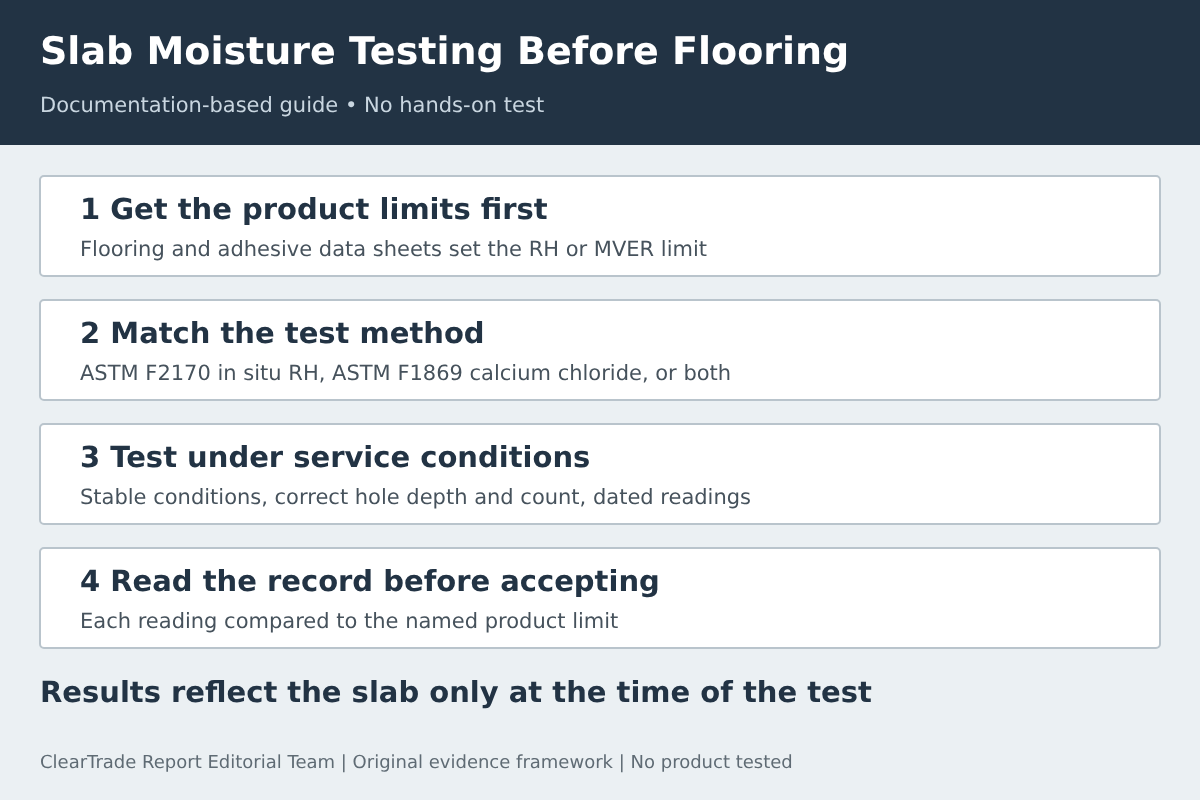
A concrete slab is ready for glue-down flooring when instrumented tests, run by the method the flooring and adhesive manufacturers name, show readings within those manufacturers’ published limits. How the surface looks or feels does not answer the question. Before you accept a slab, ask for a dated test record that names the method (usually ASTM F2170 in situ relative humidity, ASTM F1869 calcium chloride, or both), the test locations and conditions, every reading, and the specific product limit each reading was compared against.
Evidence label: Documentation-based guide. ClearTrade Report Editorial Team checked ASTM scope pages, a U.S. Department of Defense guide specification, and flooring, adhesive and test instrument manufacturer documents on November 3, 2026. No hands-on testing, site visit or outside professional review was performed. Products named below are documentation examples, not recommendations. This guide contains no affiliate links.
Why a dry-looking slab is not evidence
Moisture problems in flooring can show up after the floor is down. The scope page for ASTM F2170 states that “Excessive moisture in floor slabs after floor covering has been installed can cause floor covering system failures”. The ASTM F1869 page adds that “All floor coverings are susceptible to failure from excessive moisture vapor emissions.”
That is why the ASTM practice for preparing concrete for resilient flooring, ASTM F710, says on its public page that “All concrete slabs should be tested for moisture regardless of age or grade level,” and that “all concrete floors should be tested for pH before installing resilient flooring.” Slab age and a dry surface are not substitutes for a test result.
Who sets the moisture limit
The ASTM scope pages describe how to measure moisture, not what reading is acceptable for your floor. The F2170 scope page puts it plainly: “Manufacturers of such systems generally require moisture testing to be performed before installation on concrete.” ASTM F710 adds that “This practice does not supersede in any manner the resilient flooring or adhesive manufacturer’s written instructions.”
Flooring documents often point to the adhesive. Shaw’s “Installation Guidelines For Residential resilient Direct glue” (revision 04012022) tells installers that “All concrete substrates should be tested for IRH (Internal Relative Humidity) according to ASTM F 2170,” and then, rather than giving a number, says: “Refer to the adhesive information for the acceptable moisture limits.”
Public specifications follow the same pattern. The Department of Defense Unified Facilities Guide Specification UFGS 09 65 00, “Resilient Flooring” (November 2024), says to “Conduct moisture testing in accordance with ASTM F1869 or ASTM F2170, unless otherwise recommended by the flooring manufacturer,” and to “Conduct alkalinity testing as recommended by the flooring manufacturer.”
Who runs the test varies. Shaw’s residential guidelines say “IT MAY NOT BE THE FLOOR COVERING INSTALLER’S RESPONSIBILITY TO CONDUCT THESE TESTS,” but that it is the installer’s responsibility “TO MAKE SURE THESE TESTS HAVE BEEN CONDUCTED,” “AND THAT THE RESULTS ARE ACCEPTABLE PRIOR TO INSTALLING THE FLOOR COVERING.” Settle in the contract who tests, who pays, and who gets the report.
Limits differ by product: three documented examples
These examples show why no single “safe” number exists and why the limit must be tied to the exact product in the submittal.
- MAPEI Ultrabond ECO 360 (Technical Data Sheet, edition date June 16, 2023): “Do not install when relative humidity of concrete slabs exceeds 80% (ASTM F2170).” It also says not to install when MVER “exceeds 5 lbs. per 1,000 sq. ft.” per 24 hours “when using the anhydrous calcium chloride test (ASTM F1869).”
- Bostik LOCK A195 VCT (document T000325, revised 09.13.21): “LOCK A195 VCT™ may be used on slabs with RH readings up to 95% and a pH between 8.0-10.0.” For higher readings it says: “For slabs exceeding 95% RH, treat with Bostik’s D-250™ or Slab-Cote™ Moisture Vapor Barrier Coating.”
- TEC Fortane LVT-1F (H.B. Fuller product data sheet PDS-FLVT1F_N0525-20, May 2025): “Do not install when the concrete RH is over 99%, per ASTM F2170,” and “Do not install when MVER is over 12 lbs. per 1,000 ft² per 24 hours, per ASTM F1869.”
A 90% RH reading would exceed the MAPEI limit above but fall within the Bostik and TEC limits. A report that says only “slab passed,” without naming the product limit, cannot tell you which applies. These are different adhesives for different floor coverings, and the flooring manufacturer’s instructions still apply.
What the two ASTM test methods measure
ASTM F2170 (in situ relative humidity). The scope page says the method “covers the quantitative determination of percent relative humidity in concrete slabs.” Wagner Meters’ F2170 checklist summarizes the setup: “You’ll need three test holes for the first 1,000 square feet” and “at least one hole for each additional 1,000 square feet.” On depth: “If the slab is drying from one side, your test holes should be 40% of the depth of the slab. But if the slab is drying from both sides, your test holes only need to be 20% of the depth.” Conditions matter: “Monitor for at least 48 hours before testing to confirm stability,” and “Ensure that these conditions match the final service conditions of the space.”
ASTM F1869 (calcium chloride, MVER). This method measures what leaves the surface, not what is inside. Its scope page says the result is “expressed as the rate of moisture vapor emission, measured in pounds of moisture over a 1000 ft2 area during a 24-h period.” It “shall not be used to evaluate the rate of moisture vapor emitted by gypsum concrete or floors containing lightweight aggregate,” and “shall not be used to evaluate moisture vapor emissions over coatings on concrete or through reactive penetrants or over patching or leveling compounds.”
Both are snapshots. F2170’s page says “Moisture test results indicate the moisture condition of the slab only at the time of the test,” and F1869’s says results “may not indicate future conditions.”
Handheld meter readings are a separate topic; our guide to pin vs pinless moisture meter readings explains what those numbers mean. The manufacturer documents quoted in this guide state their concrete limits in terms of ASTM F2170 or ASTM F1869 results.
Test method decision table
| Test method | What it measures | Conditions required | What the record should show |
|---|---|---|---|
| ASTM F2170 in situ RH probes | Percent relative humidity inside the slab | Stable conditions matching service conditions, monitored at least 48 hours before testing; holes at 40% of slab depth (drying from one side) or 20% (drying from both sides); 24-hour sensor equilibration | Date, tester, slab area and thickness, test hole locations, ambient conditions, each reading, and the product RH limit compared |
| ASTM F1869 calcium chloride (MVER) | Moisture vapor emitted from the bare surface, in pounds per 1,000 sq ft per 24 hours | Bare concrete; not for gypsum concrete, lightweight aggregate floors, coated surfaces, reactive penetrants, or patching or leveling compounds | Date, tester, area tested, each MVER result, and the product MVER limit compared |
| pH (alkalinity) test | Alkalinity (pH) of the concrete slab | As the flooring or adhesive manufacturer specifies | Date, tester, area tested, readings, and the product pH range compared |
| Bond test | Compatibility of the flooring adhesive with the concrete | Per the flooring manufacturer’s printed installation instructions | Date, tester, area tested, and result |
UFGS 09 65 00 asks for test reports “stating date of test, person conducting the test, and the area tested.” Wagner’s checklist says to “record your results with the date and test hole location.”
What to ask for before you accept the slab
Get the flooring and adhesive submittals, then the test report. Check that the report uses the method the product documents name and compares every reading with the limit for that method.
Ask for pH and bond test results when the products call for them. Bostik’s VCT adhesive data sheet says “Due to the many additives being used in or on concrete slabs, it is critical that the bond test be performed.” UFGS 09 65 00 calls for a bond test “in accordance with the flooring manufacturer’s printed installation instructions.”
Finally, check the date. Shaw notes that moisture tests indicate “THE CONDITIONS ONLY AT THE TIME OF THE TEST.” If the schedule slips or conditions change before installation, ask whether the product instructions require retesting.
Know the limits of this guide
Evidence label: documentation-based guide. ClearTrade Report Editorial Team checked the sources below on November 3, 2026. We did not visit, test or measure any slab, and we did not test any product. ASTM F2170, F1869 and F710 are paid standards; we could not read their full text and relied only on ASTM’s public scope pages and on manufacturer summaries. ASTM’s F710 page lists F710-22 as a historical version, with F710-26 shown as active. Product limits change between revisions; check the current data sheet for your exact product. Hole counts, depths and conditions quoted from Wagner Meters are that manufacturer’s summary of F2170, not the standard’s text.
Primary references checked November 3, 2026: ASTM F2170-19a scope page; ASTM F1869-23 scope page; ASTM F710-22 scope page; U.S. Department of Defense UFGS 09 65 00, “Resilient Flooring” (November 2024), via the Whole Building Design Guide; Shaw, “Installation Guidelines For Residential resilient Direct glue” (revision 04012022); MAPEI, Ultrabond ECO 360 Technical Data Sheet (June 16, 2023); Bostik, LOCK A195 VCT data sheet (T000325, revised 09.13.21); H.B. Fuller TEC, Fortane LVT-1F product data sheet (May 2025); Wagner Meters, “Concrete Moisture Testing Checklist.”
Frequently asked questions
Who decides how dry a concrete slab must be before flooring goes down?
The flooring and adhesive manufacturers, in their installation instructions and technical data sheets. ASTM F710 says it does not supersede the resilient flooring or adhesive manufacturer’s written instructions.
Is ASTM F2170 or ASTM F1869 the better test?
Neither is better in every case. They measure different things: F2170 measures relative humidity inside the slab with in situ probes, while F1869 measures the moisture vapor emission rate from the bare surface. Use the method, or methods, the product documents call for, and compare the result only to the limit stated for that method.
Does a passing moisture test mean the slab will stay dry?
No. Both ASTM scope pages say results reflect the slab’s condition at the time of the test, and the F1869 page adds that results may not indicate future conditions. Treat a passing result as dated evidence for the specific products and area tested.
What should a slab moisture test report include?
The test method, date, who ran the test, area tested, each location and reading, slab thickness for RH tests, building conditions, and the product limit each reading was compared against. Add pH and bond test results if the products require them.
Disclaimer: This guide is general information based on standards-body, government and manufacturer documentation, not professional engineering, flooring, legal or construction advice for a specific project. Follow the current installation instructions and technical data sheets for the exact flooring and adhesive on your job, and use a qualified tester for any moisture testing. AI tools assisted with drafting. ClearTrade Report Editorial Team checked the cited sources and edited this guide. No hands-on testing was performed.
Need a qualified professional?
Trusted Pros uses visible license-verification states and never ranks paid listings above unpaid listings.