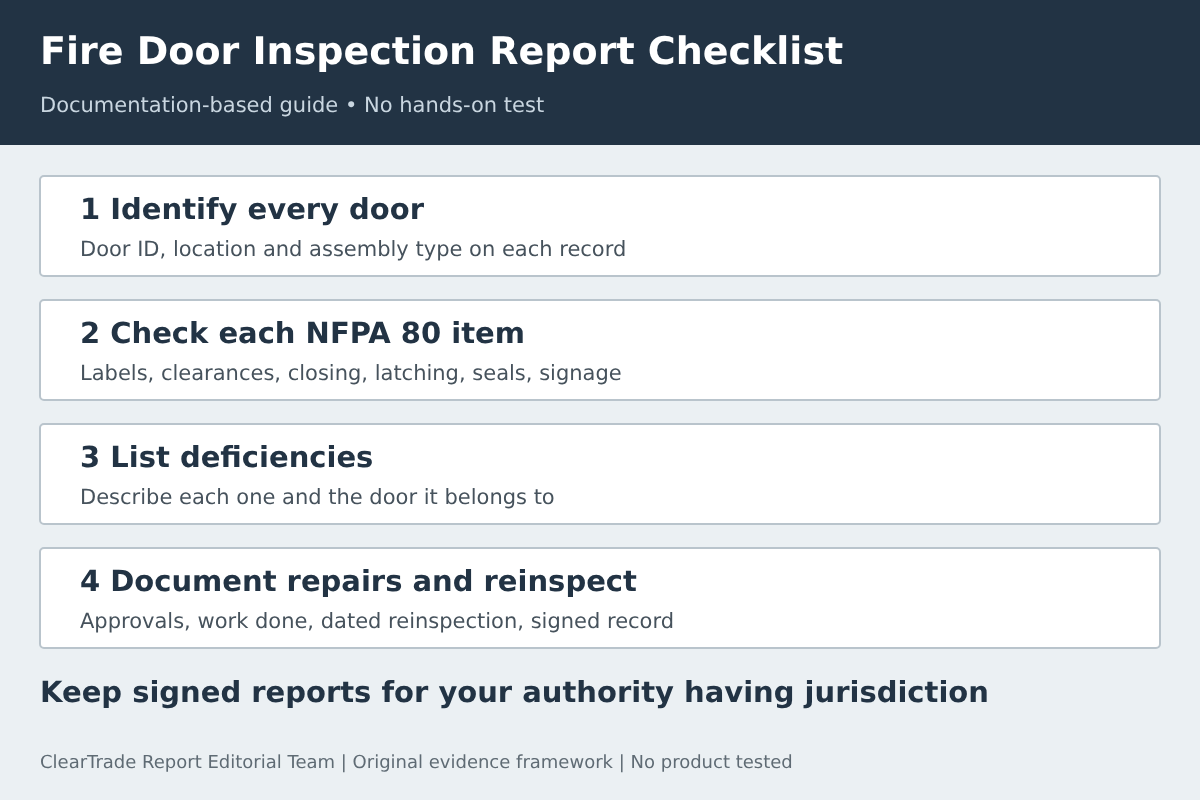
A fire door inspection report should identify every door by location and type, record pass or fail for each item NFPA 80 lists (labels, holes, glazing, hardware, clearances, self-closing, latching, auxiliary items, field modifications, seals and signage), describe each deficiency, and carry the date, facility name and inspector’s signature. We suggest a record for each repair: what was fixed, with what approvals, and when the door was reinspected. Keep signed reports for the authority having jurisdiction (AHJ) as long as your code requires.
Evidence label: Documentation-based guide. ClearTrade Report Editorial Team checked NFPA committee documents, federal and state government documents, county code documents, testing laboratory pages, and door and hardware manufacturer and industry association pages on November 3, 2026. No hands-on testing, site visit or outside professional review was performed. Organizations and services named below are documentation examples, not recommendations. This guide contains no affiliate links.
Who requires the inspection and the record
NFPA 80, the Standard for Fire Doors and Other Opening Protectives, sets the core rule. The Kansas Office of the State Fire Marshal’s fire door checklist (Form 817) quotes section 5.2.1 of the 2010 edition: “Fire door assemblies shall be inspected and tested not less than annually, and a written record of the inspection shall be signed and kept for inspection by the Authority Having Jurisdiction.”
Fire codes pull that requirement into existing buildings. The Steel Door Institute quotes the International Fire Code: “Opening protectives in fire-resistance-rated assemblies shall be inspected and maintained in accordance with NFPA 80.” For health care occupancies, a July 28, 2017 CMS memo (S&C 17-38-LSC) says “annual inspection and testing in accordance with the 2010 NFPA 80 is required for all fire door assemblies.”
Local rules can add paperwork. Montgomery County, Maryland, says “The inspection shall be performed in accordance with 2019 edition of NFPA 80” and requires a signed inspector affidavit to renew the building’s Fire Code Compliance permit. Ask your AHJ which edition and forms apply. If you are building a yearly schedule, our small commercial building maintenance calendar shows where the annual inspection fits.
As for who inspects, the Kansas form quotes section 5.2.3.1 of the 2010 edition: “Functional testing of fire door and window assemblies shall be performed by individuals with knowledge and understanding of the operating components of the type of door being subject to testing.”
What the written record should contain
Allegion’s I Dig Hardware site quotes the record requirement in the 2013 edition of NFPA 80 (section 5.2.2.4): “A record of all inspections and testing shall be provided that includes, but is not limited to, the following information:” The items it lists include “Date of inspection,” “Name of facility,” “Individual record of each inspected and tested fire door assembly,” “Type and description of each inspected and tested fire door assembly,” “Verification of visual inspection and functional operation,” and “Listing of deficiencies.”
A Second Revision report on NFPA 80 published by NFPA contains committee-revised text, marked for ballot, that would state “The records shall be on a medium that will survive the retention period” and “Paper or electronic media shall be permitted.” This is proposed text, not a requirement you can cite from an adopted edition. A proposed annex note in the same report says that “To aid the AHJ during the review of the inspections and testing reports,” the records “should include a description of the type of fire door assembly”.
On retention, Steel Door Institute says inspection records are kept for “3 years unless otherwise specified,” and that “Records of acceptance tests must be retained for the life of the assembly.” Montgomery County states: “Test records shall be retained for a period of at least three (3) years.” Confirm the period your code sets before you discard anything.
The items checked on each swinging door
Allegion’s knowledge center lists 13 inspection points from NFPA 80 Chapter 5 (the page does not name an edition). They start with “Labels are present and legible” and “No holes or breaks in the door or frame,” and cover glazing, hardware in working order, missing or broken parts, clearances, self-closing, coordinators on pairs, “Door is self-latching in the closed position,” auxiliary items that interfere with operation, “No field modifications have been performed that would void the label,” gasketing and edge seals, and signage that “covers less than 5% of door face and is not attached with metal fasteners.” The report should give each item a pass or fail for every door.
Clearances need numbers, not a checkmark. The Kansas form, citing the 2010 edition, states that clearances at the top and vertical edges of the door, and at the meeting edges of pairs, “shall be 1⁄8 in. ± 1⁄16 in. (3.18 mm ± 1.59 mm) for steel doors” and “shall not exceed 1⁄8 in. (3.18 mm) for wood doors,” and that “The clearance under the bottom of a door shall be a maximum of 3⁄4 in. (19 mm),” with a smaller limit where the bottom of the door is more than 38 in. above the finished floor. The report should name the edition used.
Allegion’s summary of Door Security and Safety Foundation research lists common deficiencies including “Painted or missing fire door labels,” “Poor clearance dimensions around the perimeter of the door in the closed position,” and “Kick-down door holders.”
Labels: what to record when one is missing or painted
UL says a frame’s certifying label “must include the frame type, the UL Certification Mark” and “a serial number or permanent issue number.” UL also says it “permits and encourages painting of embossed labels,” but that non-embossed labels “should not be painted, as the paint will obscure the information.”
For a missing or unreadable label, Steel Door Institute says the component “may need to be properly field labeled by an authorized fire door labeling service” and warns that “once a label is removed, it can not be reattached.” Intertek describes its field labeling service for labeling “that has been painted over or has been removed,” which involves “field inspecting the door assembly against listing information (past and present)” and produces “a written deficiencies report.”
Field modifications and repairs
Allegion’s January 2026 article on NFPA 80 (2025 edition) lists job-site preparations the standard allows, including “Holes for surface-applied hardware, function holes for mortise locks, and holes for labeled viewers” and “A maximum ¾ in. (19mm) wood and composite door undercutting.” Beyond those, it says “Field modifications require prior permission.” The documentation starts before the work: “Proposed rework description involves written details, graphics, pictures, templates, etc.” Review begins with the door manufacturer, and the listing or labeling agency decides whether the proposed rework is acceptable.
For deficiencies, Allegion’s May 2026 deficiencies article says “any deficiencies found must be corrected without delay.” Allegion’s 2013 review of that edition notes that, where the code references NFPA 80-2013, repaired assemblies must be “inspected and tested immediately upon completion of the work.” We suggest each repair record show the deficiency it closes, the work done, any approvals, and a dated reinspection. Local rules may add steps: Montgomery County says deficient openings “shall be repaired, replaced, or otherwise installed under permit.”
Checklist: what the report records and what to keep
| Inspection item | What the report should record | Evidence to keep |
|---|---|---|
| Door identity and type | Door ID, location and assembly type | Door schedule or plan with IDs |
| Labels | Door and frame labels present and legible; rating and serial number where readable | Label photos; any field labeling report |
| Holes, breaks and damage | Open holes or breaks and where they are | Photo; repair method and materials |
| Glazing and vision kits | Glazing and beads intact and fastened | Product data for replacement glazing |
| Hardware and parts | Door, frame, hinges and hardware secured and working; missing or broken parts | Work orders and parts used |
| Clearances | Measured gaps against the edition’s limits | Measurements; photo of failures |
| Self-closing and coordinator | Door fully closes; on pairs, inactive leaf closes first | Closer adjustment or replacement record |
| Latching | Latch secures the closed door | Repair work order |
| Auxiliary items and hold-opens | Items that interfere, such as kick-down holders | Record of removal |
| Field modifications | Changes beyond permitted preparations; approval status | Manufacturer and labeling agency approvals |
| Gasketing and edge seals | Present and intact where required | Seal product data |
| Signage | Sign size and fastening | Photo of signage |
| Sign-off and follow-up | Date, facility, inspector signature, deficiency list, corrective action, reinspection date | Signed report and reinspection record, kept for your required retention period |
The evidence column is our documentation suggestion, not a requirement quoted from NFPA 80.
Know the limits of this guide
Evidence label: documentation-based guide. ClearTrade Report Editorial Team checked the sources below on November 3, 2026. We did not inspect or repair any door. We could not read the full text of NFPA 80, NFPA 101 or the International Fire Code; NFPA 80 wording here comes from documents that quote it (the 2010 edition via the Kansas form and CMS, the 2013 and 2025 editions via Allegion, the 2019 edition named by Montgomery County) and from proposed committee text in an NFPA Second Revision report, which is not an adopted requirement. Confirm requirements with your AHJ and, for health care facilities, CMS and your accreditor.
Primary references checked November 3, 2026: Kansas Office of the State Fire Marshal, Fire Door Checklist, Form 817 (Rev. 03/31/2026); CMS, S&C 17-38-LSC, “Fire and Smoke Door Annual Testing Requirements in Health Care Occupancies” (July 28, 2017); Montgomery County, Maryland, Department of Permitting Services, Opening Protectives Affidavit (updated 7/2025); NFPA, NFPA 80 Second Revision report (committee text for ballot); Allegion knowledge center, “What are the 13 fire rated opening inspection points?”; Allegion I Dig Hardware: “Decoded: NFPA 80-2013 FDAI Changes” (August 2013), “FDAI: Inspection Criteria 11” (January 5, 2026), “Fire Door Inspection: Top 10 Deficiencies” (May 21, 2026); Steel Door Institute, “Fire Door Assembly Inspections 101”; UL, “Q&A: Fire Door Frames Label Considerations” (May 7, 2019); Intertek, “Field Labeling of Fire Doors.”
Frequently asked questions
How often do fire doors need to be inspected?
NFPA 80 requires fire door assemblies to be inspected and tested not less than annually, with a signed written record kept for the authority having jurisdiction. Check which edition your jurisdiction enforces.
Who is allowed to inspect fire doors?
NFPA 80 (2010 edition, as quoted on the Kansas fire door checklist) says functional testing shall be performed by individuals with knowledge and understanding of the operating components of the type of door being subject to testing. Steel Door Institute says certification is not specifically required by NFPA 80, but it may help an AHJ determine whether an inspector has the required expertise.
What should I do if a fire door label is missing or painted over?
Record the door ID and label condition, with a photo. Steel Door Institute says the component may need field labeling by an authorized fire door labeling service.
Can we drill holes or add hardware to a fire door?
Only within limits. Allegion lists job-site preparations the 2025 edition of NFPA 80 permits, such as holes for surface-applied hardware, and says other field modifications require prior permission. A documented proposal is reviewed first by the door manufacturer, and the listing or labeling agency decides whether it is acceptable.
Disclaimer: This guide is general information based on standards-body, government, testing laboratory and manufacturer documentation, not professional fire protection, engineering, legal or code compliance advice for a specific building. Follow the code edition adopted where you are and the door and hardware manufacturers’ listings, and use a qualified fire door inspector for inspections and repairs. AI tools assisted with drafting. ClearTrade Report Editorial Team checked the cited sources and edited this guide. No hands-on testing was performed.
Need a qualified professional?
Trusted Pros uses visible license-verification states and never ranks paid listings above unpaid listings.