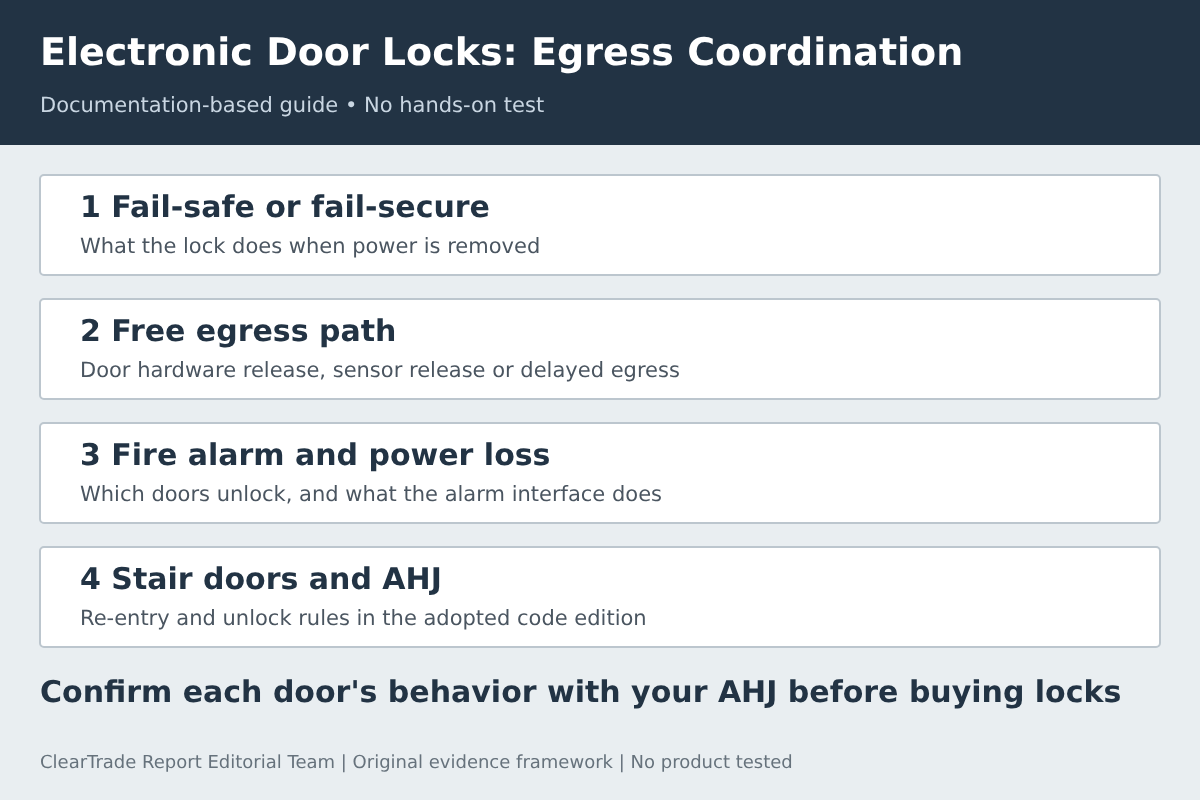
Before picking an electronic lock for an exit-path door, decide which code path the door follows (door hardware release, sensor release, delayed egress or a stair door provision). Then confirm what it must do on power loss and fire alarm, and who wires and tests that release. The adopted building and fire code and your authority having jurisdiction (AHJ) have the final word, so collect that evidence before the lock goes on the hardware schedule.
Evidence label: Documentation-based guide. ClearTrade Report Editorial Team checked model building code text as reproduced by a door hardware manufacturer, city and state fire code documents, and lock, power supply and hardware manufacturer documentation on November 4, 2026. No hands-on testing, site visit or outside professional review was performed. Products and organizations named below are documentation examples, not recommendations. This guide contains no affiliate links.
Fail-safe vs fail-secure: what happens when power drops
Allegion’s knowledge center defines both: “When a lock is Fail-Safe it means that when power is dropped it will be unlocked,” and “When a lock is Fail-Secure it means that when power is dropped it will be locked.”
Allegion’s article “Decoded: Fail Safe vs. Fail Secure” (Rev. 08/18) explains the tradeoff: “Fail secure products provide security when there is no power applied.” With a fail-safe product, “the door will be unlocked whenever there is a fire alarm or power failure, which is an obvious security risk.” Some devices only come one way: “Electromagnetic locks are only available fail safe.” Securitron’s installation instructions for its M38 and M68 Magnalocks (Rev. C, 05/12) describe them as “direct holding fail safe electromagnetic locks.”
Fail-secure does not by itself trap people, but that depends on the hardware. The same Allegion article says “Most products provide free egress whether they are fail safe or fail secure,” and elsewhere names the exceptions: electromagnetic locks, and double-cylinder institutional function locks. Allegion explains that “Fail safe/fail secure refers to the status of the secure side (key side, outside) of the door,” and that on most electromechanical locks and electrified panic trim the inside still opens mechanically. Ask the supplier to state in writing what each side does with power off and on fire alarm.
Reader wiring is a separate topic, covered in our guide to OSDP vs Wiegand access control encryption.
Free egress first: door hardware release and sensor release
Where electricity holds an egress door locked from the inside, as with a magnetic lock, the 2021 International Building Code (IBC) pages reproduced in an Allegion I Dig Hardware PDF show two permitted arrangements.
Door hardware release (2021 IBC 1010.2.11). This “shall be permitted on doors in the means of egress in any occupancy except Group H.” The door hardware must have “an obvious method of operation that is readily operated under all lighting conditions,” be “capable of being operated with one hand,” and operation “directly interrupts the power to the electric lock and unlocks the door immediately.” Also, “Loss of power to the electric locking system automatically unlocks the door.” Where panic or fire exit hardware is required, “operation of the panic or fire exit hardware also releases the electric lock.” The section adds: “The locking system units shall be listed in accordance with UL 294.”
Sensor release (2021 IBC 1010.2.12). “The sensor shall be installed on the egress side, arranged to detect an occupant approaching the doors,” and the doors unlock “by a signal from or loss of power to the sensor.” A manual unlocking device must be “located 40 inches to 48 inches (1016 mm to 1219 mm) vertically above the floor” and “within 5 feet (1524 mm) of the secured doors,” with a sign that reads “PUSH TO EXIT.” Once pressed, “the electric lock shall remain unlocked for not less than 30 seconds.” Activation of the building fire alarm system, or of the sprinkler or fire detection system, where provided, “shall automatically unlock the electric lock,” which stays “unlocked until the fire alarm system has been reset.” “Emergency lighting shall be provided on the egress side of the door.”
Allegion’s August 5, 2025 article “Decoded: Applications for Electromagnetic Locks” cites the 2024 IBC as 1010.2.10 for door hardware release and 1010.2.11 for sensor release. It notes that the 2024 IBC and IFC “limits doors with panic hardware to the door hardware release application.” Section numbers move between editions, so name the adopted edition in your specifications.
Delayed egress is its own code path
For delayed egress locks, the 2021 IBC pages in the Allegion PDF require that the system “shall have the capability of being deactivated at the fire command center and other approved locations” and that “Initiation of the irreversible process shall activate an audible signal in the vicinity of the door.”
A Minnesota Department of Labor and Industry document, “Section 1010 Doors, Gates and Turnstiles (Fire Code)” (posted as its 2020 fire code file; it does not state the model code edition), gives the core conditions: the delay “shall deactivate upon actuation of the automatic sprinkler system or automatic fire detection system” and “shall deactivate upon loss of power controlling the lock or lock mechanism.” In Minnesota’s text, an attempt to egress starts an irreversible process that allows egress “in not more than 15 seconds” once “a physical effort to exit of not more than 15 pounds (67 N) is applied to the egress side door hardware for not more than one second” (editions word the trigger differently), and “Where approved, a delay of not more than 30 seconds is permitted.”
Allegion’s June 8, 2026 article “Decoded: Delayed Egress Locks” adds planning points. The building must be “equipped throughout with an automatic sprinkler system or approved automatic smoke or heat detection system.” Recent IBC/IFC editions “allow only one delayed egress lock along any given egress path in most use groups” (the Minnesota text allows two in some Group I occupancies, with a combined delay of no more than 30 seconds). It also recommends that “delayed egress locks and fire alarm systems share a common standby power source.”
Stair doors and fire-rated openings
The City of Austin Fire Department’s “AFD Clarification on Locking Requirements for Stairway Doors” (October 4, 2024) applies the 2021 IBC Section 1010.2.7 as amended by Austin. For buildings not classified as high-rise, it says stair doors “are permitted to be locked from the side opposite the egress side” “provided they are openable from the egress side,” and “shall be capable of being unlocked simultaneously without unlatching.” In Austin’s amended text, the unlocking signal comes from “an approved fire department key switch.” For high-rise buildings, Austin cites its amended 2021 IFC Section 508.1.6, Item 7: “Stairways doors shall be physically unlocked by UL listed fire alarm system components.”
On hardware, Allegion’s fail-safe article says “Fail safe electromechanical locks are used for stairwell doors providing re-entry,” and “During a fire alarm, the lever on the stair side is unlocked (power removed).”
For fire doors, the same Allegion article says fire-rated openings need positive latching, so “fail secure strikes must be used because fail safe strikes do not provide the positive latching” and the listings required by NFPA 80. It also says fire doors do not require fail secure electric locks, only fail secure electric strikes.
Coordinating with the fire alarm contractor and the AHJ
Several code paths require a fire alarm or sprinkler signal to release locks. In LifeSafety Power’s “Troubleshooting Tips and Techniques” power guide (Sep 2020), on its FPO75, FPO150 and FPO250 supplies, “When the FAI is activated, the DC2 output will be disabled.” Lock outputs on its C4 and C8 boards are “programmable for fail-safe, fail-secure, dry contact, and fire alarm over ride.”
City of Austin’s “Electrical Locking System Guideline” (last revised August 2024, covering the 2021 and 2024 IBC) shows what one AHJ asks for. It states that since September 2024 “building permits are required to identify one of the following egress Types for all electrically locked doors,” and that “Plans will note one of the above egress types and provide a sequence of operation for all doors with electrical locking.”
The practical step is a door-by-door sequence of operation in the bid documents naming the code path, power-loss state, fire alarm release, who provides the fire alarm relay or module, and who attends the acceptance test. Allegion’s 2025 article advises readers to “consult with the Authority Having Jurisdiction (AHJ) if there are questions or concerns.”
Scope table: door type, questions, evidence
| Door type | Questions to answer | Evidence to collect |
|---|---|---|
| Exterior entry with card reader | Is the inside free egress mechanical? Fail-safe or fail-secure on the outside? Does a fire alarm need to release it? | Lock cut sheet stating fail-safe or fail-secure; written statement of power-off and alarm behavior |
| Egress door with magnetic lock | Door hardware release or sensor release? Which adopted edition and section? | UL 294 listing; sensor and push button data; emergency lighting on drawings; fire alarm release point |
| Door with panic hardware | Does operating the panic hardware release the electric lock? Does your edition limit this door to door hardware release? | Exit device data showing the release switch; hardware schedule note |
| Delayed egress door | Is the occupancy allowed? Is the building sprinklered or detected? 15 or 30 seconds? Only lock in the path? | AHJ approval for any 30-second delay; signage detail; fire alarm and power-loss release in the sequence of operation |
| Stair door | Locked from the stair side? What signal unlocks it without unlatching? Fire command center or key switch? | Local amendment text; re-entry hardware data; fire alarm interface drawing |
| Fire-rated opening | Does the hardware keep positive latching on power loss and alarm? | Door and frame label rating; fail-secure strike or latching lock data from the hardware maker |
| Every electrified door | Who provides the fire alarm interface, and who tests it? | Door-by-door sequence of operation; permit plan notes; acceptance test record |
The questions and evidence columns are our documentation suggestions, not requirements quoted from a code.
Know the limits of this guide
Evidence label: documentation-based guide. We could not read the full IBC, IFC or NFPA 101 text directly on the ICC or NFPA sites; 2021 IBC wording here comes from code pages reproduced by Allegion, and other code wording comes from Minnesota and City of Austin documents, including Austin’s local amendments. Some jurisdictions enforce NFPA 101, which has its own provisions. Confirm requirements with your AHJ and the code edition adopted where you are.
Primary references checked November 4, 2026: International Code Council, 2021 International Building Code, Chapter 10 pages reproduced by Allegion I Dig Hardware (“2021 IBC Electromagnetic Locks” PDF); City of Austin Fire Marshal’s Office, “Electrical Locking System Guideline” (last revised August 2024); City of Austin Fire Department, “AFD Clarification on Locking Requirements for Stairway Doors” (October 4, 2024); Minnesota Department of Labor and Industry, “Section 1010 Doors, Gates and Turnstiles (Fire Code)” (2020 fire code file); Allegion, “Decoded: Fail Safe vs. Fail Secure” (Rev. 08/18); Allegion knowledge center, “Explain Fail-Safe and Fail-Secure in terms of wiring with relays”; Allegion I Dig Hardware, “Decoded: Applications for Electromagnetic Locks” (August 5, 2025) and “Decoded: Delayed Egress Locks” (June 8, 2026); Securitron (ASSA ABLOY), “Installation and Operating Instructions for Model M38 and M68 Magnalocks” (Rev. C, 05/12); LifeSafety Power (ASSA ABLOY), “Troubleshooting Tips and Techniques” power guide (Sep 2020).
Frequently asked questions
What is the difference between fail-safe and fail-secure locks?
A fail-safe lock unlocks when power is removed, and a fail-secure lock stays locked when power is removed. Allegion notes that most products, except electromagnetic locks, provide free egress either way, because the setting refers to the secure (outside) side of the door.
Do electronic locks have to unlock when the fire alarm goes off?
It depends on the code path. In the 2021 IBC, sensor release doors and delayed egress locks must release on sprinkler or fire detection activation, while the 2021 IBC door hardware release section (1010.2.11) has no fire alarm release item, and Allegion’s 2025 article on the 2024 codes says those sections do not require it. Local amendments may add it. Confirm with your AHJ.
Can an electric strike on a fire-rated door be fail-safe?
Not according to Allegion, because fire-rated openings need positive latching. Allegion says fail secure strikes must be used on fire doors because fail safe strikes do not provide positive latching. Ask the door and hardware makers and your AHJ before electrifying any labeled opening.
Who is responsible for connecting locks to the fire alarm?
The codes set what must happen, not which trade does it. Name an owner for the fire alarm interface in the bid documents, and include a door-by-door sequence of operation, which the City of Austin requires on permit plans.
Disclaimer: This guide is general information based on model code text, city and state fire code documents and manufacturer documentation, not professional fire protection, engineering, legal or code compliance advice for a specific building. Follow the code edition adopted where you are, your AHJ’s direction and the lock and hardware manufacturers’ instructions, and use qualified, licensed contractors for design, installation and testing. AI tools assisted with drafting. ClearTrade Report Editorial Team checked the cited sources and edited this guide. No hands-on testing was performed.
Need a qualified professional?
Trusted Pros uses visible license-verification states and never ranks paid listings above unpaid listings.