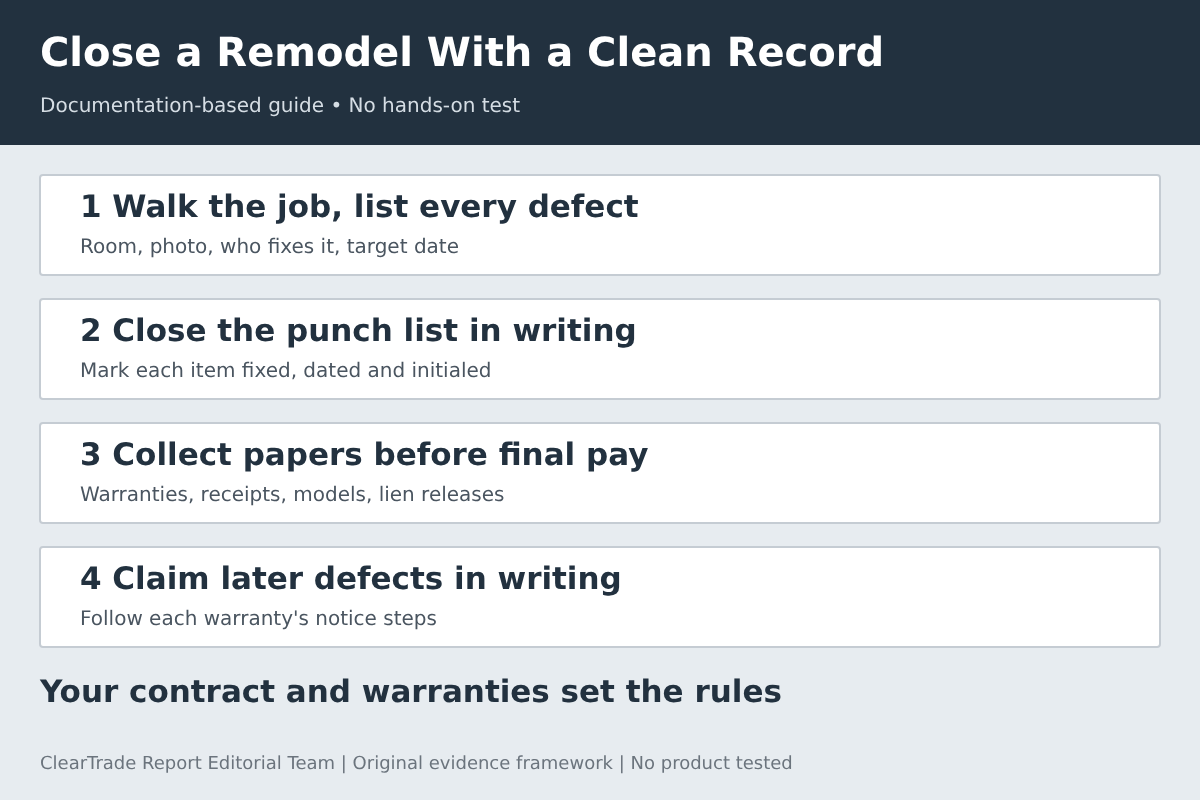
Close a remodel in two stages and keep the records for each one separate. Before the final payment, walk the job with the contractor and write a punch list: every unfinished or incorrect item, its location, a photo, who will fix it and by when. After you accept the work, a defect that shows up later is a warranty matter, handled under the written terms of the contractor or the product maker, which usually require written notice and proof of dates. The evidence that helps most is a signed-off punch list, receipts and installation dates, model and warranty documents, and dated photos. Your own contract governs the dates, payment terms and steps.
Evidence label: Documentation-based guide. ClearTrade Report Editorial Team checked AIA Contract Documents articles on substantial completion and closeout, Federal Trade Commission consumer pages on warranties and home improvement, the California Contractors State License Board home improvement contract guide, the New York Attorney General home improvement fact sheet, an Andersen windows support page and a GAF sample roofing warranty on November 6, 2026. No hands-on testing, site visit or outside professional review was performed. Organizations and products named below are documentation examples, not recommendations. This guide contains no affiliate links.
Punch list or warranty claim: where the line falls
Both deal with defects in the work, but at different times and under different rules.
- Punch list: items you find at or near completion, while money is still owed. The contractor works through the agreed list before final payment.
- Warranty claim: a defect that appears after acceptance, such as a door that starts to stick or a leak after the first heavy rain. It goes through the claim steps in the warranty, which may be the contractor’s or a product maker’s.
Mixing the two loses the record. If a known defect is never written on the punch list, it can be hard to show later that it existed at handover. A phone call about a later defect may not meet a warranty’s written notice rule. The FTC page “Warranties for New Homes” advises: “Even if the company provides a hotline for urgent requests, put your request for repair in writing.”
The closeout milestones in plain terms
The AIA Contract Documents article “Substantial Completion vs. Final Completion” describes three points:
- Substantial completion: “Substantial completion is generally reached when the work, or a designated portion of it, is sufficiently complete” for the owner “to occupy or use it as intended.” The article adds: “Limited corrective or incomplete work may remain, and that work should be identified.”
- Punch list: “The resulting punch list helps define what remains.”
- Final completion: “Final completion is the point at which the contractor has finished the work required by the contract.”
The same article says “final payment generally follows final completion and submission of all documents required by the contract.” It also says “Warranties may begin on the substantial completion date unless the contract or certificate establishes a different date.” So write down the completion date. It can start a warranty clock while punch list items are still open. Your contract may use other words, such as “acceptance,” so read it for what counts as completion.
Build a punch list that can actually be closed
The AIA Contract Documents article “Construction Contract Closeout: Key Best Practices and Lessons Learned” puts it simply: “A punch list only works when the team can act on it.” The completion article advises: “Attach the punch list and confirm that all parties are working from the same version.” For a homeowner, that means one shared, dated list.
A workable punch list entry has these parts (our suggested format, not a required form):
- Item number and room: for example, “7. Hall bath, vanity drawer.”
- What is wrong, in one sentence: “Drawer rubs the frame and will not close fully.”
- A dated photo taken at the walk-through.
- Who fixes it: the contractor, a named trade, or the product maker.
- Target date agreed at the walk-through.
- Status: open, fixed, or disputed, with the date and initials of whoever checked it.
Include cleanup. The California Contractors State License Board guide “Terms of Agreement: A Consumer Guide to Home Improvement Contracts” lists contract scope “up to and including complete cleanup and removal of debris and materials.” If your contract included dust barriers and a cleanup standard, check the final cleaning against it at the walk-through. Our guide to remodel dust containment: specify barriers, airflow and cleanup before work covers how to write that standard at the start.
Keep scope changes off the punch list. New work belongs in a written change order, which the CSLB guide says “should be kept with your other project paperwork.”
What to collect before final payment
Collect closeout paperwork before you release the final payment. The FTC page “How To Avoid a Home Improvement Scam” says: “And never make the final payment until the work is done and you’re satisfied with it.” The New York Attorney General’s “Home Improvement Fact Sheet” similarly advises: “Withhold final payment until all the work is completed,” and it ties final payment to required inspections and certificates. The AIA closeout article adds a caution that applies to homeowners too: “Final payment should follow the contract’s requirements, not an improvised checklist assembled at the end.”
The AIA closeout article lists closeout records such as “Warranties, guarantees, certificates, and start dates” and “Operations and maintenance manuals, product data, and system narratives.” For a home project, that translates to:
- The punch list, with every item marked closed or carried forward in writing.
- The contractor’s written warranty, if one is offered. The CSLB guide says: “If the contractor offers a warranty for labor and/or materials, be sure to get that in writing.”
- Receipts or invoices for installed products, showing purchase and installation dates.
- Model numbers, product names and the makers’ warranty documents and care manuals.
- Final inspection sign-off where a permit was required.
- Lien releases where your state uses them. The CSLB guide advises: “Have subcontractors sign lien releases when their portion of the work is completed.” The AIA closeout article notes: “Lien waiver rules vary by state and payment status.”
Warranty claims after you move back in
After acceptance, a new defect is usually a warranty question. Decide whose warranty applies: the contractor’s for workmanship, or a product maker’s for the product itself. The answer changes who you notify.
The FTC page “Warranties” says: “Laws in every state create implied warranties – unspoken promises – that cover almost everything you buy.” It also says: “If you have a problem with a product contact the seller,” and “If the seller doesn’t resolve the problem, write to the manufacturer.” On paperwork, it notes: “The receipt proves the date you bought the product and that you’re the original product owner,” and that “sometimes you’ll have to return a product registration card first to qualify for warranty service.”
Makers differ on the first contact. The Andersen support FAQ tells owners to “reach out to the Andersen Certified Installer who installed your product” or to contact Andersen directly. For registration it says: “You’ll need to enter your product type, quantity of product, and date of installation.” By contrast, the GAF Roofing System Limited Warranty sample says: “You must notify GAF about any claim within 30 days after you notice a problem,” and “Notice to your contractor, dealer, or home builder is NOT notice to GAF.” It also says: “You may be required to send to GAF, at your expense, photographs and sample products for testing.” The GAF sample also warns that repairing or replacing products before notifying GAF, or before it finishes evaluating the claim, can lead to a denial. If a repair cannot wait, read the warranty’s notice terms first.
The FTC new homes page notes that “A builder warranty comes with new home construction or a remodel.” Its claim steps: “Check the warranty to make sure the problem is covered.” “File your claim using the instructions in your warranty.” “Keep a record of your correspondence and conversations with the company.”
If a dispute with a licensed contractor is not resolved, a state agency may help. The CSLB guide says: “Consumers have four (4) years to file a complaint with the Contractors State License Board (CSLB) about a faulty project.” Other states have different agencies and deadlines.
Closeout checklist: defect, status and evidence
| Defect or situation | Where it belongs | Evidence to keep |
|---|---|---|
| Unfinished or wrong item seen at the walk-through | Punch list, before final payment | Numbered entry, room, dated photo, responsible party, target date, sign-off when fixed |
| Item still open when you are asked for final payment | Punch list; follow the contract’s payment and completion terms | Written list of open items, agreed dates, any written agreement about holding back an amount |
| Workmanship problem appears weeks after acceptance | Contractor warranty claim | Contractor’s written warranty, completion date, dated photos, written repair request and replies |
| Installed product fails, such as a window seal or shingle defect | Manufacturer warranty claim, by the maker’s process | Receipt, installation date, model number, registration proof, photos, notice sent within any stated deadline |
| Unsure whether it is workmanship or product | Notify the contractor in writing and check the product warranty’s notice rule | Both warranty documents, photos, copies of every notice and response |
| Change in scope requested at the end | Not a punch list item; written change order | Signed change order kept with project paperwork |
This table is our planning summary of the cited documents, not a legal standard or a contract term. Your contract, your state’s law and each warranty’s own wording decide the actual steps.
Know the limits of this guide
This guide is based only on the published documents listed below, checked on November 6, 2026. We did not review any homeowner’s contract, inspect any project or test any product. The AIA Contract Documents articles describe construction contract practice, and a small remodel contract may use different terms. The FTC new homes page is mainly about new homes, with home warranties and service contracts alongside builder warranties. The CSLB and New York Attorney General pages describe rules in those two states only. Andersen and GAF are two examples; other makers and warranty versions differ. This guide does not cover change orders, budget or selection decisions, insurance claims, lien law details or legal remedies. For a dispute, contact your state’s contractor licensing agency, consumer protection office or a lawyer.
Primary references checked November 6, 2026: AIA Contract Documents, “Substantial Completion vs. Final Completion”; AIA Contract Documents, “Construction Contract Closeout: Key Best Practices and Lessons Learned”; Federal Trade Commission, “Warranties”; Federal Trade Commission, “Warranties for New Homes”; Federal Trade Commission, “How To Avoid a Home Improvement Scam”; California Contractors State License Board, “Terms of Agreement: A Consumer Guide to Home Improvement Contracts”; New York Attorney General, “Home Improvement Fact Sheet”; Andersen Windows, “Frequently asked questions for support”; GAF, “GAF Roofing System Limited Warranty” (legal sample).
Frequently asked questions
What is the difference between a punch list and a warranty claim?
A punch list covers unfinished or incorrect work you find at or near completion, before the job is closed out and the final payment is made. A warranty claim covers a defect that shows up after acceptance, under the written terms of a contractor or manufacturer warranty. Your contract sets the exact dates and steps.
Should I hold back the final payment until the punch list is done?
Consumer agencies advise against paying in full before the work is finished. The FTC says never make the final payment until the work is done and you are satisfied with it. Follow the payment schedule in your contract and any rules in your state, and put any dispute in writing.
Who do I contact about a defect after the job is finished?
It depends on which warranty covers the item. Start with your contractor for workmanship. For a product, read the maker’s warranty. Some makers, such as Andersen, list the installer as one place to start a claim, while GAF’s sample roofing warranty says notice to your contractor is not notice to GAF.
What records should I keep after a remodel?
Keep the signed contract, change orders, the signed-off punch list, receipts showing purchase and installation dates, product model information, warranty documents, lien releases where used, care manuals, and dated photos. Keep copies of letters and notes of calls about any defect.
Disclaimer: This guide is general information based on government, contractor licensing agency, professional contract publisher and manufacturer documentation, not professional legal, construction or warranty advice for a specific project. Your signed contract, your state’s law and each warranty’s written terms govern. AI tools assisted with drafting. ClearTrade Report Editorial Team checked the cited sources and edited this guide. No hands-on testing was performed.
Need a qualified professional?
Trusted Pros uses visible license-verification states and never ranks paid listings above unpaid listings.