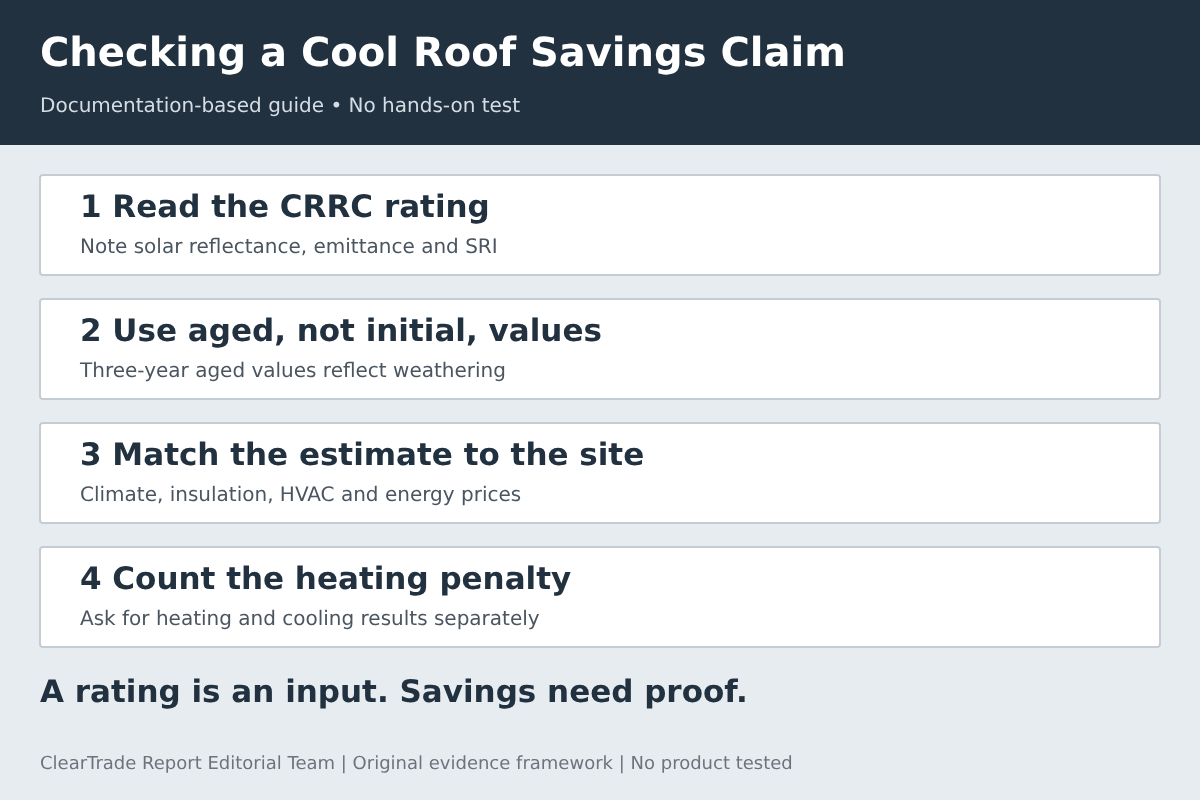
A cool roof rating tells you how a roof surface handles sunlight and heat. It does not tell you how much your building will save. Rated values such as solar reflectance, thermal emittance and the Solar Reflectance Index (SRI) describe the product. Savings depend on your building: its climate, how well the roof is insulated, how much heating it needs in winter, how much of the building sits under the roof, and what you pay for energy. To judge a savings claim, ask for the aged ratings, the inputs behind the estimate, and whether winter heating costs were counted.
Evidence label: Documentation-based guide. ClearTrade Report Editorial Team checked U.S. Department of Energy, Oak Ridge National Laboratory, Lawrence Berkeley National Laboratory, Cool Roof Rating Council, ENERGY STAR and U.S. Environmental Protection Agency documents on November 6, 2026. No hands-on testing, site visit or outside professional review was performed. Organizations and products named below are documentation examples, not recommendations. This guide contains no affiliate links.
A rating label and a savings estimate answer different questions
Cool roof pitches often blend two kinds of evidence: a product rating measured under fixed conditions, and a savings estimate for one building.
The Cool Roof Rating Council (CRRC) “Rated Roof Products” directory is direct about this. It says: “CRRC Product Ratings are determined for a fixed set of conditions, and may not be appropriate for determining seasonal energy performance.” It adds: “The actual effect of solar reflectance and thermal emittance on building performance may vary.” It also says a listing “does not mean that the product is “cool” as defined by any particular code or program,” and that a rating “does not indicate a ranking or approval.”
The U.S. Department of Energy (DOE) Energy Saver page “Cool Roofs” makes the same split from the other side. It says requirements for a cool roof “vary by standard or program, location, building type, and roof slope.” Then: “Therefore, there is no single definition of a cool roof.”
Treat the label as an input, and the savings figure as a claim that needs its own support.
What the rating numbers mean
The CRRC document “Learn About Cool Roofs and Walls: Supporting Codes, Programs & Standards with CRRC Ratings” defines the two main properties:
- Solar reflectance: “The fraction of solar energy that is reflected by the surface.”
- Thermal emittance: “The relative ability of the surface to radiate heat.”
It says: “Both properties are measured on a scale from 0 to 1, where 1 means 100% reflective or emissive.”
SRI combines the two. The CRRC directory says: “Solar Reflectance Index (SRI) is a calculated metric as defined in the CRRC-1 Roof Product Rating Program Manual.” Ask which values it was calculated from.
Initial versus aged. This is the distinction that matters most for savings. The CRRC policy document quotes California’s Title 24 energy code, which requires a roofing product packaging label that lists “the initial and 3-year aged solar reflectance, or a CRRC Rapid Rating for solar reflectance.” It lists “Three-year natural weathering by accredited test farms in three designated U.S. climates” among the features of CRRC ratings. The directory lets you filter by “Initial” or “3 Year Aged” values and notes that “Rapid Ratings are interim laboratory-aged values that simulate three-year aged values.”
DOE’s 2011 “Guide to Cool Roofs” explains why: “since many roofs become less reflective over time, energy savings should be based on long-term values of solar reflectance and thermal emittance.” An estimate built only on the initial number may overstate long-run savings.
ENERGY STAR status. You may still see ENERGY STAR on older roofing literature. An ENERGY STAR stakeholder notice on the roof products sunset says “the ENERGY STAR roof products specification will sunset,” that “Models that are certified by June 1, 2021, will remain ENERGY STAR certified until June 1, 2022,” and that “Brand owners must stop using the ENERGY STAR name and ENERGY STAR mark” for roof products. The current ENERGY STAR “Cool Roofs” page sends readers to the CRRC instead: “Learn more about roof types and product types from the Cool Roof Rating Council (CRRC).” If a current quote leans on an ENERGY STAR roof label, ask what rating actually backs the product.
What site-specific savings depend on
DOE’s Energy Saver page lists the main factors in one sentence: “How much energy you will save depends on several factors such as your home’s climate and surroundings, the extent to which the roof assembly is insulated, the type of roof you have, and the efficiency of your heating and cooling system.”
How each factor shows up in the sources:
- Climate. The ENERGY STAR “Cool Roofs” page says: “In general, cool roofs work best (save more energy) in hot sunny climates, like the Southern U.S., on buildings with low levels of roof insulation.”
- Existing insulation. That same sentence names low roof insulation. The ORNL calculator, covered below, asks for the roof’s R-value.
- Heating and cooling equipment. Energy Saver names system efficiency as a factor and lists one benefit as “Helping older inefficient (or undersized) air conditioners provide enough cooling for today’s hotter summers.”
- Building shape. The DOE guide’s headline figure is limited to one building type: “Reduce the annual air-conditioning energy use of a single-story building by up to 15%.” That is an upper bound for one building type, not a typical result.
- Energy prices and demand charges. The ORNL calculator asks for electricity and heating fuel costs and has a separate Peak version for demand charges.
Two factors the sources we checked do not quantify: ducts or air handlers in an attic or plenum, and how much of a multistory building’s floor area sits under the roof. The ORNL calculator says “the effects of a plenum, are especially important.” Treat both as questions for whoever prepares the estimate.
Timing matters too. The DOE guide says: “It is rarely economical to replace a mechanically sound roof just to increase its solar reflectance.” It says cool roofing “should be considered whenever construction, an energy retrofit, or a roof replacement is being planned.” If you are weighing that bigger decision, our guide Roof Coating vs Recover vs Tear-Off: The Evidence Behind the Decision covers the evidence for each path.
The heating penalty in colder climates
A roof that rejects summer sun also rejects winter sun. The Lawrence Berkeley National Laboratory Heat Island Group page “Cool Roofs” says: “During winter months, cool roofs increase the need for heating energy in cold climates.” DOE’s Energy Saver page states the risk: “Cool roofs can also incur a winter heating penalty.” It warns that a cool roof “can increase energy costs in colder climates if the annual heating penalty exceeds the annual cooling savings.”
The sources also say the penalty is often modest. The Heat Island Group page says “in the United States, this winter heating penalty is typically small compared to the summer cooling benefit.” The EPA page “Using Cool Roofs to Reduce Heat Islands” says the “heating penalty” is “typically offset by summer cooling energy savings,” and that “Buildings in areas with heavy and long-lasting snow cover would have the lowest heating penalty from cool roofs.” The DOE guide says: “Even in mixed climates, however, winter penalties can be smaller than summer savings.”
“Typically” is not “always.” If your building has a large heating load, ask for heating and cooling results shown separately.
Cold climates also raise a moisture question. Energy Saver says: “In cold climates, roofs can accumulate moisture through condensation.” It adds that “Condensation can be avoided using proper design techniques.” That is a design question for your roofer or designer.
How to check a savings estimate
A tool developed by the U.S. Department of Energy’s Oak Ridge National Laboratory (ORNL) shows what an estimate should include. The ORNL “Cool Roof Calculator” describes itself this way: “Estimates Cooling and Heating Savings for Flat Roofs with Non-Black Surfaces.” It asks for:
- a location (the page links “Data for All 243 Locations”);
- the proposed roof’s R-value, solar reflectance and infrared emittance;
- summer electricity cost and heating fuel cost;
- air conditioner and heating system efficiency.
It has limits. It covers flat roofs, and it says “This version of the calculator is for small and medium-sized facilities.” Large facilities that buy electricity with a demand charge are directed to “run the Peak version of the calculator in order to include the savings in peak demand charges.” It compares each roof with a black roof, so to compare two non-black options it says: “To compare two non-black roofs, print out results of separate estimates for each vs. a black roof.” It also warns: “Some things, such as the weathering of the solar radiation control properties and the effects of a plenum, are especially important.” Its plainest line: “What you get out of this calculator is only as good as what you put in.”
Use that line as your test. If someone gives you a savings figure, ask for the location, reflectance and emittance values (initial or aged), insulation level, energy prices and equipment efficiency behind it. If any are missing, the figure is incomplete.
Peak demand is a separate benefit. EPA says: “In air-conditioned residential buildings, solar reflectance from a cool roof can reduce peak cooling demand by 11–27%.” EPA cites a 2007 study by Synnefa, Santamouris and Akbari for that figure. Peak reduction is not the same as annual energy savings.
Checklist: savings claim, question to ask, evidence to request
| Claim you hear | Question to ask | Evidence to request |
|---|---|---|
| “This roof is rated cool” | Rated by whom, and against which code or program? | CRRC product listing with initial and 3-year aged values; the code or program requirement it meets |
| “It will save X% on energy” | For which building, climate and insulation level? | The calculation inputs: location, R-value, reflectance, emittance, energy prices, equipment efficiency |
| Savings based on a high reflectance number | Is that the initial or the aged value? | Both values from the CRRC listing; estimate rerun with the aged value |
| Savings shown for cooling only | Was the winter heating penalty counted? | Separate heating and cooling results and the net figure |
| “Up to 15%” or another headline figure | Does that figure apply to a building like mine? | The source of the figure and the building type it describes, such as single-story |
| “ENERGY STAR certified roof” | What rating backs this product now? | Current CRRC rating; an ENERGY STAR notice says the roof products specification would sunset on June 1, 2022 |
| Large peak or bill savings for a commercial building | Were demand charges and rate structure modeled? | Peak demand inputs and the utility rate used |
This table is our summary of the cited documents, not a code or program requirement.
Know the limits of this guide
ClearTrade Report Editorial Team read public documents on November 6, 2026. We did not test any roof, model any building or review any contractor estimate. We give no savings figures of our own. The DOE “Guide to Cool Roofs” dates from 2011, and the 11–27% peak figure on the EPA page comes from a 2007 study. The sources we checked do not quantify the effect of attic ducts or of building height on savings. This guide does not cover choosing a roof covering, code compliance, rebates or condensation design. For a specific building, ask a qualified energy professional to model it, and check your local energy code.
Primary references checked November 6, 2026: U.S. Department of Energy, Energy Saver, “Cool Roofs”; U.S. Department of Energy, “Guide to Cool Roofs” (DOE/EE-0384, 2011); Oak Ridge National Laboratory, “Cool Roof Calculator”; Lawrence Berkeley National Laboratory Heat Island Group, “Cool Roofs”; Cool Roof Rating Council, “Rated Roof Products” directory; Cool Roof Rating Council, “Learn About Cool Roofs and Walls: Supporting Codes, Programs & Standards with CRRC Ratings”; ENERGY STAR, “Cool Roofs”; ENERGY STAR, roof products sunset stakeholder notice; U.S. Environmental Protection Agency, “Using Cool Roofs to Reduce Heat Islands.”
Frequently asked questions
Does a high solar reflectance rating guarantee energy savings?
No. The Cool Roof Rating Council says its ratings are determined for a fixed set of conditions and may not be appropriate for determining seasonal energy performance. Savings depend on climate, roof insulation, roof type and heating and cooling equipment.
Should I use initial or aged reflectance values?
Use aged values for savings estimates. The DOE Guide to Cool Roofs says many roofs become less reflective over time, so energy savings should be based on long-term values. The CRRC directory shows both initial and 3-year aged values.
Can a cool roof raise my energy bills in a cold climate?
It can. DOE says a cool roof can increase energy costs in colder climates if the annual heating penalty exceeds the annual cooling savings. DOE, EPA and Lawrence Berkeley National Laboratory also say the penalty is often small or offset, so ask for heating and cooling results shown separately.
Are roof products still ENERGY STAR certified?
No. An ENERGY STAR notice says the roof products specification would sunset, that models certified by June 1, 2021, would remain certified until June 1, 2022, and that brand owners must stop using the ENERGY STAR name and mark for roof products. The ENERGY STAR Cool Roofs page now points readers to the Cool Roof Rating Council.
Disclaimer: This guide is general information based on government, national laboratory and rating-body documentation, not professional energy, engineering or roofing advice for a specific building. Savings depend on your building, climate and energy prices, so have a qualified professional model your building before relying on a savings figure. AI tools assisted with drafting. ClearTrade Report Editorial Team checked the cited sources and edited this guide. No hands-on testing was performed.
Need a qualified professional?
Trusted Pros uses visible license-verification states and never ranks paid listings above unpaid listings.