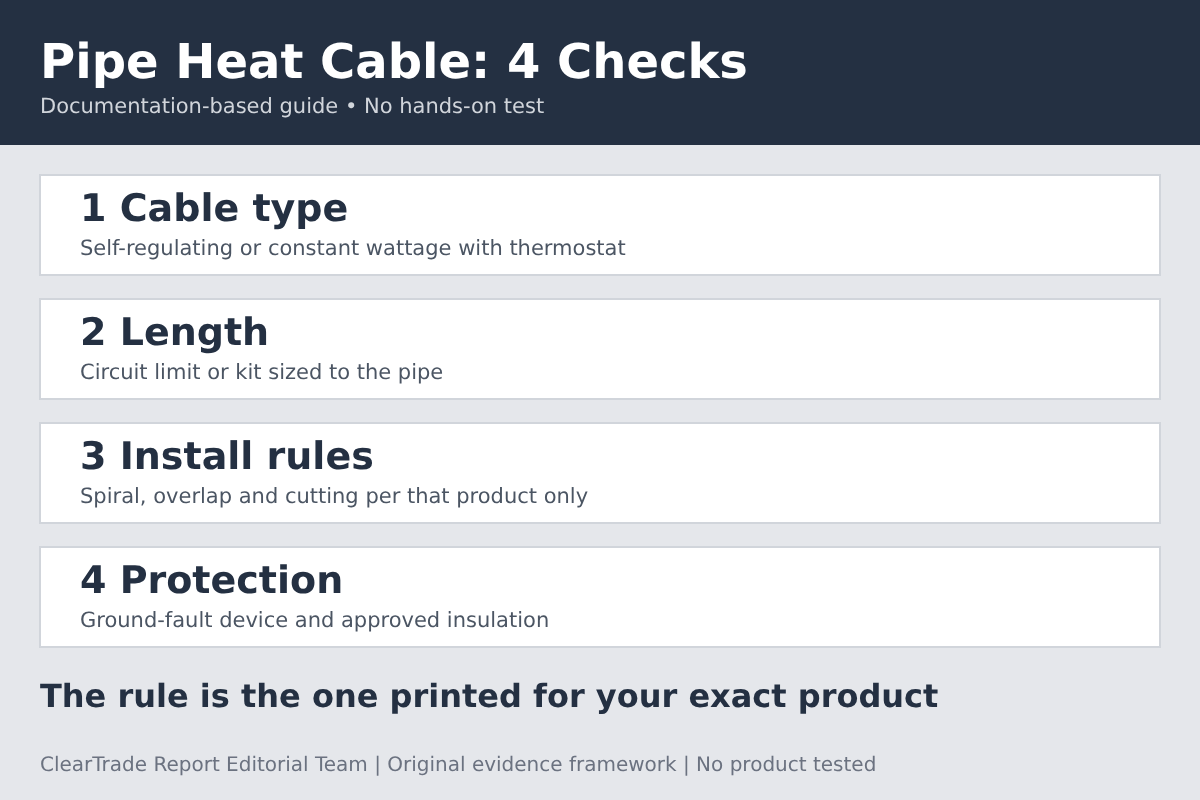
Before you buy or install pipe heat cable, check five things in the manufacturer’s documents: whether the cable is self-regulating or a fixed-output (constant wattage) cable, the maximum length or the kit size for your pipe, whether that product may be spiraled, overlapped or cut, what ground-fault protection it requires, and what insulation and pipe material it allows. The documents we read disagree on several of these points, so the rule that applies is the one printed for your exact product. This guide covers cable for water pipes only, not roof and gutter de-icing cable.
Evidence label: Documentation-based guide. ClearTrade Report Editorial Team checked documents from Chemelex (Raychem), WarmlyYours, EasyHeat, Frost King (Thermwell Products) and the U.S. Consumer Product Safety Commission on November 20, 2026. No outside professional review was performed and nothing was tested. Companies and products named are documentation examples, not recommendations. This guide contains no affiliate links.
Self-regulating vs constant-wattage: what the documents say
Self-regulating cable changes its heat output as the temperature around it changes. The Raychem Frostex data sheet says the cable “uses a self-regulating conductive core that reacts to changes in temperature” and that “As the environment becomes colder, cable resistance decreases to generate greater heat.” It works “with no need for thermostats.” Frostex is rated for “Service voltage 120 V” and a “Thermal output at 50°F (10°C) 3 W/ft (10 W/m).”
Constant wattage cable puts out the same watts per foot whenever it is on. The WarmlyYours PRO-Tect constant wattage support page says “For a fixed-output cable, watts = length in feet × W/ft,” and gives the example that “A 30-foot, 7 W/ft kit draws 210 watts while energized.” It lists PRO-Tect kits from 3 to 80 feet, all “7 W/ft, 120V.”
Some documents do not use either label. The EasyHeat HB Heating Cable instruction sheet (11001-001 Rev. 8, ©2013) calls HB a “non-automatic” cable and says it “does NOT have an integral thermostat and must be controlled by a separately connected thermostat.”
Length: circuit limits, kit sizes and runs per pipe
Length rules come in two forms.
- A maximum circuit length. The Frostex data sheet lists a “Maximum circuit length 50 ft (15 m).” The WarmlyYours PRO-Tect self-regulating install manual (PT-Series) ties circuit length to breaker size, cable rating and start-up temperature. At a 0°F start-up on a 15 A, 120 V breaker, its table allows 140 feet of 5 W/ft cable, 100 feet of 8 W/ft cable and 80 feet of 10 W/ft cable.
- A fixed kit length matched to the pipe. The WarmlyYours constant wattage page says “Never use a cable that is longer than the pipe.” The Frost King heat cable instruction sheet has you pick a cable from a chart by pipe length and diameter and says “Follow the selection chart carefully and do not oversize the cable.”
Runs per pipe. Self-regulating cable may need more than one straight run. The Frostex data sheet says you choose “how many straight runs of cable you will need” from your pipe material, pipe size, insulation thickness and “the lowest expected temperature (–40°F to 20°F).” It says “One run is equal to the length of the pipe.”
Overlap, spiral and cutting rules belong to one product
Products differ most here. The U.S. Consumer Product Safety Commission’s 1996 heat tape guidelines (release 96-062, January 22, 1996) said “Do not wrap heat tape over itself unless specifically permitted in the manufacturer’s instructions.” That guidance is 30 years old, but current manufacturer documents still defer to product instructions in the same way.
Spiraling.
- WarmlyYours (constant wattage page): “Never spiral heating cable on pipes.” The cable goes “straight along the bottom of horizontal pipe.”
- WarmlyYours PT-Series self-regulating manual: “Do not attach the cable to the pipe in a spiral pattern.”
- Frost King: “The cable must not be wrapped or spiraled and must be placed flat to the pipe.”
- Raychem Frostex: the cable “is designed to be run straight along the pipe, not spiraled.”
- EasyHeat HB: “Spirally wrap or apply straight as indicated in Table 1.” The same sheet says the “Heating portion (black) of cable must not touch, cross over or overlap itself.”
Overlap. The WarmlyYours constant wattage page says “Do not use damaged equipment or overlap cable unless the exact product instructions permit it.” None of the documents we read gave permission to overlap a cable on itself.
Cutting. The WarmlyYours PT-Series manual, written for a self-regulating cable assembled with a separate power connection and end seal, says “Cut the cable to length needed,” within its circuit length table, and “Install all end seals and power connection before turning on power.” The EasyHeat HB sheet says the opposite for its product: “Never alter this heating cable in any way. If made shorter, it will overheat.” Raychem’s installation instructions for custom MI heating cable applications, a mineral-insulated cable for custom applications such as roof and gutter de-icing and snow melting rather than a plug-in pipe cable, says “Do not alter cable length” and “Do not install so that heating cables are crossed, overlapped, or grouped.” If the instructions do not clearly allow cutting, do not cut.
Ground-fault protection and the power connection
The documents agree that ground-fault protection is needed, but name different devices and ratings.
- Raychem Frostex: “ground-fault equipment protection must be used on each heating cable branch circuit.” It warns: “Arcing may not be stopped by conventional circuit protection.” Its plug kit includes “a specially designed ground-fault protected plug,” and the sheet lists a “Ground-fault rating 27 mA.”
- WarmlyYours PT-Series self-regulating: “Use 30-mA ground-fault protection on each heating cable branch circuit for maximum protection.”
- EasyHeat HB: “The use of a ground fault protected circuit, such as GFCI receptacle, is required.”
- CPSC, 1996: “Plug heat tapes into an outlet protected by a ground-fault circuit-interrupter (GFCI),” and “Always plug the 3-prong plug into a 3-prong outlet to make sure the heat tape is grounded.”
The WarmlyYours constant wattage page says “Pipe heat should always be plugged directly into a receptacle or hardwired to the circuit that is powering it.”
Where the electrical code already requires a GFCI depends on location and code edition. Our guide to GFCI protection by location explains how to check the baseline in your area.
Insulation, pipe material and tape
Insulation. The documents disagree sharply, so this is a check you cannot skip.
- Frostex is “designed to freeze-protect dry or weather-proofed, insulated, aboveground residential water pipes,” with insulation from 1/2 to 1 1/2 inches in its table.
- The WarmlyYours PT-Series manual says to “Cover the pipe, cables, connections, and valves with fiberglass insulation or better,” waterproofed with a vapor barrier outdoors.
- The WarmlyYours constant wattage page says “Never use more than ½” of fiberglass or other non-flammable pipe insulation” because more “can cause the cable to overheat and cause a serious fire hazard or electrical shock.”
- Frost King says “The entire installation should be wrapped with 1/2″ fiberglass insulation.”
- EasyHeat HB: “Never use thermal insulation or overwrap on HB heating cables.”
The CPSC’s 1996 guidance said “Do not cover the heat tape with insulation unless advised by the manufacturer,” to “Use non-flammable insulation such as fiberglass,” and “Do not use foam or vinyl insulation that could catch fire from a failing heat tape.”
Pipe material. Frostex sizing covers “metal or plastic” pipe. WarmlyYours says “Never install constant wattage pipe heat on plastic/PVC/PEX piping unless it is filled with water at all times.” Frost King lists “water filled plastic or metal supply pipes.” EasyHeat HB says “Use on metal water pipes only. Do not use on plastic pipes.”
Tape. Frost King and WarmlyYours both call for tape rated at least 176°F (80°C). Frost King warns that other tapes “could result in over heating, fire or electrical shock.”
The table compares what each document says.
| Product document | Length rule | Spiral, overlap and cutting | Ground-fault protection | Insulation and pipe |
|---|---|---|---|---|
| Raychem Frostex (self-regulating) | Max circuit 50 ft; runs per pipe from table | Straight, not spiraled; overlap and cutting not addressed in data sheet | GFEP on each branch circuit; plug kit 27 mA | Insulated pipe, 1/2 to 1 1/2 inch; metal or plastic |
| WarmlyYours PRO-Tect PT-Series (self-regulating) | By breaker and start-up temperature, e.g. 100 ft of 8 W/ft at 0°F, 15 A | No spiral; cut to length allowed per manual | 30 mA on each branch circuit | Fiberglass or better, vapor barrier outdoors |
| WarmlyYours PRO-Tect plug-in (constant wattage) | Kits 3 to 80 ft; never longer than the pipe | Never spiral; no overlap unless exact instructions permit | “Specified electrical protection”, device not named; plug directly into a receptacle or hardwire | Max 1/2 inch fiberglass; plastic pipe only if always water filled |
| EasyHeat HB (non-automatic, separate thermostat) | Length chosen for the pipe from table | Spiral or straight per table; must not touch, cross or overlap itself; never shorten | Ground fault protected circuit such as GFCI required | No insulation or overwrap; metal pipe only |
| Frost King heat cable | Chosen from chart by pipe length and diameter; do not oversize | Not wrapped or spiraled; flat to the pipe | Not stated in English text we read | 1/2 inch fiberglass wrap; water filled plastic or metal pipe |
Every season. WarmlyYours says to “inspect it before each cold season.” The CPSC in 1996 said to look for “discolored surfaces (especially at the plug), charring, cuts, or breaks in the insulation, or bare wires.”
Know the limits of this guide
This guide reads published documents. Nothing was tested, and no product is recommended. The EasyHeat HB sheet is dated 2013 and was read from a copy hosted by a heating supplier, so a newer edition may exist. We found no English ground-fault or UL listing statement in the Frost King sheet. The Raychem MI instructions cover custom mineral-insulated cable applications such as roof and gutter de-icing, not plug-in pipe cable. The CPSC guidance is from 1996. We did not review the National Electrical Code or UL standards directly.
Primary references checked November 20, 2026: Chemelex, Raychem Frostex Pipe Freeze Protection data sheet (RAYCHEM-DS-H57419, ©2025); WarmlyYours, PRO-Tect Plug-In Heat Tape for Pipes Support (constant wattage cable support page); WarmlyYours, PRO-Tect Pipe Freeze Protection Self-Regulating Heating Cable Install Manual (PT-Series, Manual A); EasyHeat, HB Heating Cable instruction sheet (11001-001 Rev. 8, ©2013); Frost King, Instruction Sheet: Heat Cables (undated); Chemelex Raychem, Installation Instructions for Custom MI Heating Cable Applications (RAYCHEM-IM-H60759); U.S. Consumer Product Safety Commission, CPSC Re-Issues Heat Tape Guidelines in Wake of Zoo Fire (release 96-062, January 22, 1996).
Frequently asked questions
Can I overlap pipe heat cable or wrap it around the pipe?
Only if the instructions for that exact product say so. The CPSC 1996 guidance said not to wrap heat tape over itself unless the manufacturer’s instructions permit it. The WarmlyYours, Frost King and Raychem Frostex documents we read say to run their cables straight, not spiraled. The EasyHeat HB sheet allows spiral wrapping by its table but says the heating portion must not touch, cross over or overlap itself.
Can I cut pipe heat cable to fit my pipe?
It depends on the product. The WarmlyYours self-regulating PT-Series manual says to cut the cable to the length needed, within its circuit length limits. The EasyHeat HB sheet says never to alter the cable and that a shorter cable will overheat.
Does pipe heat cable need GFCI or ground-fault protection?
Every manufacturer document we read that addresses it calls for ground-fault protection. The Raychem Frostex data sheet requires ground-fault equipment protection on each branch circuit, and its plug kit includes a ground-fault protected plug. The EasyHeat HB sheet requires a ground fault protected circuit such as a GFCI receptacle.
Can I put foam insulation over pipe heat cable?
Check the product’s instructions first. The CPSC 1996 guidance said not to cover heat tape with insulation unless the manufacturer advises it, and not to use foam or vinyl insulation. Current documents differ: Frostex is designed for insulated pipe, WarmlyYours limits its constant wattage cable to half an inch of fiberglass or other non-flammable insulation, and the EasyHeat HB sheet says never to insulate.
Disclaimer: This guide is general information based on manufacturer, government and standards documents, not professional plumbing or electrical advice for a specific home or system. Follow the installation instructions for your exact product, and have hardwired circuits installed by a qualified electrician under local codes. Manufacturer instructions and product designs may change. AI tools assisted with drafting. ClearTrade Report Editorial Team checked the cited sources and edited this guide.
Need a qualified professional?
Trusted Pros uses visible license-verification states and never ranks paid listings above unpaid listings.