On this page
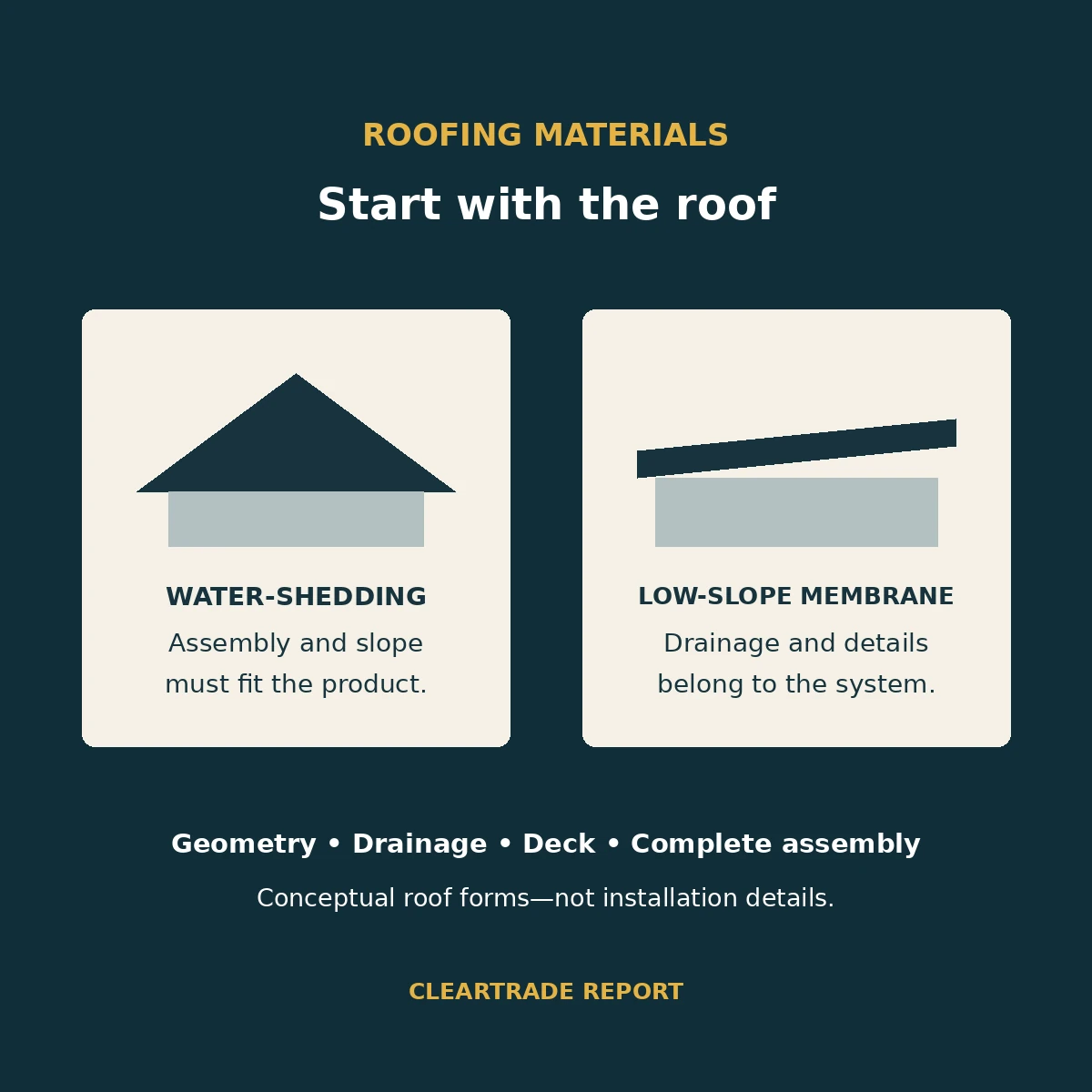
Asphalt shingles, metal roofing and low-slope membranes are not interchangeable choices for every roof. Before comparing appearance or price, establish the roof’s geometry, drainage, deck and assembly requirements.
A useful proposal explains why the complete system fits the building. A sample board shows only part of that decision.
Identify the application first
Have the roofing professional document the roof’s slope and configuration, drainage paths, penetrations, existing layers and known deck conditions.
A building can contain more than one roof type. A low-slope addition and a steeper main roof may need different assemblies and carefully designed transitions.
Do not infer suitable materials from a distant photograph or the roof covering already in place. An existing installation is not proof that the proposed replacement is appropriate.
Asphalt shingles: compare the full system
Shingles are commonly considered for water-shedding roof applications. Product instructions set conditions for their use.
GAF and the Asphalt Roofing Manufacturers Association identify special requirements for lower-slope shingle applications. The practical lesson is not to memorize one threshold and approve a roof yourself: slope affects suitability and details.
Ask which exact shingle, underlayment, flashing and accessory system is proposed, and where its installation instructions address the actual roof. Do not apply one manufacturer’s conditions to every product.
Metal: the category is not the specification
“Metal roof” does not identify a complete system. Panel profile, seam and attachment approach, substrate, accessories and application limits need to be specified.
Ask the proposer for the exact product and its applicable installation and warranty documents. Clarify how penetrations, transitions and future service will be handled.
Avoid assuming that all metal systems have the same slope capability, weather performance, sound or maintenance needs. Those claims require product- and assembly-specific evidence.
Low-slope membranes: compare the assembly
EPDM, TPO and PVC identify different membrane families. They do not, by themselves, identify the insulation, cover board, attachment, perimeter details, drainage or completed roof rating.
Ask which assembly is proposed for the building and which manufacturer details apply. Clarify who is responsible for compatibility at penetrations and transitions.
A membrane warranty is not a substitute for resolving drainage or deck conditions. Read its coverage and maintenance conditions rather than comparing warranty length alone.
For an existing low-slope roof, distinguish the covering material from the proposed intervention. Our coating, recover and tear-off comparison explains the condition evidence, retained layers, repairs and complete scope to request before comparing proposals.
Compare proposals on the same scope
Request consistent answers:
- What existing material is removed or retained?
- How will concealed deck conditions be handled?
- Which complete assembly and product documents apply?
- What drainage and transition work is included?
- Who handles penetrations and adjacent-trade coordination?
- What permits, inspections and closeout records are included?
- What maintenance does the owner assume?
If one bid includes substantial assembly repairs and another prices only a covering, the totals are not directly comparable.
Treat lifespan and cost claims carefully
A universal lifespan figure hides climate, exposure, workmanship, maintenance and the particular system. A universal installed price hides access, geometry, removal, repair and local labor conditions.
Ask for a project-specific scope and a written explanation of warranty coverage. Separate the contractor’s workmanship commitment from the manufacturer’s material or system warranty.
If insurance is involved, keep the coverage decision separate from the roofing selection. The insurer’s willingness to pay for a scope does not establish how a roof should be designed.
Plan for service
Ask how drains, penetrations, rooftop equipment and repairs will be accessed without damaging the assembly. Record restrictions on future work and who should be contacted before alterations.
For commercial roofs especially, coordinate equipment replacement and other trade work before choosing the sequence. A new covering followed immediately by unplanned penetrations creates avoidable coordination problems.
Related reading: roof replacement and insurance questions; roofing fall-protection questions.
Where a roof meets a wall, review the step-flashing and kick-out repair-scope checklist alongside the material proposal. Ask how the roof-wall drainage connection, concealed conditions and trade responsibilities will be documented before the work is covered.
Frequently asked questions
Is metal always better than shingles?
No universal ranking fits every roof. Compare a suitable complete system for the actual building.
Can any membrane go on any low-slope roof?
No. The assembly and application details must match product instructions and project requirements.
Does a long warranty prove a long service life?
No. Read what is covered, excluded and required of the owner.
What is the best first step?
Document the roof and compare proposals using the same assembly and scope questions.
Sources
Sources rechecked October 26, 2026.
- GAF: Minimum Slope for Shingles — product/application limits.
- ARMA: Shingles on Lower-Sloped Roofs — lower-slope conditions, not universal installation permission.
- Carlisle: Thermoplastics TPO/PVC Field Guide catalog — catalog verified; linked PDF unavailable during this check. No installation detail is inferred from the listing.
- MBCI: LokSeam Technical/Installation Manual — an example of product-specific profile, attachment and application documentation; not a recommendation for a particular roof.
- Carlisle: EPDM — membrane-family context, not a comparative endorsement.
This article does not rank tested products or prescribe a roof assembly.
Need a qualified professional?
Trusted Pros uses visible license-verification states and never ranks paid listings above unpaid listings.