Source review: October 27, 2026.
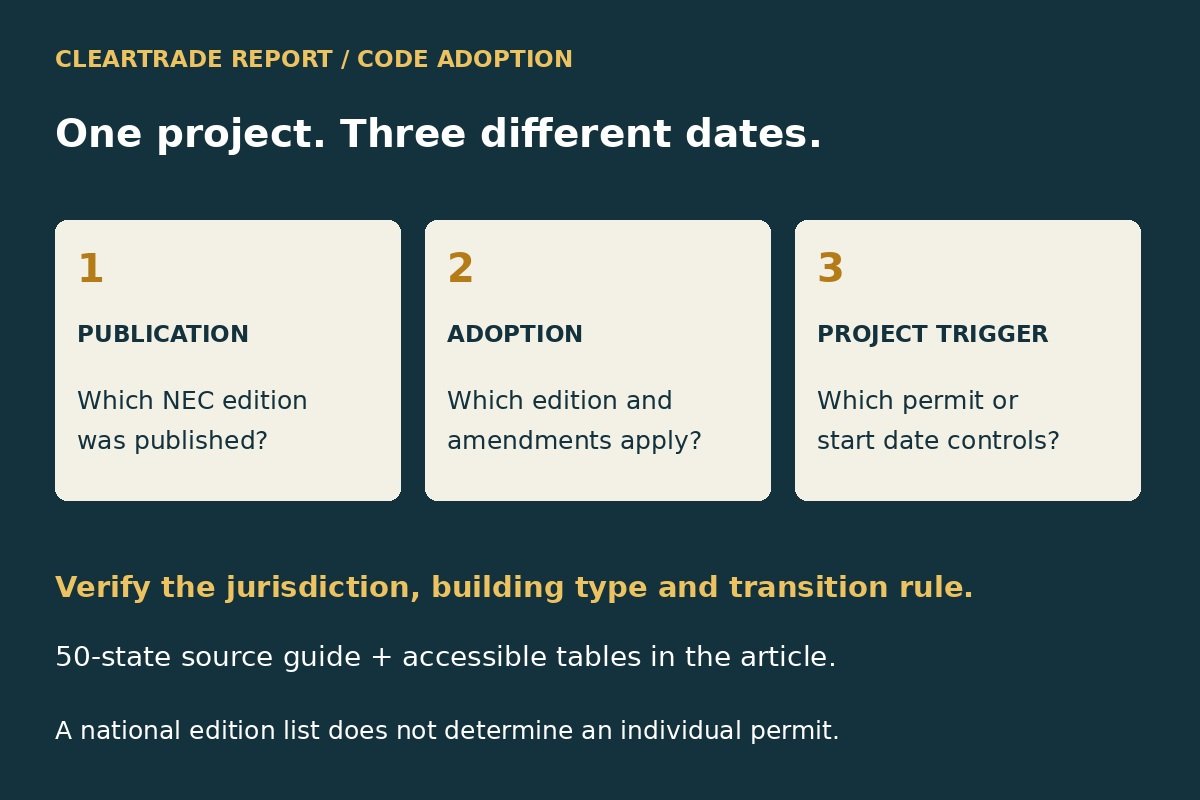
The National Electrical Code edition printed on a new book is not necessarily the edition that governs a project. States adopt editions at different times, amend particular requirements, and sometimes leave adoption to local authorities. A permit filed before a change may remain under an older edition. A state building program may also have different authority from a city building department.
This tracker provides an official-source starting point for all 50 states. Read the scope and timing columns together. An edition shown for a specific program is not a claim that every building in that state uses that edition. Dates are identified as adoption, enforcement, installation-start or permit dates where the source makes that distinction. Where an exact transition date is not established here, it is explicitly left for confirmation rather than inferred from a website update or a code book’s publication year.
Start with the project, not the map
Record the property address, building use, proposed work and permit application date before choosing a code edition. Ask the authority handling the electrical permit to identify the adopted NEC edition, state and local amendments, and the transition rule that applies to the application. Keep that answer with the estimate and plans.
“Authority having jurisdiction,” often shortened to AHJ, means the organization or official responsible for enforcing the applicable requirements. The electrical AHJ may differ from the office that issues a general building permit. Utility service requirements and equipment installation instructions are additional checks; identifying the NEC edition does not resolve either of them.
For a comparison across cities, use the same project description and evidence fields in every jurisdiction. Our electrical-permit city-comparison framework explains how to keep permit scope, fees and timing comparable. A national edition list cannot substitute for that project-specific work.
Read the status labels correctly
- Current agency listing: the agency identifies an edition for the stated program. Check amendments and project transition rules before using it.
- Future change: the source identifies a later operative date. Do not use that edition as the current requirement merely because adoption has been announced.
- Local or split authority: a single statewide edition would conceal a material jurisdiction or building-type distinction.
- Confirm timing: the source establishes an edition or adoption action, but this tracker does not establish the exact date controlling an individual permit.
The tables are an editorial reference, not a determination that a design complies. They do not reproduce the NEC or every amendment. Official source links in each row lead to the rule, adoption notice or responsible agency used for that entry.
Alabama through Georgia
| State and official source | Edition or adoption status | Scope and timing to check |
|---|---|---|
| Alabama — Division of Construction Management | DCM lists 2020 NEC, adopted July 1, 2022. | DCM covers specified state-funded, educational and other regulated buildings. Do not apply that listing to all ordinary residential or commercial work; identify the applicable residential or local authority. |
| Alaska — Mechanical Inspection | Current agency listing: 2020 NEC under 8 AAC 70.025(a). | Confirm the permit transition date. State inspection scope and delegated local inspection are separate issues; the agency describes commercial and triplex-and-larger inspection coverage. |
| Arizona — Phoenix code example | Local authority. Phoenix’s 2024 construction-code package references 2023 NEC. | Phoenix’s package became effective August 1, 2025. This is a city example, not an Arizona-wide edition; obtain the rule for the actual city or county. |
| Arkansas — 17 CAR 210-601 | Current codified text adopts 2026 NEC with amendments. | Confirm the effective-date history and permit transition with the board. The rule includes substantive dwelling-unit amendments; an unamended national summary is insufficient. |
| California — Building Standards Commission | 2025 California Electrical Code, based on 2023 NEC. | The 2025 Title 24 cycle took effect January 1, 2026. Use California’s adopted text and applicable local amendments, not the NEC alone. |
| Colorado — official Rule 1.5 | 2026 NEC. | Rule 1.5(A) specifies August 1, 2026 for the NEC. The docket’s July 15 date is the broader rule effective date; do not substitute it for the specific NEC date. Confirm the project’s permit transition. |
| Connecticut — current code history | 2022 State Building Code references 2020 NEC. | Current state code package took effect October 1, 2022. Apply state amendments and confirm which permit date controls. |
| Delaware — State Fire Marshal update | 2023 NEC in the updated fire-regulation standards. | Regulation 701 effective January 1, 2026; the notice also identifies a submission cutoff. Verify fire-regulation jurisdiction and any separate local electrical requirements. |
| Florida — adopted residential standards | 8th Edition (2023) Florida Building Code references 2020 NEC. | The state identifies December 31, 2023 as the package effective date. The proposed 9th Edition is not a substitute for the adopted code. Check Florida amendments and project scope. |
| Georgia — final adoption memorandum | 2023 NEC with 2026 Georgia amendments. | Amendments effective January 1, 2026. “2026 amendments” does not mean Georgia adopted the 2026 NEC. Check applicable local amendments as well. |
Hawaii through Maryland
| State and official source | Edition or adoption status | Scope and timing to check |
|---|---|---|
| Hawaii — State Building Code Council adoption | State adoption: 2020 NEC, March 15, 2022. | Notice distinguishes state-building and county implementation deadlines. Check the county’s adoption and amendments instead of assigning the state adoption date to every permit. |
| Idaho — current electrical rules | Rule 600 incorporates 2023 NEC with amendments. | The current rule includes an April 4, 2025 history notation. That notation alone is not proof of the original NEC adoption date; confirm the permit transition. |
| Illinois — Capital Development Board | Local or project-specific authority. | State-funded and certain commercial projects without a local code have distinct statutory requirements. Use the local code directory and the rule for the building type; no universal edition is assigned here. |
| Indiana — current commission rules | 2009 Indiana Electrical Code, based on 2008 NEC, listed as currently in effect. | Current rule is 675 IAC 17-1.8. A newer draft or a project-specific variance does not establish statewide adoption. |
| Iowa — electrical permits and inspections | 2023 NEC with the statutory exceptions identified by the agency. | HF 2800 took effect June 2, 2026. The agency explains the removal of prior administrative amendments pending official adoption of 2026 NEC; use the current exception list. |
| Kansas — state code-compliance guidance | Local or program-specific authority. | State-owned construction and State Fire Marshal jurisdiction are distinct from ordinary local projects. Obtain the city or county electrical adoption before choosing an edition. |
| Kentucky — confirmation of adoption | 2023 NEC; agency confirms enforcement began January 1, 2025. | Residential delayed provisions and amendments require a separate check. Do not confuse the later licensing-exam transition with construction enforcement. |
| Louisiana — current construction-code chart | 2020 NEC, effective January 1, 2023. | The commission separately describes the 2023 NEC adoption proposal. A notice of intent is not proof that the proposed edition already controls a project. |
| Maine — Electricians’ Examining Board | Adopted Chapter 120 incorporates 2026 NEC. | Applies to electrical installations commencing on or after July 1, 2026, with state and local requirements. The trigger is installation commencement in the cited notice. |
| Maryland — state code matrix | Split authority: matrix lists different electrical references by program. | The March 18, 2026 matrix distinguishes modular/state-owned construction, fire-code requirements and local adoption. Select the relevant column and local jurisdiction rather than one statewide NEC year. |
Massachusetts through New Jersey
| State and official source | Edition or adoption status | Scope and timing to check |
|---|---|---|
| Massachusetts — electrical code | 2026 NEC with Massachusetts amendments. | 527 CMR 12 effective April 24, 2026. Read the state amendment document and applicable project transition. |
| Michigan — final Part 8 rules | Part 8 incorporates 2023 NEC with specified amendments and incorporated corrections. | Effective March 12, 2024. Confirm the construction-code path for the building and work; a residential-code reference should not be silently treated as the same adoption instrument. |
| Minnesota — electrical codes and standards | 2026 NEC. | Effective August 17, 2026. Agency distinguishes permits filed before that date under 2023 NEC from those filed on or after it. |
| Mississippi — uniform building-code information | Local adoption and state-program distinctions. | State guidance describes local enactment under SB 2378 and the historical opt-out. Confirm the local code and separate Fire Marshal jurisdiction; this row does not assign one NEC edition to all projects. |
| Missouri — code jurisdictions | Local authority. | Obtain current adoption directly from the jurisdiction. Older county survey data is useful for finding an office, not proof of today’s electrical code. |
| Montana — current codes | Agency lists 2023 NEC with state amendments. | Current code page gives September 26, 2026. Confirm transition requirements and the responsible state or certified local program. |
| Nebraska — Electrical Division notice | 2023 NEC with amendments. | Electrical permits received on or after August 1, 2024 use 2023 NEC; the notice says existing permits remain on 2017 NEC. |
| Nevada — State Public Works code enforcement | Local or state-project authority. | State Public Works requirements apply to its jurisdiction, including state-owned land. Obtain the city/county adoption for other projects; no universal statewide NEC edition is assigned here. |
| New Hampshire — State Building Code | Current agency listing: 2023 NEC with amendments. | Agency amendment summary identifies the July 1, 2025 code change. Confirm the applicable permit and transition provisions. |
| New Jersey — Fall 2026 code notice | 2023 NEC adopted August 17, 2026. | Complete applications may use the preceding 2020 edition through February 17, 2027 under the stated grace-period conditions. Identify the chosen edition explicitly; adoption does not switch every project immediately. |
New Mexico through South Carolina
| State and official source | Edition or adoption status | Scope and timing to check |
|---|---|---|
| New Mexico — 14.10.4 NMAC | 2020 NEC with New Mexico amendments. | Rule effective March 28, 2023; the initial prior/new-code permit option ended September 28, 2023. Review current permit applicability rather than reusing the expired transition. |
| New York — Uniform Code adoption | 2025 state code package uses 2023 NEC-based electrical provisions. | Fully effective December 31, 2025. New York City’s separate code is outside this statewide Uniform Code entry. |
| North Carolina — current electrical code and interpretations | Agency identifies 2020 NEC-based code for its stated scope; 2023 adoption is indefinitely delayed. | 2020 electrical code effective November 1, 2021 excludes one- and two-family dwellings from that adoption. Read the separate residential interpretation; do not apply the general edition to those dwellings. |
| North Dakota — State Electrical Board rules | 2023 NEC with state wiring standards. | Board notice identifies July 1, 2024 for the code/rule change. Check the current wiring standards and permit transition. |
| Ohio — current referenced-standards rule | 2023 NEC with Ohio modifications; residential Chapters 34 and 44 also adopt 2023 NEC. | Residential electrical amendments effective April 15, 2024. The current nonresidential reference rule is effective October 15, 2025 and modifies the outdoor GFCI exception’s expiration; check the applicable building-code path. |
| Oklahoma — Construction Industries Board notice | 2023 NEC adoption notice. | Effective September 14, 2024. Confirm the applicable OUBCC commercial or residential rule and amendments rather than assuming identical scope. |
| Oregon — electrical code program | 2026 Oregon Electrical Specialty Code, based on 2026 NEC. | Effective October 1, 2026, with Oregon amendments and scope exclusions. Do not confuse an earlier amendment to 2023 OESC with the new code cycle. |
| Pennsylvania — final UCC update | 2021 ICC-based UCC package effective January 1, 2026. | Confirm the NEC reference and amendments for the selected UCC path. The separate industrialized-building program expressly identifies 2020 NEC and a June 1, 2026 production trigger; those dates are not interchangeable. |
| Rhode Island — adopted codes | SBC-5 incorporates 2023 NEC with Rhode Island amendments. | Effective December 1, 2025. The agency explicitly distinguishes the NEC edition from the ICC editions in the same package. |
| South Carolina — code adoption notice | Current 2020 NEC with South Carolina modifications. | Current package effective January 1, 2023. The later 2023 NEC change is scheduled for January 1, 2027; it is future as of this review. |
South Dakota through Wyoming
| State and official source | Edition or adoption status | Scope and timing to check |
|---|---|---|
| South Dakota — Electrical Commission resources | 2023 NEC with state requirements. | Agency identifies November 12, 2024 and a permit-received trigger. Check the applicable wiring bulletin and amendments. |
| Tennessee — state electrical permit program | State program says it enforces 2017 NEC. | Exempt local jurisdictions have their own authority. Check the linked exempt-jurisdiction list and local adopted code; a training course on a newer NEC is not adoption. |
| Texas — final adoption notice | 2026 NEC with the stated Texas exception. | Effective September 1, 2026. Review the adopted rule, limited outdoor GFCI exception and local requirements before applying a national summary. |
| Utah — current 15A-2-103 | Current statutory version incorporates 2023 NEC. | This version applies July 1 through December 31, 2026. Read state and permitted local amendments; the future statutory version must be checked separately. |
| Vermont — adopted codes | Agency lists 2023 NEC under Vermont electrical safety rules. | Current licensing page identifies the 2025 rules effective November 5, 2025. Confirm the installation transition and amendments; an examination edition alone is not evidence of adoption. |
| Virginia — DHCD codes | 2020 NEC in the 2021 Virginia code cycle. | Effective January 18, 2024. Check the applicable Virginia construction/existing-building provisions and permit history. |
| Washington — WAC 296-46B-010 | Current 2023 NEC; 2026 NEC replaces it December 31, 2026. | Apply the rule’s electrical-permit, building-permit and plan-review transition provisions. The future edition must not be labeled current before its operative date. |
| West Virginia — 87 CSR 4 | State Building Code incorporates 2020 NEC with amendments. | Rule effective August 1, 2022. Confirm local administration and State Fire Code interaction; the rule addresses conflicts and specific exceptions. |
| Wisconsin — final agency announcement | 2023 NEC with Wisconsin amendments. | Effective September 1, 2026. Apply the agency’s plan-submission transition guidance rather than using the publication date of the NEC. |
| Wyoming — Fire Prevention and Electrical Safety | Agency announces 2026 NEC. | Effective July 1, 2026. The June 2024 date elsewhere on the site relates to the International Codes and should not be copied as the NEC date. |
Build a usable project evidence record
Save more than a screenshot of the edition year. A useful record identifies the source URL, document title, rule section, effective date, date checked, building type, local amendments and the event that fixes the project’s code edition. Keep the permit receipt or accepted application alongside it.
If two sources disagree, first determine whether they describe different things: an examination syllabus, a proposed rule, an adopted rule with delayed implementation, a state-owned building program, or a local ordinance. Prefer the applicable final instrument and current administering-agency guidance. A newer search result is not automatically the controlling source.
For example, New Jersey’s notice allows qualifying complete applications to use the previous code during a stated grace period. Washington identifies a future replacement date and several transition paths. Maine’s notice refers to when an installation commences. Those are different triggers; reducing each to “state + NEC year” loses information needed to make a project decision.
Changes in adopted editions can affect the questions asked about AFCI requirements and GFCI protection. They do not, by themselves, establish that an existing installation must be fully rebuilt. The actual work, adopted alteration provisions and AHJ determination still matter.
Methodology and update limits
ClearTrade reviewed administering-agency pages, final rules, adoption notices and code-publisher references. The linked sources support the particular scope described in each row. This is an editorial source review, not legal advice, an engineering review or a site inspection. No professional endorsement or independent trade review is claimed.
All 50 states are included. The District of Columbia and territories are outside this table’s scope. Local variation, source conflicts and dates not established in the reviewed evidence are shown explicitly. The tracker does not claim to verify every municipality or every amendment. Recheck the responsible authority before preparing an estimate, submitting plans or changing work already under permit.
Code adoption and licensing are separate checks. Use our 50-state electrical contractor license verification directory to locate the official business and individual credential routes, then confirm local requirements for the project.
Frequently asked questions
Does the newest NEC automatically apply everywhere?
No. A jurisdiction must adopt the applicable edition through its legal process. The adopted edition may have amendments, a delayed effective date or project transition provisions.
Can two projects in the same state use different editions?
Yes. Local authority, building type, permit dates and grace periods can produce different applicable editions. Identify the controlling rule for each project instead of relying only on the state name.
Is an electrical licensing exam’s NEC edition the construction code?
Not necessarily. Exam standards and construction enforcement can change on different schedules. Verify the adopted construction rule and its effective date separately.
What should I do when the state page and local office disagree?
Compare the jurisdiction, project scope, final adoption instrument and transition dates. Ask the responsible permit authority to identify the rule it is applying and retain that determination with the project record.
AI tools assisted with drafting. ClearTrade Report Editorial Team checked the cited sources and edited this guide. No hands-on inspection or testing was performed.
Need a qualified professional?
Trusted Pros uses visible license-verification states and never ranks paid listings above unpaid listings.