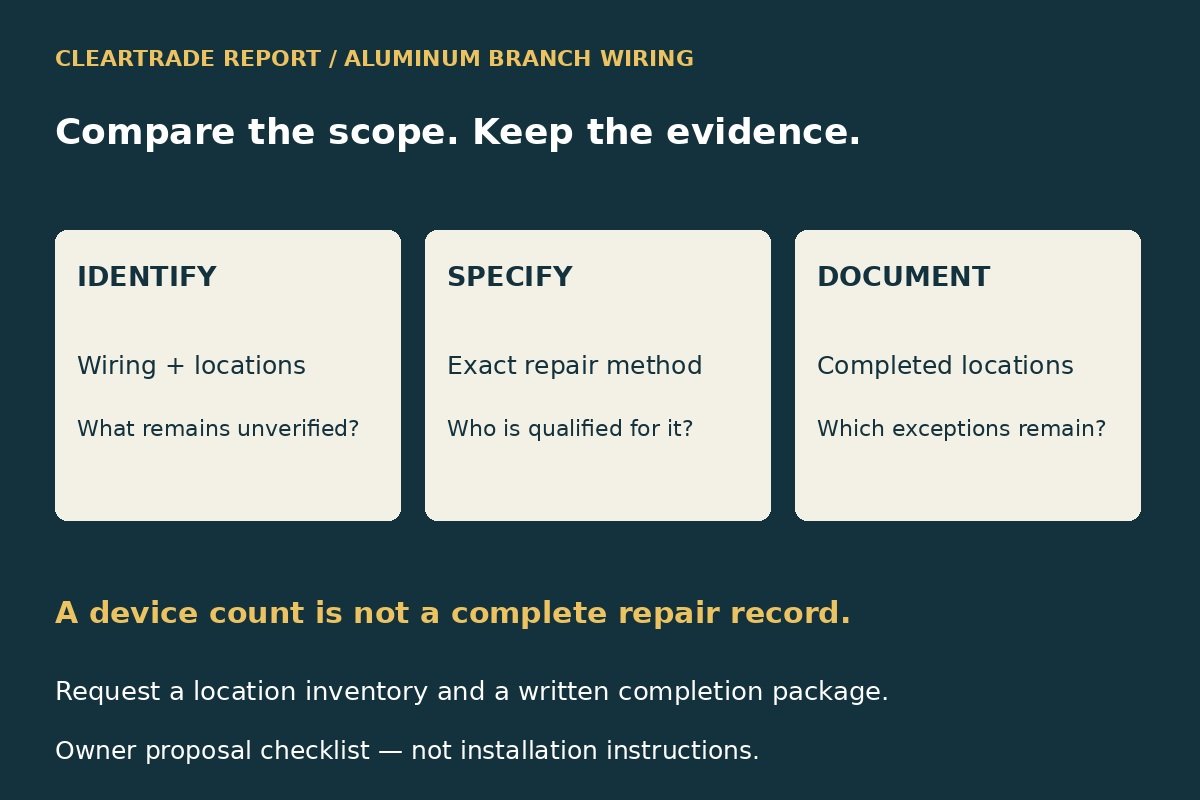
Finding aluminum branch wiring should lead to a documented repair assessment, not simply a shopping list of replacement outlets. For owners comparing proposals, the useful questions are which wiring is present, which connections the contractor will address, what method will be used and how completion will be recorded.
This guide concerns older small-gauge aluminum branch circuits. It does not evaluate modern aluminum service or feeder conductors, and it does not provide connector installation instructions.
What the CPSC guidance establishes
The Consumer Product Safety Commission’s Repairing Aluminum Wiring, Publication 516, dated June 2011 and still linked by the agency at this review, describes three permanent-repair approaches: complete copper replacement, COPALUM retermination, and AlumiConn as an acceptable alternative when COPALUM is unavailable. Its recommendations address the covered branch wiring, not copper-clad aluminum or larger aluminum service and appliance circuits.
The publication focuses on connection failures and calls for qualified electrical repair. Absence of visible symptoms does not establish that connections are safe. Replacing a few switches or receptacles is not evidence of complete remediation. The publication also does not treat ordinary twist-on pigtailing or CO/ALR device replacement as equivalent whole-system permanent repairs.
Those are the agency’s dated recommendations, not a claim that ClearTrade tested the methods or inspected a particular home. The project still needs an electrician’s assessment and the applicable permit and inspection requirements.
Compare the proposed scope
| Approach | What the proposal should identify | Evidence to request |
|---|---|---|
| Complete replacement with copper | Circuits replaced, routing, access openings and the disposition of existing wiring | Circuit schedule, scope drawings or location list, permit requirements and completion records |
| COPALUM retermination | Covered connection locations and the exact residential repair system | Installer authorization, approved tooling and product identification, plus a location-by-location completion record |
| AlumiConn repair | Exact connector version and its suitability for the actual conductors and enclosure | Current instructions, connector identity, workmanship/torque verification process and unresolved-location list |
| Limited device or connection work | The specific defect being corrected and the limits of the work | A clear statement that limited work is not represented as complete remediation |
A lower total can reflect a smaller scope rather than a less expensive way of doing the same work. Ask each bidder to use the same location inventory. If one proposal includes appliance connections and junction boxes while another includes only visible receptacles, the totals do not describe equivalent projects.
COPALUM: verify the installer and system
TE Connectivity’s current residential retermination program page identifies dedicated COPALUM tooling and supporting documents. Its published installer terms require manufacturer-trained installers, at least journeyman electrician status for the individuals performing installation, and TE-approved tools, products and techniques.
Ask who will actually perform the repair and how their authorization will be confirmed. A company offering electrical services is not, by that fact alone, evidence of authorization for this particular system. Our electrical contractor license verification guide explains why business and individual credentials should be checked separately. Manufacturer authorization is an additional question.
Avoid accepting a generic crimp-connector description in place of the named repair system. The estimate should say what is being supplied, who is installing it and what happens if a location cannot be repaired as planned.
AlumiConn: the exact instructions matter
King Innovation’s three-port instruction sheet, 50100-46 Revision Q, June 2023, specifies allowed conductor sizes and materials, a single conductor per port, no reuse, and different torque requirements according to the conductor. It warns that failure to follow the torque instructions can cause failure. The manufacturer’s FAQ identifies a torque screwdriver for its listed installation method.
These details are reasons to require the correct instruction sheet and a documented installation process. They are not a homeowner procedure. Do not transfer requirements from a different connector, port count or product revision. Ask the contractor how the actual conductor condition, available space and box arrangement will be evaluated, and how incompatible or damaged locations will be handled.
Manufacturer statements about listings or repair acceptance also do not establish that a specific installation complies. Retain the product identity and instructions with the project record; ask the installer to identify the applicable listing and local approval requirements.
Build the location inventory before comparing bids
Use a simple record with one line per assessed location. The following fields are an editorial procurement checklist, not an electrical inspection standard:
- Circuit and room or equipment served.
- Location identifier that can be matched to a photo or drawing.
- What was accessible and what remains concealed or unverified.
- Proposed method and exact connector or replacement scope.
- Additional access, enclosure or equipment work included in the price.
- Completion status, installer and date.
- Exceptions, follow-up work and responsibility for closing them.
The distinction between assessed, repaired and unverified is useful. A photo of one finished connection can support that location’s record; it cannot demonstrate that every connection in a house was addressed. Keep exceptions visible instead of treating them as completed because the main contract is finished.
Before signing, resolve access assumptions. Identify who moves furniture, opens walls where needed and restores finishes. State how concealed conditions will be priced and approved. Ask whether the quote is fixed for an established inventory or provisional until further assessment. This avoids turning an undefined repair project into repeated, difficult-to-compare change orders.
What a useful completion package contains
Request the agreed scope, final location record, product and instruction references, documented exceptions, and applicable permit/inspection disposition. Keep the contractor’s written description of the work performed. If a lender, insurer or future buyer needs particular documentation, obtain that party’s requirements before work begins; this article does not guarantee their acceptance or insurance coverage.
Ask the contractor to explain how completion was checked. Separate a manufacturer’s product claim, the installer’s workmanship record and a jurisdiction’s inspection result. None should be described as a ClearTrade endorsement or a guarantee that unrelated defects were eliminated.
For a home that also has knob-and-tube wiring, use a separate scope for that condition. Our knob-and-tube remodel planning guide addresses a different wiring system. One repair label should not conceal several distinct conditions.
For the tool evidence behind an installation record, see our guide to torque-tool range, accuracy and calibration records. It explains what a serial-specific tool file can show; it does not select a repair system or replace the connector instructions.
Frequently asked questions
Does aluminum wiring always mean a complete rewire?
The appropriate proposal depends on the confirmed wiring and project conditions. Compare replacement with documented connection-repair options and require a clear scope from the qualified electrician.
Is replacing the outlets proof that the house was remediated?
No. Ask what connections were assessed and addressed, which method was used and what remains unresolved. A device-replacement invoice alone does not establish the scope of a whole-home repair.
Should I buy connectors before the electrician visits?
Have the installer identify the exact system and quantity after assessing the conductors, locations and project requirements. A product name alone does not establish suitability for each location.
Will a completed repair guarantee insurance approval?
No guarantee is made here. Ask the insurer what documentation it requires and have the contractor describe the completed work accurately. Retain the records and unresolved exceptions.
Sources and editorial method
Reviewed October 26, 2026 Pacific. Primary sources: CPSC Publication 516, June 2011; TE Connectivity’s residential COPALUM program and installer terms; King Innovation’s three-port AlumiConn instruction sheet, Revision Q, June 2023, and FAQ. Product instructions and authorization requirements should be rechecked for the exact installation. No ClearTrade hands-on testing, home inspection, installer endorsement or outside professional review is claimed. This is a proposal-comparison framework, not electrical installation instructions.
AI tools assisted with drafting. ClearTrade Report Editorial Team checked the cited sources and edited this guide. No hands-on inspection or testing was performed.
Need a qualified professional?
Trusted Pros uses visible license-verification states and never ranks paid listings above unpaid listings.