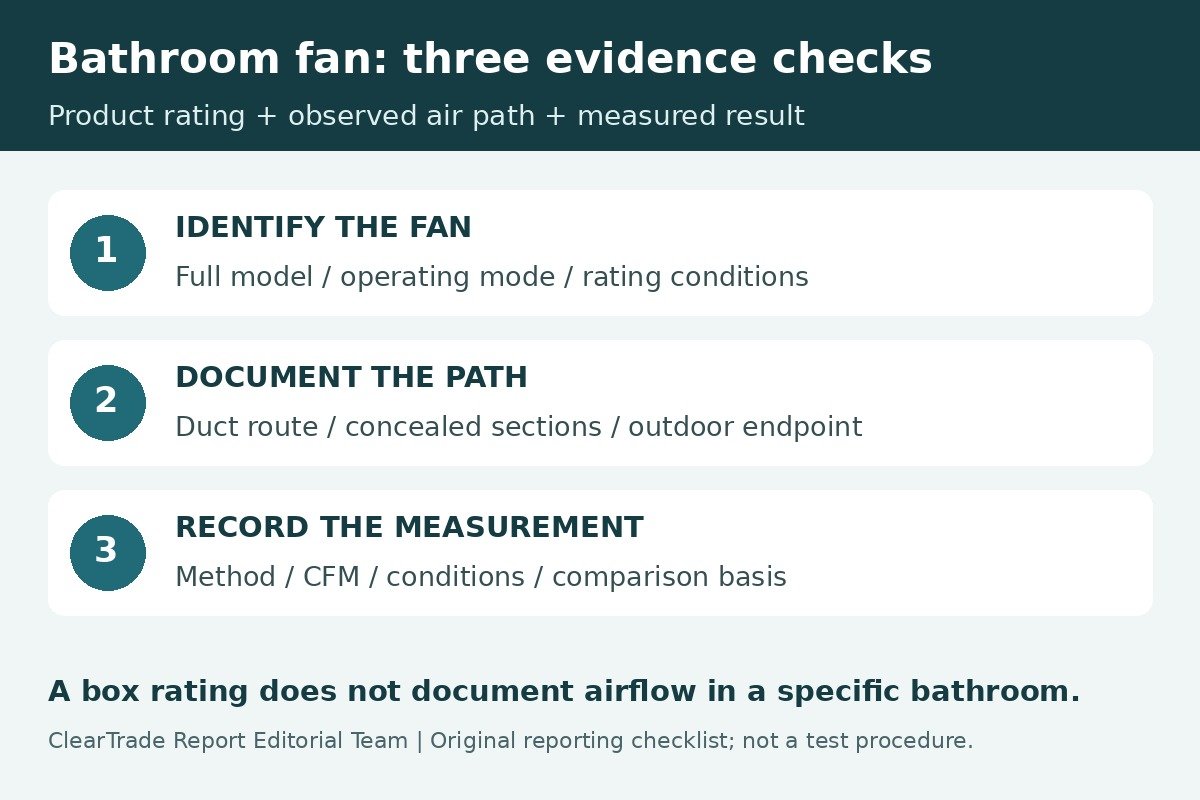
A bathroom fan’s advertised cubic feet per minute (CFM) describes performance under specified rating conditions. It does not document the airflow in your bathroom. Before replacing a noisy or ineffective fan with a larger one, ask for three things: the exact model and operating setting, a description of the duct route to outdoors, and an installed-airflow measurement with its method and conditions recorded.
This guide helps homeowners and remodelers review that evidence. It does not size a particular installation, diagnose a moisture problem remotely or replace an installer’s instructions. Electrical circuits, shower-location suitability and control wiring require their own review; the focus here is the mechanical air path and the quality of the handover report.
What a CFM label tells you
CFM is a volume of air moved per minute. A useful product comparison retains the pressure at which that airflow was rated. Static pressure, often expressed in inches of water gauge, provides context for how a fan performs against resistance. Comparing two headline CFM numbers without their test conditions can obscure an important difference.
The ENERGY STAR key product criteria illustrate this distinction: the page specifies a laboratory airflow comparison at 0.1 and 0.25 inches water gauge for certifying bathroom and utility-room fans. Its stated requirement is at least 70% of the lower-pressure airflow at the higher pressure. That is a product-certification criterion, not a promise that any duct installation will deliver 70% of its box rating or a field acceptance threshold for your home.
The Home Ventilating Institute’s certification guidance describes certified product performance ratings. Treat those ratings as product evidence, then obtain separate evidence about the installed system. A certification label and a contractor’s measured-flow report answer related but different questions.
When requesting a quote, ask the contractor to identify the applicable local requirement or project specification separately from the selected product rating. “An 80-CFM fan” is not a complete acceptance statement. The report should say what operating mode was assessed, what delivered flow was required, where that requirement came from and what result was obtained.
Follow the complete air path
PNNL’s bathroom exhaust guidance explains that ductwork, termination choices and installation can reduce measured airflow below a factory rating. It recommends an outdoor discharge, the manufacturer’s specified duct diameter and a direct route with few bends. A crushed section, abrupt turn or obstructed damper belongs in the assessment of the complete path, rather than being dismissed because the motor runs.
Ask for a route sketch or labeled photographs showing the fan outlet, accessible duct sections and exterior termination. Mark concealed sections as unverified. A photograph of the ceiling grille cannot establish where the duct ends, and a roof-cap photograph cannot prove that every concealed joint is connected.
Use model-specific instructions instead of a universal duct-size rule. For example, the Broan-NuTone model 750 instructions, document 99043077H, specify four-inch round duct and a short route with few elbows. That is an example for that model, not a recommendation to fit every bathroom fan with four-inch duct. It is not evidence of current availability, a product endorsement or permission to adapt a different fan to an existing small duct.
Before finishes conceal the route, request a record of the actual materials, diameter, fittings and termination. If an existing route cannot be inspected, have the quote distinguish the work included from the investigation still required. “Reuse existing duct” should remain an explicit assumption until suitability is checked.
An evidence checklist for the visit
The following is an original reporting checklist, not a code inspection form. Give it to the person preparing the assessment so that findings, assumptions and next steps remain distinguishable.
| Evidence item | What to record | Question it resolves |
|---|---|---|
| Fan identity | Manufacturer, full model, manual revision and selected mode | Which rating and instructions apply? |
| Duct route | Observed size, material, fittings and concealed sections | What was actually inspected? |
| Outdoor endpoint | Location, photograph and observed damper condition | Is the discharge path documented? |
| Flow assessment | Method, instrument, result, units and operating conditions | Is this a measurement or an estimate? |
| Acceptance basis | Requirement, source, edition or project document and mode | What is the result compared with? |
| Follow-up | Finding, responsible person, correction and retest record | Which questions remain open? |
Keep the original report and photographs with the invoice. If another company later assesses the fan, a dated record gives it a starting point beyond “the old installer said it was fine.” Ask permission before recording a technician or sharing photographs that show private household details.
What a useful airflow report includes
PNNL’s airflow-measurement guidance discusses capture hoods and other measurement devices, including their limitations. Hood fit, instrument range, calibration, wind and the resistance introduced by the measuring device can affect the result. A displayed number alone is therefore incomplete evidence.
For an assessment request, ask the technician to report the measurement location, equipment and method used, calibration status, fan mode, relevant door/window conditions, other operating ventilation and any limitation. This is a request for traceable documentation, not a substitute test procedure. The technician should select a method appropriate to the system and any governing project or program requirement.
Do not translate a pressure reading directly into CFM without the applicable measurement arrangement and conversion information. PNNL explains that pressure-based airflow devices depend on their specific calibration or relationship between pressure and flow. A generic manometer reading does not supply that missing relationship.
Also keep product-certification tests separate from field tests. The PNNL measurement page discusses ANSI/RESNET/ICC 380-2019, while its bathroom page refers to an earlier edition. Those references are historical context here; this article does not establish which edition or method currently governs a particular permit, rating program or project.
Use a comparison to ask a better question
Consider a fictional report for one fan: “Mode B; grille measurement; 42 CFM; door closed.” A second entry reads “Mode B; same equipment and location; 58 CFM; door open.” These invented numbers illustrate recordkeeping only. They are not expected performance, a sizing recommendation or an acceptance result.
The useful next question is what changed and whether the comparison was controlled well enough to interpret. It is not “Which number should go on the invoice?” Ask the assessor to explain whether the difference is repeatable, what limitations apply and what additional investigation is needed. A door-position comparison is not, by itself, a design for a door undercut or transfer grille.
Similarly, a post-repair improvement should be accompanied by a description of the repair and comparable test conditions. If the fan mode, measurement method and door position all changed, the two readings cannot isolate the contribution of one duct correction. Keep each result with its conditions rather than retaining only the highest number.
For a remodel, put the proposed acceptance basis in the scope before purchase. That lets both parties distinguish product selection, installation completion and demonstrated performance. If the contractor cannot yet specify the target because the governing requirement needs confirmation, record that as an open item with an owner and a due date.
When a larger fan is not the next decision
A motor replacement quote and a duct investigation quote may cover different problems. Ask each bidder to state whether it has assessed the existing route, verified the termination and included a performance check. This makes the scope comparable without assuming that the cheapest or highest-CFM option solves the reported concern.
The model 750 manual also warns that adequate air is needed for combustion and flue-gas exhaust from fuel-burning equipment. Where those appliances are present, include their interaction in the contractor’s assessment before changing exhaust capacity. Do not use this article to decide that depressurization is harmless or to perform a combustion-safety test.
Local bathroom exhaust and whole-house ventilation should also be distinguished in the scope. If the fan has a role in the home’s ventilation plan, have the assessor identify it before changing its operation. Our HRV-versus-ERV guide explains the separate decisions involved in whole-house recovery ventilation.
PNNL discusses maintenance and checking for obstructed exhaust paths. Follow the actual unit’s cleaning and isolation instructions; the model 750 manual specifically requires power disconnection and securing the supply before cleaning or service. Leave roof access, concealed-duct investigation and electrical work to people equipped and qualified for that scope.
Close the job with a written disposition
A concise completion record can read: “Observed route documented; specified mode assessed; measured result attached; comparison basis identified; remaining limitation assigned.” If any element is missing, identify it rather than replacing it with “fan works.”
Keep a separate log of the original complaint, such as when condensation is noticed and which controls were operating. That observation history helps frame the service request, but it should not be presented as an airflow measurement or proof that a fan caused building damage. A useful closeout explains what was checked, what changed and what remains unknown.
Frequently asked questions
Does an 80-CFM label prove that 80 CFM leaves my bathroom?
No. It describes product performance under specified rating conditions. The installed duct route and termination need separate assessment, and delivered airflow should be documented with an appropriate measurement method and operating conditions.
Does ENERGY STAR’s 70% criterion set my home’s pass mark?
No. The cited criterion compares product-test airflow at two static pressures. It is not a universal installed-flow percentage or the acceptance requirement for a particular bathroom.
Can a tissue at the grille replace a flow measurement?
A tissue observation does not provide a calibrated volumetric airflow result. For a report that states CFM, ask for the measurement method, equipment, units, conditions and limitations rather than treating the observation as a numerical test.
Should I replace the fan before checking the duct?
Ask the contractor to define the assessment first: exact fan, observed route, outdoor endpoint, measured performance and acceptance basis. That evidence helps distinguish a replacement scope from unresolved duct or measurement questions.
Sources and scope
Sources checked October 27, 2026: PNNL bathroom exhaust and airflow-measurement guides; EPA ENERGY STAR ventilation-fan criteria; HVI certification guidance; and Broan-NuTone model 750 instructions, document 99043077H. These support a bounded explanation and original reporting checklist. They do not establish local code adoption, a current model listing or a project-specific design. No fan, instrument, home or contractor was tested or professionally reviewed for this article.
AI tools assisted with drafting. ClearTrade Report Editorial Team checked the cited sources and edited this guide. No hands-on inspection or testing was performed.
Need a qualified professional?
Trusted Pros uses visible license-verification states and never ranks paid listings above unpaid listings.