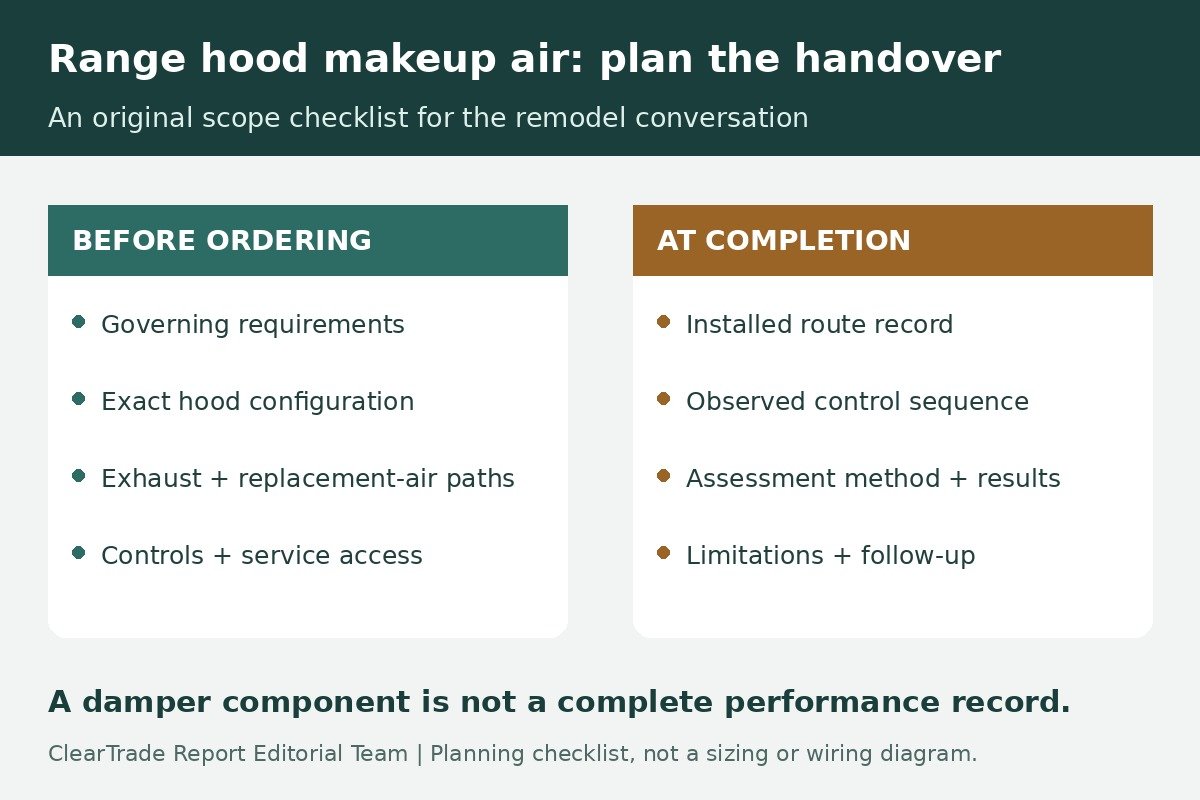
Before ordering a ducted range hood, resolve where its replacement air will come from, how that air path will operate with the hood, and how the finished installation will be checked. A larger advertised exhaust rate is not a complete kitchen-ventilation plan. The hood, duct route, makeup-air arrangement, heating and cooling equipment, and any combustion appliances need to be considered together.
For a remodel, request a written scope covering the applicable local requirements, exact equipment, air paths, controls, access and completion checks. This guide is a planning checklist for homeowners and kitchen remodelers. It does not select duct sizes, set a safe pressure limit or provide wiring instructions.
Start with the home, not a CFM threshold
Makeup air replaces air removed by exhaust equipment. PNNL’s kitchen-exhaust guidance warns that powerful exhaust can interfere with non-sealed-combustion equipment. Its guide also distinguishes factory-rated airflow from delivered airflow, which can be affected by ducts and terminations. That makes the house and the installed system relevant before a shopping decision.
Give the assessor the proposed hood model, cooking-appliance information, existing duct route and a list of other exhaust and fuel-burning equipment. Include fireplaces and equipment outside the kitchen. Ask the assessor to identify appliance venting types and locations rather than assuming that every gas appliance behaves alike.
An electric or induction cooking surface does not answer questions about a separate furnace, water heater or fireplace. Equally, the presence of a gas connection is not a substitute for identifying the actual appliance and venting system. Record what is observed, what is supported by a manual and what remains unknown.
Tell the contractor about planned enclosure changes, such as window replacement or air sealing, and any changes to other ventilation equipment. Ask whether the design assumptions describe the completed remodel. A proposal based on the house before the work should explain how later changes will be addressed.
Why “the 400-CFM rule” needs context
A number quoted online should lead to the applicable code text, not end the discussion. As a bounded example, the published 2021 Seattle Residential Code, chapter 15, section M1503.6, places a fuel-appliance condition before its over-400-CFM requirement: it addresses certain fuel-burning appliances within the dwelling’s air barrier that are neither direct vent nor mechanically draft-vented. Omitting those conditions changes the explanation.
Seattle’s residential-code page identifies its adoption of the 2021 IRC with local amendments. That is a local illustration, not a statement that Seattle’s rule governs another city, every building type or your permit. The source excerpt is sufficient to show why the qualifier matters; it is not a complete project compliance determination.
Ask the designer or code official which adopted edition, local amendment and project requirements apply, and how exhaust capability is established for the selected configuration. If a proposal relies on a setting or capacity limitation, request the exact manufacturer documentation and the basis for local acceptance. A promise to “use low speed” should not silently replace that evidence.
Keep code applicability and building performance as separate questions. If a bidder says makeup air is not required, ask for the basis and ask what assessment supports the proposed installation’s interaction with the home. A threshold alone does not document satisfactory operation.
Compare two air paths and one control sequence
Have the proposal show the exhaust path from the hood to outdoors and the proposed replacement-air path. Ask for enough detail to see where ducts, terminals, service access and finished cabinetry interact. Mark a concealed existing route as unverified until someone assesses it.
PNNL recommends smooth metal kitchen-exhaust duct, the manufacturer’s specified diameter and a direct outdoor route with few bends. Its older code references are not used here as current requirements. Obtain the selected hood’s own manual and have the installer reconcile that document with the actual route and applicable local provisions.
For makeup air, ask how the specified opening, damper or supply equipment is intended to operate. “Includes a damper” identifies a component; it does not describe a complete sequence. Request an explanation of the hood command, any sensing or interlock, damper action, any associated fan operation and what happens when the hood stops.
The Broan-NuTone MD6T product documentation illustrates the compatibility issue: its direct-wire arrangement is described for select compatible hoods. The MD6T/MD8T/MD10T installation instructions expressly distinguish those dampers from combustion-air supply. This is an example of documentation to request, not a recommendation of these models or permission to copy their wiring to another system.
A proposal checklist before purchase
Use this original checklist to compare the scope each bidder has actually included. It is a document-review aid, not a sizing table or inspection certificate.
| Planning item | Evidence to request | Unresolved item to flag |
|---|---|---|
| Governing basis | Applicable jurisdiction, edition, amendment and project conditions | A threshold without its source or qualifiers |
| Exhaust equipment | Exact hood/blower configuration and installation manual | CFM without the configuration or rating conditions |
| Both air paths | Route sketch, terminals, observed constraints and concealed sections | An assumed reusable duct or unidentified intake |
| Controls | Equipment compatibility and written operating sequence | “Automatic” without saying what starts or stops |
| Comfort and access | Treatment of outdoor air, service locations and maintenance scope | An inaccessible filter or unevaluated return-air connection |
| Completion | Required checks, report contents, responsible party and follow-up | Installation marked complete without performance evidence |
Ask the bidder to return the checklist with “included,” “excluded” or “requires investigation” beside each item. An investigation allowance can be a legitimate way to handle uncertainty if the scope and next decision are explicit. It should not be presented as a verified design.
If kitchen cabinetry is being ordered at the same time, identify which decisions must be resolved before fabrication. A route, access panel or intake location discovered later may affect work outside the hood installer’s scope. Assign one person to coordinate those interfaces rather than relying on separate trades to discover them independently.
Resolve outdoor-air comfort and service access
Bringing outdoor air into a home raises practical questions about where it enters, where it is delivered and how the arrangement works in local weather. Ask the designer to explain filtration, temperature and humidity considerations, noise, accessible maintenance and the equipment assumptions used. Request the solution rather than specifying a heater, filter or connection from a generic article.
Broan’s application guide, dated April 17, 2013, discusses return-air temperature constraints and climatic considerations when connecting outdoor air to a central duct system. It also recommends post-installation checks of damper operation, depressurization and exhaust/combustion equipment. Its historical rules of thumb and code citations are not current universal design criteria.
The model-specific installation instructions discuss direct outdoor intake, contaminant-source separation, filters and accessible inspection. Ask the installer to identify the relevant requirements for the actual equipment and location. A bird screen and a particle filter have different functions in that manual; request a clear maintenance description for each specified component.
Have the handover identify filter access, replacement information and who will maintain the intake and damper. Photograph the completed service locations before they are covered or furnished. Do not treat access that requires removing permanent finishes as equivalent to an accessible service point without an explicit review.
Specify completion evidence before installation
Ask who will verify the installed exhaust and makeup-air arrangement, what operating conditions will be evaluated, and how the result will be recorded. The final record should identify the equipment configuration, applicable acceptance basis, method, measured results where required, limitations and disposition of unresolved findings.
PNNL’s combustion-appliance-zone explanation describes why gravity-drafted appliances warrant attention when other exhaust devices operate. Its discussion includes checking venting and interactions under combined exhaust operation. That work belongs to a qualified assessor using an appropriate procedure; this article does not provide a homeowner test or a universal safe pressure value.
Keep a damper-opening demonstration distinct from the full performance assessment. A control can move a component while leaving questions about airflow, outdoor-air delivery or appliance interaction unresolved. Ask the report to identify exactly what was demonstrated and what was not assessed.
For a fictional closeout, “damper opened with the hood” would document one observed action. A fuller record would also identify the assessed hood mode, method, applicable criterion, results, limitations and any corrective work or retest. This example illustrates report structure; it is not an account of a ClearTrade field test.
Coordinate the mechanical plan with the separate electrical scope. Our kitchen-remodel electrical guide covers the circuit and appliance-planning discussion; this article does not select those circuits. Keep the final manuals, route records, settings and completion report together so that later service does not depend on someone’s memory.
Frequently asked questions
Does every hood above 400 CFM have the same makeup-air requirement?
Do not apply a headline threshold without its governing text. Confirm the adopted edition, amendments, building and appliance conditions, and selected hood configuration with the designer or code official. The Seattle example in this guide includes qualifiers and is not a national determination.
Is a makeup-air damper the same as combustion-air supply?
No. The cited Broan instructions explicitly say those damper models are not intended to provide combustion air. Have the assessor address combustion-air and venting requirements separately for the actual appliances.
Does an automatic damper prove the installation performs correctly?
Its operation is one item to check. Request a completion report that also identifies the applicable performance basis, operating conditions, assessment method, results and unresolved limitations for the installed system.
What should I resolve before ordering cabinetry or the hood?
Resolve the governing basis, exact hood configuration, both air paths, equipment compatibility, control sequence, service access and completion checks. Label investigations and exclusions clearly so that a purchase is not based on an unverified route or assumption.
Sources and review scope
Sources checked October 27, 2026: PNNL kitchen-exhaust and combustion-appliance-zone guidance; Seattle’s 2021 residential-code materials and adoption information; Broan-NuTone MD6T product documentation, MD6T/MD8T/MD10T instructions and April 17, 2013 application guide. Some automated full-document requests were restricted; retrieved primary-source excerpts and access limits are retained in the editorial audit. The guide provides planning questions, not local permit approval, a system design, product certification or hands-on testing. No outside professional review is claimed.
AI tools assisted with drafting. ClearTrade Report Editorial Team checked the cited sources and edited this guide. No hands-on inspection or testing was performed.
Need a qualified professional?
Trusted Pros uses visible license-verification states and never ranks paid listings above unpaid listings.