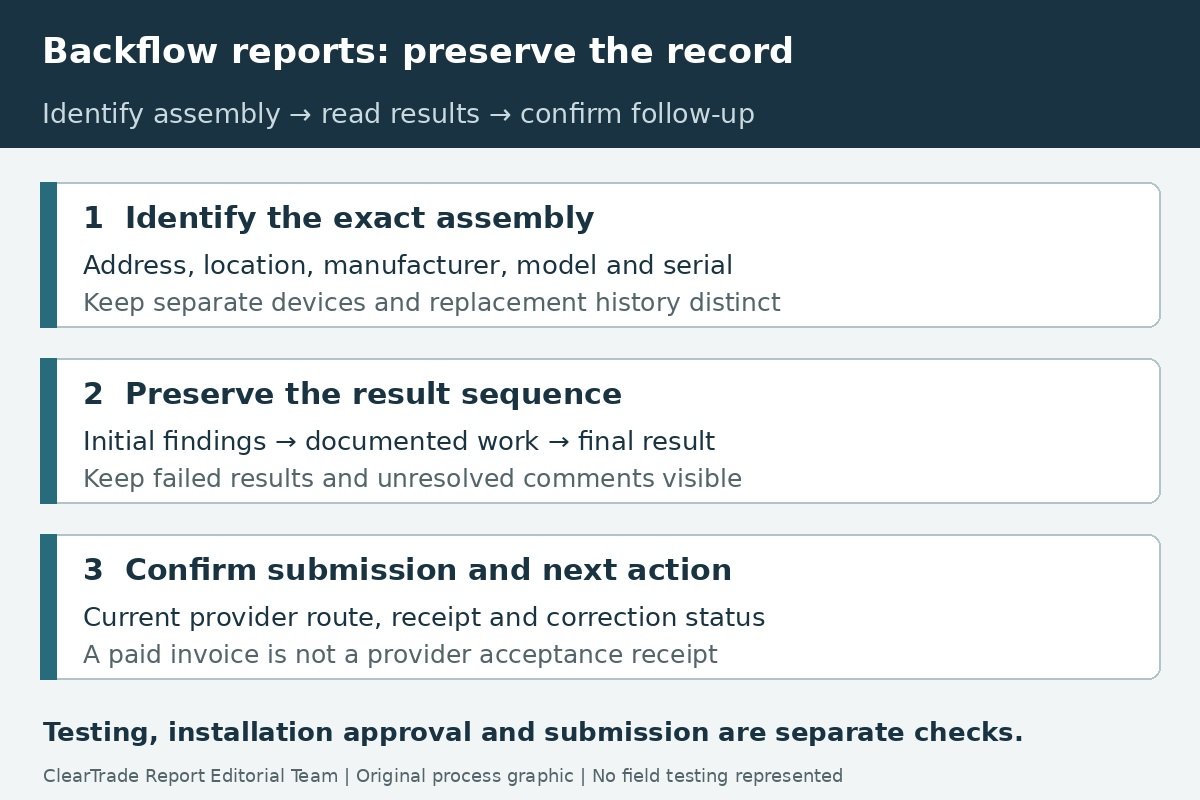
A useful backflow test report connects one identified assembly to its inspection, initial test, any repair and follow-up result. Read those parts together, then confirm that the water provider received the report. A paid invoice or a single checked box does not explain the whole record.
This guide helps property owners and facility teams ask better questions about a report. It uses Washington, Seattle, Vancouver, Washington, and Portland, Oregon, as labeled examples checked October 27, 2026 Pacific. Their forms, deadlines and submission routes are not national rules. ClearTrade Report Editorial Team has not inspected an installation, performed a field test or obtained outside trade review. This is a source-led records guide, not a testing procedure or a drinking-water clearance.
Identify the assembly before reading the result
Start with the service address, exact location and assembly identity. A large property may have separate protection for irrigation, fire service or other uses. “Backflow passed” is not enough to identify which item was tested or whether every item on the property was addressed.
Compare the manufacturer, model, size and serial number with your prior record and the provider notice. Preserve letters and leading zeros. If something differs, ask whether the assembly was replaced, the earlier entry was wrong or the new report identifies another location. Do not silently edit a tester’s signed report to make the records match.
For Washington, WAC 246-292-036 specifies report information covering the facility, assembly, installation, results, repair, test kit and tester. It distinguishes initial readings from readings after maintenance or repair and requires the pass/fail outcome for each test. That local reporting structure is a useful reminder to look beyond the final box.
Build an owner review sheet with the following questions. It is an editorial aid, not a replacement for the provider’s required form or the tester’s certification.
| Part of the record | Question for the owner or facility team |
|---|---|
| Address and account | Does this match the water-provider notice and the property served? |
| Physical location | Could another person find this particular assembly without confusing it with a second one? |
| Exact identity | Do model, size and serial number agree with the current asset record? |
| Initial result | What was found before any maintenance or repair during this visit? |
| Work performed | Are cleaning, repairs or replacement parts identified when applicable? |
| Final result | Is the follow-up outcome documented separately from the initial result? |
| Tester and equipment | Are the responsible tester, dates and relevant test-kit records identifiable? |
| Submission and follow-up | Is there a submission receipt, an unresolved correction or another required action? |
Decode the device name without choosing a replacement
The abbreviation helps identify which record you are reading; it is not a menu from which an owner should select the cheapest replacement. Ask the tester or water provider to explain the full assembly name and the hazard or connection it protects.
The Oregon Health Authority’s assembly guidance distinguishes reduced-pressure, double-check, pressure-vacuum-breaker and spill-resistant-vacuum-breaker families, including detector variants. It separately describes non-testable devices and air-gap methods. Consequently, not every backflow-prevention entry belongs on an identical pressure-test form.
If your report says RP, RPBA, DC, DCVA, PVB or another abbreviation, retain exactly what it says and request the full description. Do not translate an unfamiliar term into a different assembly type based on appearance. An air-gap inspection and a testable assembly record should describe the assessment actually performed.
This is also separate from leak detection, a smart shutoff or thermal-expansion control. Those names should not be used to fill a blank backflow-protection field. Our water-heater expansion-tank documentation guide addresses a different question; an expansion-tank record does not substitute for backflow testing.
Read initial results, repairs and final results in sequence
Keep the order of events visible. A record can show an initial failure followed by work and a passing follow-up result. That is different from a report showing no corrective work, and different again from a failure with no later test documented.
Do not erase an initial failure just because the last test passed. The history helps the next service provider understand what changed. Conversely, an old failed result should not be quoted as the current condition after a documented repair and subsequent test without acknowledging the later evidence.
Ask the tester what the reported readings, labels and units mean for that assembly and accepted test method. A pressure number is not a portable pass threshold for every device. This article intentionally supplies no numerical pass/fail limits or valve-operating sequence. It does not recalculate or overrule a certified tester’s finding.
Use a small follow-up register to keep the unresolved work assigned. The entries below are fictional record situations, not diagnoses or permission to continue operating an installation.
| Fictional record situation | Next documentation question |
|---|---|
| Initial fail, repair described, final pass | Does the final test identify the same assembly and the work completed, and has the full report been submitted? |
| Initial fail, no repair or final result | Who is responsible for the correction, what instructions apply now and when will the follow-up be completed? |
| Invoice says serviced, report is missing | Can the testing company provide the actual report and submission evidence? |
| Final pass with installation comments | What separate issue remains in the comments, and who must confirm its resolution? |
| Serial number differs from last year | Is there a documented replacement or a record correction tying the old and new identities together? |
| Portal shows a warning or rejection | Is the issue an incomplete submission, a technical result or another discrepancy requiring correction? |
Separate a test outcome from approval and submission
Three questions deserve separate answers: what was the test outcome, is the assembly and installation acceptable for the application, and did the provider accept the submission? A result in one column should not be used to assume the other two.
The USC Foundation’s approved-assembly list guidance explains that entries identify specific assembly details and that approved replacement shutoff valves matter. It also points readers to the current digital list, which changes over time. A familiar model family or an old printed list is not enough evidence for a new exact-model decision.
Have the responsible provider or qualified specialist resolve the applicable approval and installation questions. Save the response with the record. This article has not verified a particular assembly against the current list, checked a property’s hazards or approved a replacement. A passing field result also is not a laboratory test of drinking-water quality.
Submission has its own evidence trail. Ask for the date, destination and confirmation identifying the relevant assembly. If the provider requests a correction, keep both the original and corrected report, the reason for the change and the later confirmation. Do not label a rejected upload as accepted merely because a file was sent.
Use the current local route, not an old email address
Seattle illustrates how a sound report can still go to the wrong destination. Its regulatory database update says electronic entry through the SAMS Tester Portal became required August 17, 2026, and that the former test-report email inbox stopped accepting reports. The update identifies a notice letter code or the exact serial in its records as submission lookup information. Do not copy an old email instruction without checking the newer notice.
Portland, Oregon, publishes a different workflow. Its testing and report guidance describes annual testing by a state-certified tester, owner scheduling responsibility and tester submission within 10 business days. It says assemblies must be retested after repairs and directs owners to obtain Water Bureau approval before replacement. Those details are Portland examples; they do not set the deadline or replacement process elsewhere.
Vancouver, Washington, provides another useful distinction in its SAMS portal instructions: initial entries and repair/final entries have separate purposes, and validation can identify inconsistencies or likely rejection. It currently directs searches using the notice letter code. Do not assume two cities using the same platform have identical lookup or submission instructions.
For your property, start with the named water provider on the current notice. Ask which form and portal apply, who submits, how receipt is confirmed, when the next action is due and how a replacement changes the asset record. Keep the answer dated. This is more useful than forwarding instructions from a neighboring service area.
Close the follow-up loop without rewriting history
Before the visit, give the testing company the notice and existing assembly records. Ask about access and any expected service interruption so the facility can coordinate with affected occupants and operations. Obtain the company’s scope for testing, repair and resubmission instead of assuming one fee includes all three.
After the visit, request the complete report, an explanation of unresolved remarks and the next step for any failure. Ask the provider or responsible professional about required actions and deadlines. This guide does not prescribe shutting valves, bypassing protection, repairing an assembly or deciding whether water service may continue.
Keep one folder or asset entry per assembly with the following dated items:
- The provider notice and identifying information.
- The original report, including both initial and final results when applicable.
- Repair or replacement documentation tied to the same identity.
- The submission receipt and any rejection, correction or acceptance message.
- The responsible person’s follow-up assignment and due date.
- The next testing reminder based on the applicable provider’s requirements.
If a reminder arrives after the test, reconcile the assembly identity, test date and submission status with the testing company and provider. Do not ignore the notice on the assumption that paying the invoice closed the provider’s record. For a changed building use or changed water-system connection, ask whether the protection assessment itself also needs review.
The goal is a readable chain from the device on the property to the provider’s record. You should be able to identify what happened, which evidence supports it and what remains unresolved without guessing at technical thresholds.
Frequently asked questions
Does a paid testing invoice prove the report was accepted?
No. Request the actual report and submission evidence identifying the assembly. A payment record, a test result and the water provider’s submission status answer different questions.
Can an initial failure and a final pass appear on the same report?
Yes. Read the sequence of initial findings, documented work and follow-up testing. Preserve the initial result and any unresolved comments rather than replacing the history with a single pass label.
Are all backflow devices tested and reported the same way?
No. Assembly types and protection methods differ. Ask the tester and water provider which inspection, test, form and approval requirements apply to the exact installation.
Does a passing assembly test certify drinking-water quality?
No. A field-test result for an identified backflow assembly is not a drinking-water laboratory result or a complete assessment of every connection at the property.
Sources and scope
Sources checked October 27, 2026 Pacific: Washington WAC 246-292-036; Washington Department of Health sample report guidance; Oregon Health Authority assembly guidance; USC Foundation list guidance; and the linked Seattle, Portland and Vancouver instructions. The Washington sample includes optional fields as well as required content; a sample form does not remove the applicable reporting requirements. Local procedures can change. No customer report, tester credential, exact assembly approval or field result was independently verified, and no actual portal submission was performed.
AI tools assisted with drafting. ClearTrade Report Editorial Team checked the cited sources and edited this guide. No hands-on inspection or testing was performed.
Need a qualified professional?
Trusted Pros uses visible license-verification states and never ranks paid listings above unpaid listings.