Cat6 can be a sound choice for many homes and small businesses. Cat6A is the clearer standards-based choice when the design requires 10GBASE-T across a full 100-meter channel, dense higher-power PoE, or additional alien-crosstalk margin.
The category label is only one part of the decision. Pathway space, bend radius, termination, component compatibility, test requirements and installer workmanship can matter as much as the cable name.
The short comparison
| Decision factor | Cat6 | Cat6A |
|---|---|---|
| Common fit | Shorter, lower-density home and small-business runs | Full-distance 10GBASE-T and higher-demand structured cabling |
| Frequency rating | 250 MHz category performance | 500 MHz category performance |
| 10GBASE-T | May support shorter channels under applicable design conditions | Specified for 10GBASE-T to a 100 m channel |
| Physical size | Often smaller and easier in constrained pathways | Often larger; reduced-diameter products exist |
| Alien crosstalk | Requires attention for 10GBASE-T applications | Category includes alien-crosstalk performance requirements |
| Cost and labor | Often lower | Often higher because of cable, connectivity, pathways and termination |
These are category-level tendencies, not a substitute for the exact product specifications or a channel design.
Start with the application
Ask what the permanent cabling must support:
- 1-gigabit access;
- multigigabit wireless access points;
- 10-gigabit workstations, storage or uplinks;
- PoE cameras, access points, phones or controls;
- high-density bundles;
- long runs; or
- a known owner standard.
TIA announced ANSI/TIA-568.2-E in 2024 as the current balanced twisted-pair cabling and components standard. Another TIA addendum for wireless access points calls for two Category 6A cables in the specified commercial-building context. That does not mean every home outlet requires two Cat6A cables. It shows why application and project standard come before a universal rule.
Distance and 10-gigabit Ethernet
A Cat6A system is designed to support 10GBASE-T over the full 100-meter channel when installed as a compliant system.
Cat6 may support 10GBASE-T over shorter distances, but the allowable result depends on the standard, channel conditions and alien-crosstalk environment. Avoid promising a single shorter-distance number without applying the current design and testing requirements.
If full-distance 10-gigabit service is a firm requirement, Cat6A removes that ambiguity.
Cable size and pathway space
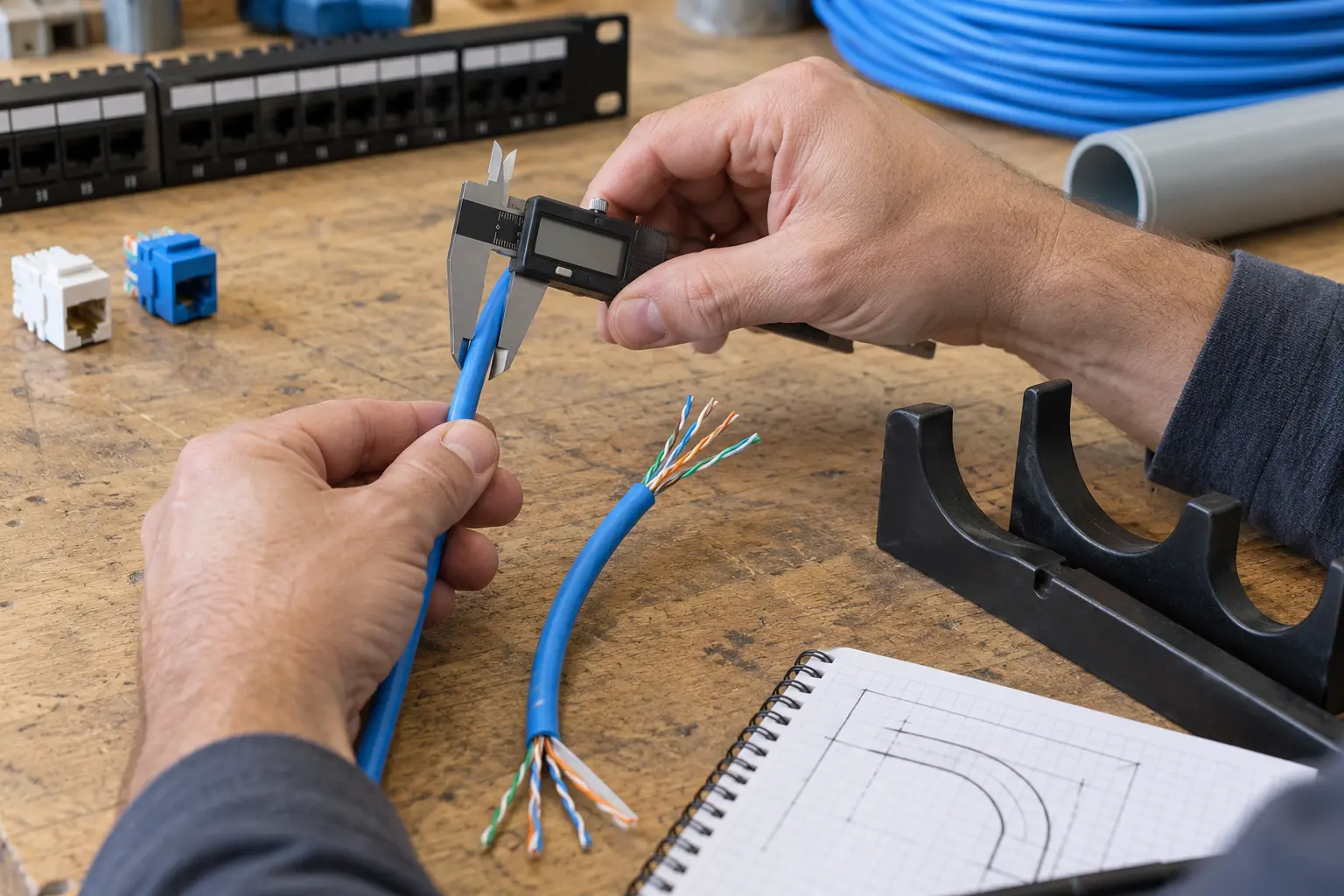
Cat6A cable is often larger than Cat6 because manufacturers use construction methods intended to control crosstalk and meet higher-frequency performance. Larger diameter can affect conduit and sleeve fill, cable tray density, bend radius, patch-panel density, outlet-box space, cable management and pulling effort.
Do not assume all Cat6 or Cat6A cable has the same outside diameter or bend radius. Plan the pathway from the exact selected cable’s manufacturer specifications, including outside diameter and minimum bend radius—not from the category label alone. Where future pulls or service access matter, preserve practical pathway access or pulling provisions without inventing a universal spare-capacity percentage.
Termination and component compatibility
A structured cabling channel includes more than horizontal cable:
- patch panels or modules;
- work-area outlets;
- patch cords;
- consolidation or transition points, if used; and
- installation and termination quality.
Mixing category labels does not automatically produce the higher category. The installed permanent link or channel must meet the applicable performance requirements.
Use compatible components, follow the manufacturer’s termination instructions and certify the installation to the required limit when the project needs documented performance.
PoE: category is not the only issue
Both Cat6 and Cat6A systems can carry standards-based PoE when properly designed and installed. Higher-power PoE and dense bundles increase the importance of conductor size, bundle size, temperature, pathway conditions and connection quality.
Cat6A may offer practical advantages in some higher-power or high-density designs, but “Cat6A” alone does not prove a PoE bundle is acceptable. Use current standards, cable specifications and temperature/bundling guidance.
For switch-side capacity, see PoE Power Budgets Explained.
Shielded or unshielded?
Cat6A is available in shielded and unshielded constructions. Shielding is not a universal upgrade.
A shielded system requires a complete design, compatible components and proper bonding/grounding practices. It may be appropriate for a defined electromagnetic environment or owner standard. It should not be selected only because “shielded sounds better.”
Homes: where Cat6 often remains reasonable
Cat6 may be appropriate when:
- runs are short;
- 1 Gb/s is the known requirement;
- 10 Gb/s is limited to a short, verified path;
- pathways are constrained;
- the project does not have a Cat6A owner standard; and
- the installer can test and document the system as required.
Conduit or accessible pathways may provide more useful flexibility than spending the entire budget on a category label while ignoring routes, outlet locations and spare capacity.
Small businesses: when Cat6A becomes easier to justify
Cat6A becomes more compelling when:
- full-channel 10GBASE-T is required;
- access-point cabling follows a commercial standard or owner requirement;
- the installation is dense;
- higher-power PoE is planned;
- long-term moves, adds and changes matter; or
- the owner needs consistent documented performance across the site.
The decision is not only bandwidth. Space, heat, labor, testing and future operational needs belong in the comparison.
Questions to ask before buying cable
- What applications and speeds are required now?
- Is 10GBASE-T required, and over what maximum channel length?
- What PoE loads and bundle conditions are expected?
- What are the exact cable diameter and bend-radius requirements?
- Do conduit, tray and outlet boxes have adequate space?
- Are jacks, panels and patch cords part of a compatible system?
- What permanent-link or channel test will be delivered?
- Is shielding actually required, and how will the complete system be bonded?
- Are spare pathways or pull strings more valuable than upgrading every run?
Frequently asked questions
Is Cat6A always better than Cat6?
It provides higher category performance and full-channel 10GBASE-T capability, but it can require more space, labor and cost. The better choice depends on the application and pathway.
Will Cat6 run 10-gigabit Ethernet?
It may over shorter channels under applicable conditions. Do not promise a distance without a standards-based design and test plan.
Is Cat6A better for PoE?
It can offer practical advantages in some dense or higher-power designs, but category alone does not settle conductor, bundling, temperature or connector requirements.
Should a home use shielded Cat6A?
Only when the environment and complete system design justify it. Shielding requires compatible components and proper bonding/grounding practices.
Electrical review: This article was technically reviewed by Lavender Electric LLC, a Washington electrical contractor. ClearTrade Report retains editorial control.
Sources
Accessed October 4, 2026.
- TIA: ANSI/TIA-568.2-E publication announcement
- TIA: commercial-building cabling addendum for wireless access points
- Leviton: Cat 6A systems
- Leviton: reduced-diameter Cat 6A cable specification
- Leviton: Cat 6A UTP cable specification with minimum bend radius tied to cable outside diameter
For a fiber backbone or a route requiring a different optical-media decision, see our single-mode versus multimode fiber comparison. Match supported optics, reach and acceptance records separately from the copper-category choice.
Need a qualified professional?
Trusted Pros uses visible license-verification states and never ranks paid listings above unpaid listings.