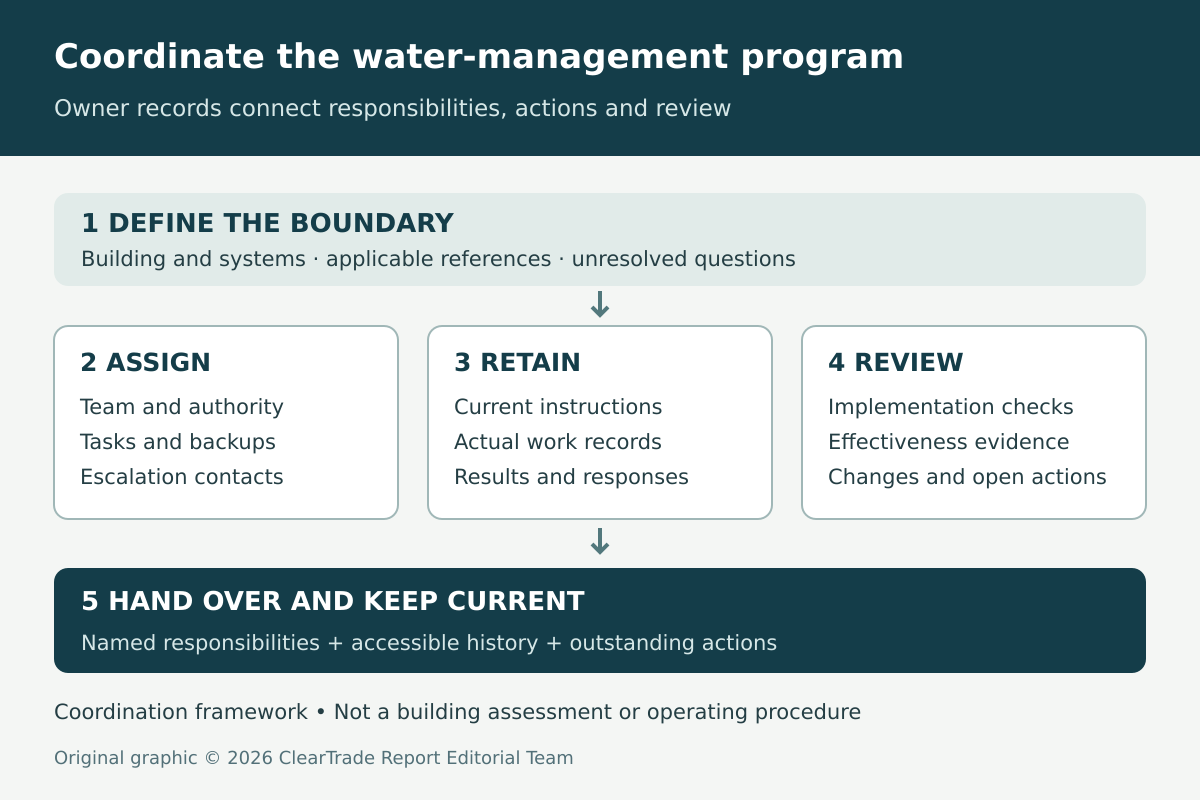
A commercial building water-management plan needs an accountable team, a description of the actual water systems, defined control and response responsibilities, and records showing what happened. A sampling invoice alone does not explain who operates the program or what happens when a result or operating condition needs attention.
This guide helps owners scope that coordination work. It does not assess a building, prescribe water treatment, interpret a laboratory result or certify that water is safe. Use the building's qualified program team and applicable authorities for technical and jurisdiction-specific decisions.
Establish the program boundary before buying services
CDC's water-management overview explains that a program must fit the building and its users. Depending on the setting, a program may address an entire building or particular devices. CDC also identifies healthcare requirements, public-health reporting, building codes and water-treatment regulations as factors that can affect the approach.
Start the owner file with the address, building uses, system boundaries, responsible organizations and open questions. Record whether the scope includes tenant-operated equipment or shared systems serving more than one property. A contract that names only the street address can leave those interfaces unresolved.
Ask the team to identify which requirements it is using, the edition or version, who administers them and why they apply. A national reference is not a determination of local adoption. ASHRAE's public titles and scopes listing identifies Standard 188-2021 as the published legionellosis risk-management standard. This article has not audited a program against its full requirements or checked adoption in every jurisdiction.
Make the distinction visible in proposals: a consultant's assessment, a laboratory service, a maintenance visit and ongoing program management are different deliverables. If one provider supplies several, ask for each responsibility to be identified rather than relying on the company name to imply complete coverage.
Name the people who can make and carry out decisions
An owner needs to know who authorizes spending, who maintains the program document, who performs assigned work and who reviews exceptions. Put names or clearly assigned positions beside these functions, with backups and a route for after-hours escalation.
CDC's program-development guidance calls for a team with suitable skills, a written system description and flow diagrams, identification of hazardous conditions, monitoring and corrective responses, confirmation that the program operates effectively, and documentation. The following owner worksheet organizes accountability; it is not a substitute for that technical program.
| Coordination function | Owner question | Evidence to retain |
|---|---|---|
| Program sponsor | Who can approve resources and resolve cross-company gaps? | Assigned authority and escalation contacts |
| Program coordinator | Who controls the current document and outstanding actions? | Version register and action list |
| Operations | Who performs each assigned task and covers absences? | Task assignments and completed records |
| Technical decisions | Who establishes methods, limits and responses for this building? | Named decision maker and supporting basis |
| Results review | Who receives, evaluates and escalates findings? | Review record and follow-up responsibility |
| Tenant interface | Who communicates access, changes and restrictions? | Contact list and documented handoffs |
Keep organizational boundaries explicit. If the property manager hires a consultant but the tenant controls access to a device, the plan needs a workable access arrangement. If the service company changes, identify who transfers the history and closes unresolved actions. Merely listing both companies does not establish a handoff.
Build a system record people can actually use
Request a current description and diagram from the responsible team, with a way to identify the equipment and locations used in its records. Ask what information came from drawings, what was checked in the building and which assumptions remain unresolved. Label an unverified drawing as unverified.
Useful owner questions include: Which areas does the document cover? How are separately managed systems distinguished? How will staff find the named monitoring locations? Who updates the document after alterations? These questions test whether the file can support the work; they do not require the owner to diagnose water-system hazards.
Keep equipment documents and service histories available to the team. Avoid treating an asset register as a risk assessment. A list containing a water heater, a fountain and a cooling tower can identify assets without explaining the controls and responsibilities for any of them.
For a multi-building portfolio, use a consistent filing structure while retaining each building's actual program. A common cover sheet helps administration; copying another property's operating decisions does not establish suitability. Record the building identifier on logs and reports so that similar equipment names do not send a result to the wrong site.
Connect monitoring records to defined responses
CDC's monitoring guidance discusses temperature, disinfectant residual, pH and water movement. It also recognizes the interaction between hot-water management and anti-scald requirements. Ask the qualified team to specify the actual monitoring method, locations, limits and response for the building; this article supplies no universal setpoints or flushing procedure.
For each assigned observation or measurement, request a record format that identifies the location, date, method, result, person performing the work and reviewer. Ask how instruments and procedures will be identified. The owner should be able to connect a reported result to the relevant program instruction without guessing which sheet applies.
Define how missing information is handled. A blank cell should not silently mean acceptable, not applicable or not performed. Give staff a way to report that access was unavailable, equipment was out of service or a task was deferred, and assign someone to resolve the gap.
Have the program team describe the escalation route in advance. Who is contacted when a limit is not met? Who decides the next step? Where is that decision recorded? Avoid a contract in which the provider sends an alert but no one has accepted responsibility for reviewing it. This guide does not provide a remedial treatment recipe or permission to change building operation.
Separate implementation checks from effectiveness review
CDC distinguishes verification—checking that the program is being implemented as designed—from validation, evaluating whether it controls the relevant hazardous conditions. Ask for separate evidence of each. A completed task log and an effectiveness review answer different questions.
CDC's validation page says routine Legionella testing over time is the best validation method and recommends routine testing for inpatient healthcare facilities. It places sampling decisions with the team and says sampling should be part of a comprehensive program. Frequency, locations and methodology are facility-specific; this article does not convert that guidance into a generic testing calendar.
Ask the team to document the validation approach, its basis and who interprets the findings. If sampling is included, have the responsible provider specify collection arrangements, laboratory responsibilities, reporting and follow-up. An owner should receive the actual result and the team's documented interpretation, rather than a favorable summary disconnected from the report.
Keep the limits of the evidence visible. A single laboratory report is a record of the reported samples and method, not a whole-building health assurance. Do not label a program validated merely because a purchase order was closed or a report arrived. Ask the designated reviewer what conclusion is supported and which actions remain open.
Define the consultant's deliverables and conflicts
CDC's consultant guidance suggests considering relevant experience, laboratory and assessment expertise, remediation and water-management capabilities, knowledge of local requirements and potential conflicts of interest. CDC does not endorse a consultant through that guidance.
Turn those considerations into a comparable scope. Request the names or roles of the people doing the work, experience relevant to the facility, included deliverables, exclusions and continuing support. Ask whether the provider writes a program only, helps implement it, reviews records or supplies an ongoing service. Identify any separately priced work before comparing bids.
Ask the provider to disclose a financial interest in proposed products or additional services. That does not by itself decide whether a proposal is appropriate, but it helps the owner understand who is evaluating the options and who sells the response. This article recommends no named product or service company.
Make document ownership and access practical. The building should have access to the current program, completed records and outstanding actions when a contract ends. Specify the export format and handover process so that a change of vendor does not erase the operating history.
Keep changes and unusual conditions connected to the program
Ask the team to establish how building changes reach the program coordinator. Renovation, changes in use, system work and extended periods of reduced occupancy are examples of events an owner can flag for review; the team decides what those events mean for the actual program.
Use a change record with the affected area or system, proposed date, responsible provider, documents needing review and person authorized to close the item. Identify who communicates any restrictions or access arrangements. A construction completion certificate should not be assumed to resolve every water-management action.
Keep suspected illness or an outbreak response separate from routine administration. Follow the applicable public-health and facility response process through the responsible professionals; a general article or routine service ticket is not an investigation protocol. Protect private occupant and health information in shared records.
For ordinary operations, link the program's assigned tasks into the existing maintenance system without replacing their technical instructions. Our commercial-building maintenance calendar covers broader scheduling. A water-management program adds building-specific responsibilities, controls and review that a general calendar does not supply.
Use an owner closeout register
Before treating a new or revised program as handed over, review the administrative deliverables below. This is ClearTrade's editorial coordination checklist, not a compliance audit or technical acceptance certificate.
| Deliverable | Question before administrative handover |
|---|---|
| Scope and requirements | Are the building, systems, applicable references and unresolved questions identified? |
| Team and authority | Is each function assigned, with backups and escalation contacts? |
| System documents | Are descriptions, diagrams and location identifiers available and versioned? |
| Operating instructions | Has the responsible team specified tasks, monitoring and responses? |
| Review arrangements | Are verification, validation and results interpretation assigned? |
| Records and training | Can assigned staff access current instructions and record actual work? |
| Open actions | Does each unresolved item have an owner, next step and closure record? |
Ask for a demonstration using the actual filing system: find a current instruction, locate a completed record and trace an exception to its response. The purpose is to expose access and coordination gaps before responsibility passes between organizations. It does not demonstrate the technical effectiveness of the program.
Retain the handover date, participants, document versions and unresolved items. Keep later revisions linked to that history. A useful owner file shows what changed and who accepted the next responsibility, rather than presenting the first plan as permanently finished.
Frequently asked questions
Is periodic sampling the same as a water-management program?
No. Sampling can contribute to validation, but the program also needs building-specific responsibilities, operating controls, responses and records. Ask the team how reported results connect to decisions and follow-up.
Can one template cover every building in a portfolio?
A common filing structure can help administration. The technical program must reflect the individual building, its systems and users. Ask the team to identify what has been assessed and which assumptions remain open for each property.
Does this guide specify temperatures or testing intervals?
No. The responsible program team must determine appropriate methods, limits, locations and frequencies for the facility and applicable requirements. This guide is an owner-coordination framework, not operating or treatment instructions.
What should an owner request when a provider changes?
Request the current program, its versions, completed records, outstanding actions and assigned handover responsibilities. Retain the original reports and confirm who receives and reviews future findings.
Sources and editorial method
Sources checked October 28, 2026. The linked CDC overview, development, monitoring, validation and consultant pages display March 15, 2024 dates. ASHRAE's public listing was checked for the Standard 188-2021 identifier; no full-standard conformity review is claimed. Requirements for the actual address and facility must be checked by the responsible team.
The tables, owner questions and handover examples are ClearTrade's editorial framework. No building inspection, sampling, laboratory analysis, product test, professional review or water-safety certification was performed for this article. Existing product-record links are not recommendations or evidence of suitability for this work.
AI tools assisted research organization and drafting. ClearTrade Report Editorial Team is responsible for the article. The original graphic is a coordination framework, not a building assessment or operating procedure.
Need a qualified professional?
Trusted Pros uses visible license-verification states and never ranks paid listings above unpaid listings.