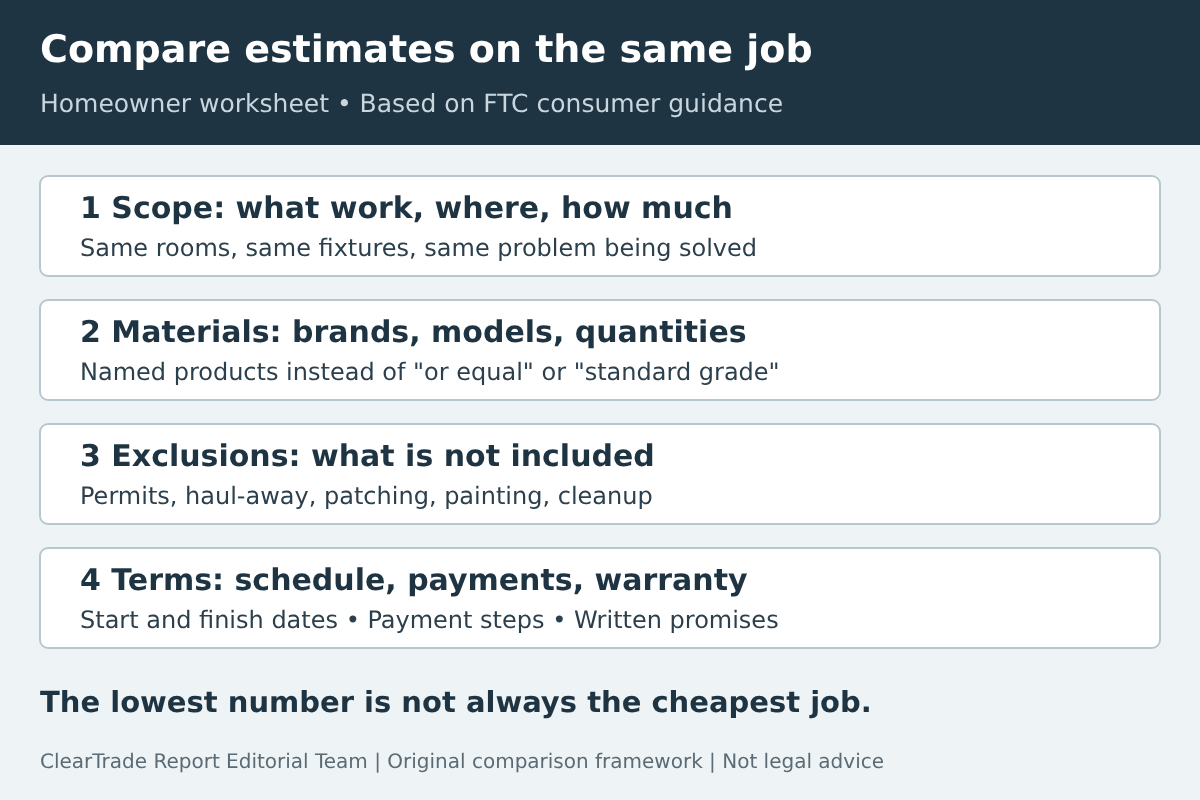
To compare home repair estimates without knowing the jargon, first make sure every contractor is pricing the same job, then ask each one to answer the same plain questions in writing: what they will do, what they will install, what is not included and when it will be finished. The differences that matter usually show up once the answers sit side by side.
Evidence label: Guidance based on Federal Trade Commission consumer advice and ClearTrade Report’s existing reporting, checked October 29, 2026. This is not legal advice, and rules differ by state.
Start by making the estimates comparable
Most confusing estimates are not confusing because of the jargon. They are confusing because each contractor is pricing a slightly different job. Before you compare totals, make sure each estimate describes the same work.
The Federal Trade Commission (FTC) guidance on avoiding home improvement scams says a written estimate should include “a description of the work to be done, materials, completion date, and the price.” If one of those four pieces is missing from an estimate, ask for it in writing before you compare anything else.
A simple way to do this: write one sentence describing what you want done, give the same sentence to every contractor, and ask each one to tell you in writing if they think the job needs something different.
Translate the estimate into four plain questions
You do not need to know trade terms to read an estimate. For each line, ask the contractor to answer four questions in plain words:
- What exactly will you do? Which rooms, how many items, and where the job starts and stops.
- What will you install? The brand, model or grade of materials, or at least a description you can compare.
- What is not included? Patching, painting, haul-away, permits and repairs to things found once walls or floors are opened are common gaps.
- When will it be done? A start date, a completion date, and what could push those dates.
If a contractor cannot or will not explain a line in plain language, that is useful information too.
Line the estimates up side by side
Put the estimates into a simple table. Seeing the answers next to each other is often enough to show why the prices differ.
| What to compare | Estimate A | Estimate B | Estimate C |
|---|---|---|---|
| Work described (what, where, how much) | |||
| Materials (brand, model or grade) | |||
| Not included | |||
| Permits: who gets them and is the cost included | |||
| Start and completion dates | |||
| Payment schedule and deposit | |||
| License number and proof of insurance | |||
| Total price |
When one estimate is much lower or higher than the others, the FTC’s advice is to “ask for an explanation if there’s a big difference among the estimates” and not to “automatically choose the lowest bidder.” A low price that leaves out permits, cleanup or a needed part of the job may cost more in the end.
Check who you are hiring
The FTC recommends that you “Consider only contractors who are licensed and insured” and that you check with your state or county government to confirm a license and ask the contractor for proof of insurance. It also suggests getting recommendations from people you know and trust, reading reviews “with a critical eye,” and checking with consumer protection officials for complaints.
For electrical work, our guide on verifying an electrical contractor license shows where state license lookups live.
Get the agreement in writing
According to the FTC, contract requirements vary by state, but “Even if your state doesn’t require a written agreement, ask for one.” Before you sign, the FTC says the contract should include the contractor’s name, address, phone number and license number; an estimated start and completion date; and any promises made in conversations about the scope of work and costs. It should also be complete: “make sure all blank spaces are filled in.”
If you signed the contract in your home or somewhere other than the seller’s permanent place of business, the FTC says the contract should include a written statement of your right to cancel within three business days.
Changes happen on many projects. Ask how changes will be priced and approved before work starts, and keep each approved change in writing. Our guide to construction change orders explains what a change record should show.
Be careful with payments and pressure
The FTC advises: “Don’t pay the full amount for the project up front,” notes that some states limit how much a contractor can ask for as a down payment, and says to “never make the final payment until the work is done and you’re satisfied with it.”
It also lists warning signs, including contractors who knock on your door because they are “in the area,” say they have leftover materials from another job, pressure you for an immediate decision, ask you to pay everything up front or only in cash, or suggest you borrow from a lender they know. If financing is offered, the FTC says to shop around and compare loan terms first.
Keep a simple project file
Keep every estimate, the signed contract, approved changes, permits, receipts and photos in one folder. If something goes wrong later, the FTC suggests trying to resolve it with the contractor first and following phone conversations with a letter sent by certified mail. A clear file makes that much easier.
Some projects are bigger than they look. Replacing an electrical panel and upgrading the electrical service, for example, are different jobs with different costs, as our guide to panel replacement vs service upgrade explains. When two estimates seem to describe different projects, ask each contractor which one they are pricing.
Frequently asked questions
How many estimates should I get?
The FTC advises getting multiple estimates. What matters most is that each one describes the same work, materials and schedule so you can compare them fairly.
Should I pick the lowest estimate?
Not automatically. The FTC says not to automatically choose the lowest bidder and to ask for an explanation when estimates differ a lot. Check what each one includes and leaves out.
What should a written estimate include?
According to the FTC: a description of the work, materials, completion date and price. Ask each contractor to also list what is not included.
How much should I pay up front?
Don't pay the full amount up front. Some states limit down payments, so check with your state or local consumer agency, and don't make the final payment until the work is done to your satisfaction.
Sources checked October 29, 2026: Federal Trade Commission (FTC) guidance on avoiding home improvement scams (page dated July 2022).
More for homeowners: ClearTrade homeowner guides and remodeling and repairs.
Disclaimer: This guide is general information for homeowners, not legal, financial or professional advice for a specific project. Rules differ by state and city; check with your local building department, consumer protection office or a qualified professional. AI tools assisted with drafting. ClearTrade Report Editorial Team checked the cited sources and edited this guide. No hands-on inspection or testing was performed.
Need a qualified professional?
Trusted Pros uses visible license-verification states and never ranks paid listings above unpaid listings.