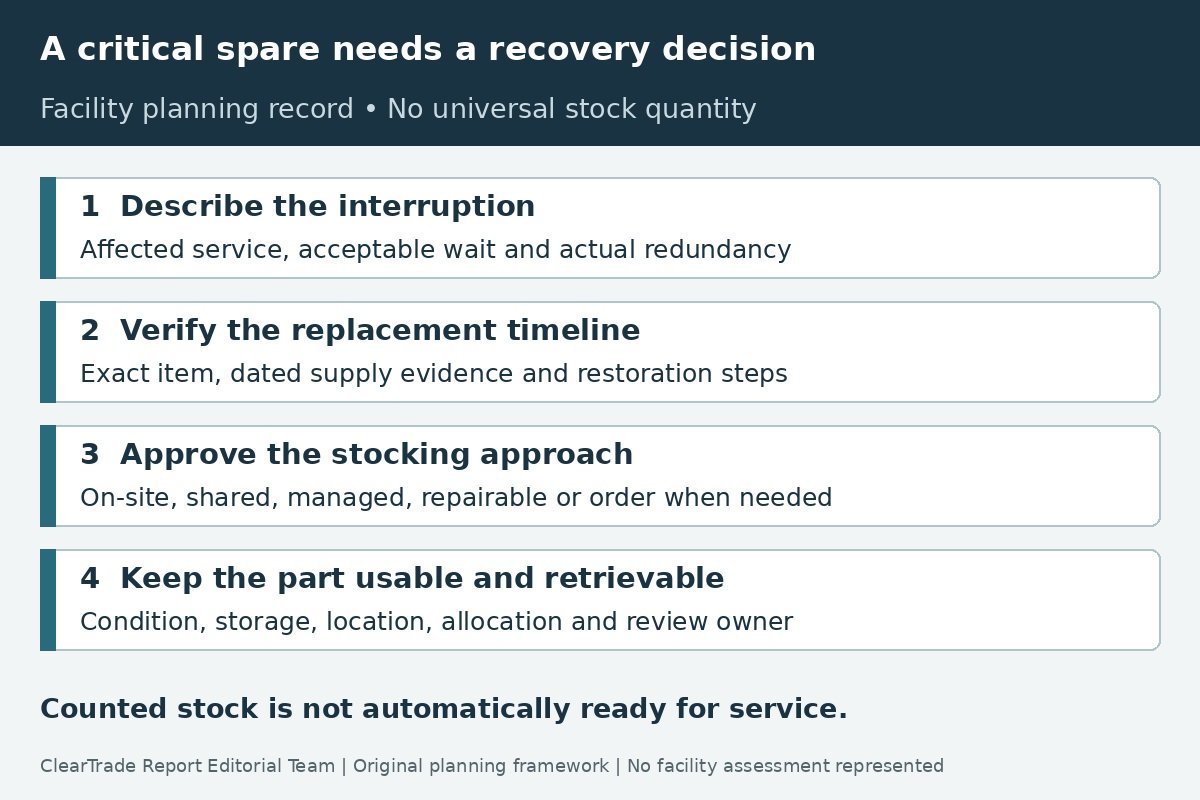
A useful spare-parts policy connects each stocked item to the equipment it serves, the consequence of an unavailable part, the time needed to obtain a usable replacement, and the conditions that keep it usable in storage. A high purchase price does not automatically make a part critical; a low issue count does not automatically make it expendable.
Start with a documented decision for the equipment and failure scenario. Then assign the stock location, replenishment trigger, responsible owner and review date. This guide gives facilities and procurement teams a planning framework, not a universal spare-parts list, engineering reliability calculation or assurance that a particular facility can recover safely. ClearTrade Report Editorial Team checked the primary references October 28, 2026. No facility inspection, supplier inventory verification, hands-on testing or outside professional review was performed.
Start with the service interruption, not the shelf value
Identify which service the equipment supports and what happens when it is unavailable. Ask operations and the responsible technical team about the affected occupants, production, environmental conditions, safety functions and contractual commitments. Record the acceptable interruption and who approved it. An estimate of lost production alone should not silently decide a safety-related requirement.
Distinguish a repairable nuisance from an interruption that the organization cannot tolerate. Identify any standby equipment, alternate process or temporary service, along with the conditions under which it can actually be used. Redundancy on an equipment list is not proof that the alternate is operational, independent or sufficient for the load.
The Department of Energy Inspector General’s September 2024 WAPA critical-spares audit, DOE-OIG-24-30, illustrates why an asset program and a spare-parts program are different. The audit identified gaps in documented critical-parts identification, inventory, stocking levels, reorder points and strategic locations. That was a finding about WAPA’s audited program, not a statement about its present condition or a mandatory stocking rule for commercial buildings.
For each important interruption, write a short scenario: what fails, which service is lost, what temporary response is available, and what evidence supports the recovery expectation. The scenario makes the reason for a spare understandable to a new employee or purchasing approver.
Match the replacement to the actual installed equipment
Link the item to an asset identifier, manufacturer, exact model and relevant serial or configuration information. Retain the current parts document and the source of the proposed part number. Identify quantity per repair, revision restrictions and any required associated components. A label that says only “pump seal” or “control board” is insufficient for an approved purchase.
Use the equipment manufacturer’s recommended spare-parts information as an input, then reconcile it with the actual installed population and operating conditions. Honeywell’s July 9, 2021 spare-parts guidance recommends comparing its OEM spare-parts list with physical inventory and checking for obsolete items. That supports a reconciliation process; it does not establish a quantity for unrelated equipment.
Ask the responsible technical party to resolve superseded numbers, approved substitutions and configuration requirements before purchasing. Similar appearance, a matching connection or a distributor’s search result is not sufficient evidence of interchangeability. Keep the approval and its scope with the item record. This article endorses no component or substitute and gives no installation instructions.
Measure the time to a usable replacement
Request a dated lead-time statement for the exact item and quantity. Identify whether the estimate starts when a quote is issued, an order is accepted or a factory release occurs. Separate stock on hand from a catalog listing and expected production from a committed shipment.
Build a timeline that includes internal approval, procurement, manufacture or repair, shipping, receiving checks, configuration and the qualified labor needed to return equipment to service. Record which steps can overlap. A part delivered to a loading dock has not necessarily restored the service. Keep a supplier estimate separate from a contractual commitment and from a receipt observed at your site.
Ask about order cutoffs, after-hours access, transport constraints and whether a quoted pool is reserved for your organization. If an agreement promises a response, determine whether that means answering the telephone, dispatching a technician, shipping a part or completing restoration. Those are different milestones.
Mitsubishi Electric’s June 1, 2022 description of its spare-parts strategy combines usage trends with current lead times and obsolescence information in its own stock reviews. This is a labeled manufacturer example, not evidence of current availability, a universal review interval or a service guarantee for readers.
Choose a stocking approach for each scenario
The following is an original editorial decision table. Use it to organize a review with operations, maintenance, procurement and the responsible technical authority. It does not calculate a failure probability or select a safe stock quantity.
| Situation to investigate | Stocking approach to evaluate | Evidence needed before relying on it |
|---|---|---|
| Replacement cannot arrive within the accepted interruption | Dedicated on-site spare | Exact compatibility, usable condition, access and a complete restoration plan |
| Several sites use an approved common item | Shared regional stock | Allocation rules, transport time and simultaneous-demand exposure |
| A supplier offers managed inventory | Reserved or managed stock | Written reservation, release conditions, condition checks and delivery commitments |
| Equipment can tolerate a documented wait | Purchase when required | Current supply route and approved interruption or workaround |
| Removed components can be repaired | Repairable exchange pool | Repair capacity, turnaround, acceptance criteria and return tracking |
| Parts are becoming obsolete | Last-buy, redesign or equipment-replacement review | Technical approval, remaining equipment life and storage constraints |
Do not assume that one spare covers every asset with a similar description. Check configuration differences and whether several units could need the item during the same event. Conversely, do not automatically buy a full kit for every identical asset when an approved common stock policy can address the actual exposure.
If no acceptable supply approach meets the recovery need, escalate the gap. Additional stock is one possible response; equipment changes, a different support arrangement or a revised operating plan may also need evaluation. Keep the decision owner and unresolved risk visible rather than disguising the gap as a completed purchasing task.
Separate routine replenishment from rare critical failures
For regularly consumed items, a documented demand history can support a replenishment calculation. Use consistent units and a defined review period. Separate planned maintenance consumption, failures, returns, transfers and corrections so that an inventory adjustment does not look like equipment demand.
Consider this deliberately simplified example: an item is used at an average of two units per week, replenishment takes three weeks, and the organization separately approves a two-unit buffer. Expected usage during that lead time is 2 × 3 = 6 units; adding the assumed buffer gives an illustrative reorder trigger of eight units. The buffer is an input chosen for the example, not a calculated service level or a recommendation for any facility.
Define the inventory position used by the trigger. In this example it means usable on-hand units plus confirmed units on order, minus units already allocated. With five usable units on hand, four confirmed on order and three allocated, the position is 5 + 4 − 3 = 6. Six is below the illustrative trigger of eight, so the team would review replenishment. It does not follow that two units is the correct order quantity: an approved target, order multiple, expiration constraint and the timing of the incoming delivery still matter.
Check the dated supply timeline separately. Four units scheduled after the next required use do not solve that earlier shortage merely because they appear in the position calculation. Exclude damaged, quarantined or unapproved items from usable stock and avoid counting the same incoming units twice.
Do not apply this average-use example mechanically to a rarely failing critical component. Zero recorded issues may reflect a small population, a short observation period or unrecorded work. Ask the responsible technical team to evaluate credible failure scenarios, redundancy, replenishment exposure and uncertainty. This guide supplies no probability distribution, safety-stock optimization or claimed outage-risk reduction.
Preserve the spare’s condition and make it retrievable
A quantity record should distinguish serviceable, reserved, quarantined, awaiting inspection, under repair and obsolete items. Assign a real storage location and a person responsible for its condition. A spare that cannot be identified, retrieved or released when needed should remain an unresolved readiness issue.
Record the relevant manufacturer’s packaging, environment, preservation, shelf-life and inspection instructions for the exact item. Ask about storage-age restrictions before buying a multi-year supply. Batteries, lubricated components, electronics and elastomeric items need their own applicable instructions; this article assigns no common shelf life to them.
As a bounded example, NSK’s bearing-handling guidance explains that storage conditions affect corrosion protection and identifies heat, humidity, sunlight, packaging damage and retrieval arrangements as concerns. The appropriate conditions and storage life for a particular spare still require its applicable manufacturer documentation. A generic bearing page is not approval to use an aged or damaged part.
Keep receiving and condition records, identifiers and any expiration or preservation dates with the location record. Establish a check appropriate to the equipment and storage instructions. If condition is uncertain, have the responsible party resolve it before classifying the item as available; this guide provides no reconditioning or acceptance procedure.
Make the inventory record support real work
Use one controlled item identity connected to the assets it serves. Keep quantities, locations, reservations and orders current when a part is issued or returned. Honeywell’s guidance also describes inventory records, labeled storage and physical-count reconciliation. Software can support that discipline; it cannot establish compatibility or turn an unverified count into a usable spare.
| Record field | Question the team should be able to answer |
|---|---|
| Asset and approved item identity | Which installed equipment and revision does this part serve? |
| Criticality rationale | What interruption does the stock decision address, and who accepted it? |
| Demand and supply evidence | Which issue history and dated lead-time information support the policy? |
| Stock rule | What are the approved trigger, target and reservation rules? |
| Condition and location | How many usable units exist, where are they, and who can release them? |
| Review responsibility | Who checks changes in equipment, demand, supply and storage condition? |
Connect planned consumption to the work schedule. Our small-commercial-building maintenance calendar explains how to organize work from the asset and its obligations. The calendar determines when work is planned; this separate spares decision determines how materials will be available for it and for credible failures.
Review the policy when its assumptions change
Name a review owner and an appropriate review cadence. Also trigger a review after a stockout, unexpected failure, equipment replacement, changed operating duty, extended lead time, obsolescence notice, storage incident or discovery that a supposed spare is incompatible. A routine date should not delay action on a known gap.
Compare actual interruption and replenishment experience with the documented scenario. Record unused stock and shortages without automatically treating either as proof that the original decision was wrong. Low-demand insurance stock and repeatedly consumed maintenance supplies require different explanations.
Keep the approval, evidence date, unresolved questions and next review together. The outcome should be a traceable policy for each material recovery scenario, rather than a warehouse total or an unsupported assurance that every critical part is covered.
Primary references checked October 28, 2026: DOE-OIG-24-30, September 2024 report with September 24 memorandum; Honeywell guidance dated July 9, 2021; Mitsubishi Electric strategy dated June 1, 2022; NSK’s current bearing-handling page, no publication date displayed. Manufacturer examples describe their stated approaches, not verified supply offers. No facility failure records or private supplier quotations were provided; numerical examples and decision tables are original illustrations.
Frequently asked questions
Does every critical asset need a dedicated on-site spare?
Not automatically. Compare the accepted interruption with verified replacement and restoration time, compatibility, storage requirements and any shared or contracted supply arrangement. Document who approves the approach and unresolved gaps.
Can a rarely used part be removed from stock because it has no recent issues?
Issue history alone does not resolve a rare critical-failure scenario. Review the affected equipment, failure consequence, redundancy, supply time and uncertainty before changing the policy.
Is a reorder point the same as an order quantity?
No. A reorder point triggers review or replenishment under the defined policy. Order quantity also depends on the approved target, usable stock, allocations, incoming supply, order constraints and storage limits.
What makes a spare available rather than merely counted?
The record should establish its approved identity, usable condition, location, access and allocation. It also needs a realistic path for qualified personnel to return the equipment to service.
AI tools assisted with drafting. ClearTrade Report Editorial Team checked the cited sources and edited this guide. No hands-on inspection or testing was performed.
Need a qualified professional?
Trusted Pros uses visible license-verification states and never ranks paid listings above unpaid listings.