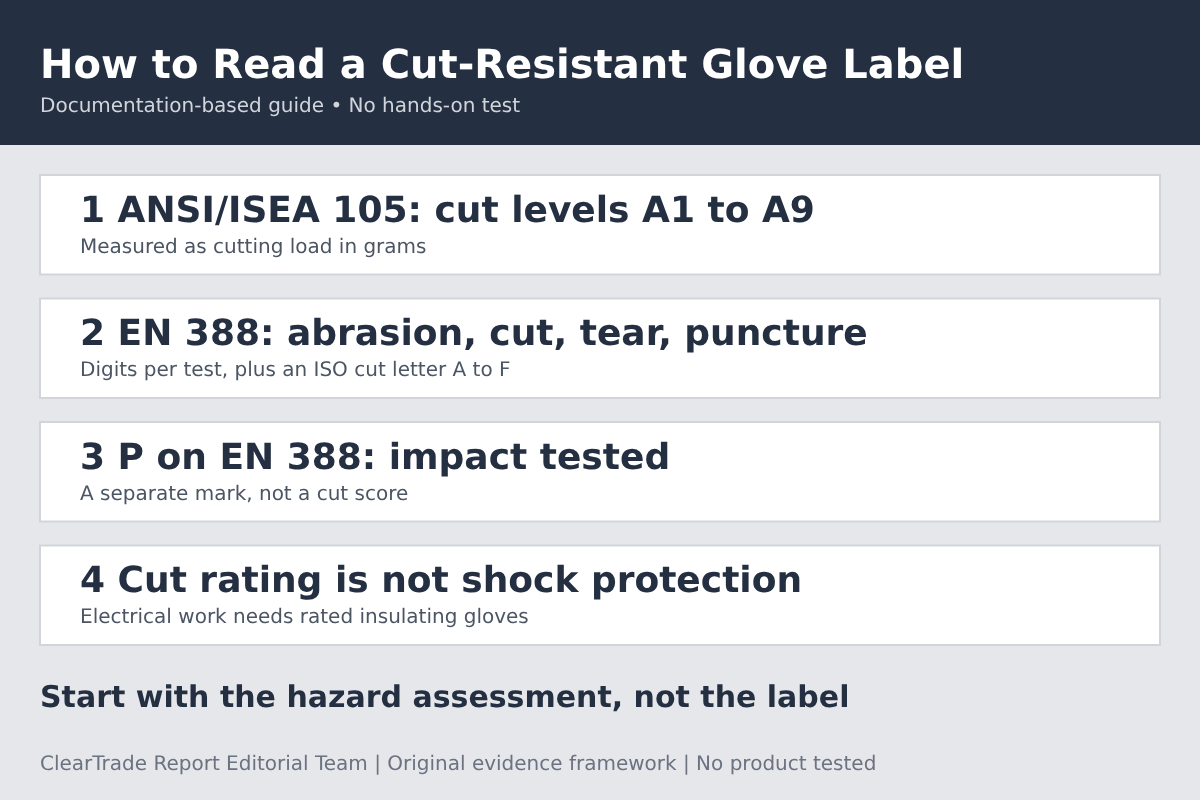
Pick hand protection from a written hazard assessment of the task, then use glove ratings to compare products against that hazard. An ANSI/ISEA 105 cut level (A1 to A9) and an EN 388 marking each report how a glove material did in specific laboratory tests, mostly against a straight, sharp blade. They do not cover serrated edges, saws or powered tools, and they say nothing about electrical shock. Work on or near energized parts calls for rubber insulating gloves under a different standard, ASTM D120, which OSHA addresses in 29 CFR 1910.137. OSHA’s general rule, 1910.138, asks employers to match glove performance to the task, the conditions, the duration of use and the hazards found.
Evidence label: Documentation-based guide. ClearTrade Report Editorial Team checked documents from the International Safety Equipment Association (ISEA), ASTM International, the Occupational Safety and Health Administration (OSHA), Ansell, HexArmor, Superior Glove and Milwaukee Tool on November 19, 2026. No outside professional review was performed and nothing was tested. Companies named are documentation examples, not recommendations. This guide contains no affiliate links.
What OSHA asks you to do before you pick a glove
The selection duty comes first, and it is task based. OSHA’s 29 CFR 1910.138 says “Employers shall select and require employees to use appropriate hand protection” when hands are exposed to hazards that include “severe cuts or lacerations; severe abrasions; punctures; chemical burns;” and “thermal burns; and harmful temperature extremes.”
Paragraph (b) sets how the choice is made. Selection must rest on “an evaluation of the” “performance characteristics of the hand protection relative to the task(s) to be performed,” plus “conditions present, duration of use, and the hazards and potential hazards identified.”
It builds on the PPE hazard assessment in 29 CFR 1910.132. Paragraph (d)(1) says “The employer shall assess the workplace” “to determine if hazards are present, or are likely to be present.” Paragraph (d)(2) calls for a written certification naming the “workplace evaluated,” the “person certifying,” and the “date(s) of the hazard assessment.”
OSHA’s nonmandatory Appendix B to Subpart I is blunt about the idea of one glove for every job: “OSHA is unaware of any gloves that provide protection against all potential hand hazards.”
ANSI/ISEA 105: cut levels A1 to A9
ANSI/ISEA 105 is the American National Standard for hand protection classification. ISEA’s hand protection page says the 2024 edition “Provides a comprehensive classification system for hand and arm protection, including gloves and sleeves.”
ISEA’s Key to Hand Classifications (November 2024) lists nine cut levels by the load, in grams-force (gf), needed to cut through the material. It starts with “Light cut hazards (200 gf)” at A1. The thresholds it lists are 200 gf (A1), 500 (A2), 1000 (A3), 1500 (A4), 2200 (A5), 3000 (A6), 4000 (A7), 5000 (A8) and 6000 (A9).
ISEA’s page adds: “Levels A4, A5, A6 protect against cuts for which stitches would be required.”
The test behind the A levels is a tomodynamometer, or TDM, method. We could not read the ISEA standard itself, so this point comes from a glove maker’s explanation. HexArmor’s guide to cut standards says “ANSI/ISEA 105-2024 establishes ASTM F2992/F2992M-15 as the official test method for measuring cut resistance.” It says “A straight razor blade is drawn across a glove material sample.”
ISEA’s announcement says it “does not make any major changes to test methods or levels of protection” and that “The big change is in product labeling.” On the new pentagon label, “The Cut rating symbol is in the top center,” and “An ‘X’ can be applied in place of a rating to indicate the classification was not tested or is not applicable.”
EN 388: four numbers, a letter and sometimes a P
EN 388 covers glove protection against mechanical hazards, and some gloves, such as the Ansell example below, carry both an EN 388 and an ANSI/ISEA 105 marking. We did not read EN 388 itself. Ansell’s EN 388 Guide explains the marking: the pictogram is “followed by four numbers (performance levels)” and then letters.
- Position a: abrasion resistance.
- Position b: blade cut, from the Coupe test, on a 1 to 5 scale. HexArmor describes it as a circular blade moving back and forth across the material.
- Position c: tear resistance.
- Position d: puncture resistance.
- Position e: the EN ISO cut letter. Ansell says “The EN ISO cut test is rated from A to F, with F being the highest level of cut resistance,” with thresholds of 2, 5, 10, 15, 22 and 30 newtons for A through F.
- Position f: impact. Ansell says “A letter ‘P’ in the sixth position is for gloves certified to provide impact protection.”
An X in position b is common on high-cut gloves. Ansell says X is used when “a dulling effect occurs during the Coupe test,” and in those cases it reports only the EN ISO cut result. HexArmor says that when dulling occurs, “EN 388 requires the ISO 13997 test to be used.” Superior Glove’s cut-resistant glove guide also names the letter test ISO 13997.
So “4X42B” on a glove, the example in Ansell’s marking guide, reads as abrasion 4, blade cut not reported, tear 4, puncture 2, EN ISO cut B and no impact claim.
In North America, ISEA says impact gloves fall under a separate standard, ANSI/ISEA 138-2019.
Why a rating is a lab result, not a promise
ASTM’s summary of F2992 says the method “assesses the cut resistance of a material when exposed to a cutting edge under specified loads.” ASTM says the test is “not representative of puncture, tear, or other modes of fabric failure,” and the summary notes that it does not reflect serrated edges, saw blades or motorized cutting tools. It also says “This procedure is not valid for high-porosity materials.”
Ansell’s guide to understanding cut standards says “No glove, regardless of rating, provides complete protection against cuts.” HexArmor says “Cut-resistant does not mean cut-proof” and “Testing is good to understand, but it’s not a 1:1 equivalent to the real world.”
Where on the glove matters too. Superior Glove says “Testing standards for cut resistance only require the palm of the gloves to be tested.” HexArmor says ratings come from “testing a specific sample area of the glove material.” If the hazard reaches the back of the hand or the wrist, ask what was tested.
The two systems do not line up neatly. HexArmor says the standards are “not directly interchangeable,” and notes that EN 388 tops out at F, which it treats as roughly equal to A6.
ISEA also warns that “not all puncture-resistant gloves protect against needle sticks.”
A cut rating says nothing about electrical shock
No cut, abrasion or puncture number tells you a glove insulates against voltage. A glove maker may list “electrical maintenance” among suggested uses for a cut level, as Superior Glove’s guide does under A4. That is a cut hazard suggestion, not an insulation rating.
Insulating gloves fall under OSHA’s 29 CFR 1910.137, Electrical Protective Equipment. It says “Rubber insulating equipment meeting the following national consensus standards is deemed to be in compliance,” and for gloves it lists “ASTM D120-09, Standard Specification for Rubber Insulating Gloves.”
These gloves are marked by class, for example “Class 00 equipment shall be marked Class 00.” OSHA’s Table I-4 sets maximum use voltages: 500 volts ac for Class 00 and 1,000 volts ac for Class 0. OSHA’s Table I-5 calls for testing gloves “Before first issue and every 6 months thereafter.” It also says “Protector gloves shall be worn over insulating gloves,” with limited exceptions.
OSHA’s 1910.132 also says “Paragraphs (d) and (f) of this section do not apply to §§ 1910.134 and 1910.137.” Electrical protective equipment has its own rules, so keep those records separate.
How to read a glove spec sheet and document the choice
A product page should name the edition and give the full code. Ansell’s HyFlex 11-542 product page is an example of the format. It lists EN 388:2016 +A1:2018 as “4X32F” and ANSI/ISEA 105-2024 as “4 3 A7,” and describes the glove as “EN ISO F/ANSI A7 hand protection.”
Shorter retail labels need a second look. Milwaukee Tool’s gloves page lists items such as “Milwaukee® Cut Level 3 Nitrile Dipped Gloves.” Before approving a product like that, ask for the full markings, the edition and the instructions for use.
| Marking | What it reports | Units or scale | What it does not tell you |
|---|---|---|---|
| ANSI/ISEA 105 cut, A1 to A9 | Load to cut through material with a straight blade on a TDM machine | Grams-force, 200 (A1) to 6000 (A9) per ISEA | Serrated, saw or powered tool cuts; areas of the glove not tested |
| EN 388 position b (Coupe) | Circular blade cut result | 1 to 5, or X | A result when the blade dulls during the test; X means not tested or not applicable |
| EN 388 position e (EN ISO cut) | Straight blade cut result, ISO 13997 | A to F, 2 to 30 newtons per Ansell | A direct match to an ANSI A level |
| EN 388 positions a, c, d and P | Abrasion, tear, puncture; P for impact | Performance levels; P present or absent | Needle-stick protection, per ISEA |
| ASTM D120 class (OSHA 1910.137) | Rubber insulating glove class | Class 00 to 4; Class 00 to 500 V ac | Cut resistance; needs protectors and periodic electrical tests |
For the selection file, keep these items together:
- The hazard assessment. The certified 1910.132(d) record for the job, with the hand hazards named.
- The task details. Blade type, materials, duration and conditions.
- The full markings. Standard, edition, every digit and letter.
- Gaps. Any X, any missing P, and which part of the glove the cut rating covers.
- Separate electrical records. Class, test dates and protector use for insulating gloves.
The same habit applies to other gear; see our guide to HEPA dust extractor selection evidence.
Know the limits of this guide
This guide reads published documents. We did not read the paid texts of ANSI/ISEA 105, EN 388, ISO 13997, ASTM F2992 or ASTM D120. Details of those tests come from ISEA pages, ASTM’s public summary and glove makers’ explanatory pages, and we say so where we use them. Nothing here was tested, and no glove is recommended. A listed rating applies to the edition named. Chemical, heat and cold hazards are not covered, and state plan or construction rules may also apply. Your safety professional decides what a given job needs.
Primary references checked November 19, 2026: OSHA, 29 CFR 1910.138 Hand protection; OSHA, 29 CFR 1910.132 General requirements; OSHA, 29 CFR 1910.137 Electrical Protective Equipment; OSHA, 1910 Subpart I Appendix B, Nonmandatory Compliance Guidelines for Hazard Assessment and Personal Protective Equipment Selection; ISEA, Hand Protection page; ISEA, Key to Hand Classifications (November 2024); ISEA, ISEA Announces Updated ANSI/ISEA 105 Hand Protection Standard; ASTM International, F2992 Standard Test Method for Measuring Cut Resistance of Materials Used in Protective Clothing with Tomodynamometer Test Equipment (store summary); Ansell, EN 388 Guide; Ansell, EN 388 Update: Glove Markings Guide; Ansell, Guide to Understanding Cut Standards; Ansell, HyFlex 11-542 product page; HexArmor, Safety gloves 101: The ultimate guide to cut resistance; Superior Glove, Everything You Need to Know About Cut Resistant Gloves; Milwaukee Tool, Gloves and Sleeves page.
Frequently asked questions
Does a high ANSI cut level make a glove safe for electrical work?
No. ANSI/ISEA 105 cut levels report cut resistance in a lab test. Work on or near energized parts calls for rubber insulating gloves, which OSHA 29 CFR 1910.137 ties to ASTM D120 and marks by class, such as Class 00 or Class 0.
What does an X mean in an EN 388 marking?
Ansell’s EN 388 guide says an X means not tested or not applicable. In EN 388 position b, the Coupe blade cut score, X often appears when the blade dulls during the test, and the EN ISO cut letter is reported instead.
Can I convert an EN 388 cut letter to an ANSI A level?
Not exactly. ANSI levels are in grams-force and EN ISO letters are in newtons, with different scales. HexArmor says the standards are not directly interchangeable, so compare ratings within the same standard where you can.
What does OSHA require when choosing work gloves?
OSHA 29 CFR 1910.138 says employers must select and require appropriate hand protection. Selection must be based on glove performance relative to the task, the conditions present, the duration of use and the hazards identified.
Disclaimer: This guide is general information based on standards bodies, government and manufacturer documents, not professional safety, legal or electrical advice for a specific job or product. Confirm hand protection choices with a qualified safety professional and your employer’s hazard assessment, and follow the glove maker’s instructions. Standards and regulations may change. AI tools assisted with drafting. ClearTrade Report Editorial Team checked the cited sources and edited this guide.
Need a qualified professional?
Trusted Pros uses visible license-verification states and never ranks paid listings above unpaid listings.