On this page
- Start with the charging need, not the largest charger
- Common charging settings change the electrical load
- Breaker space is not service capacity
- What the load calculation is doing
- Four possible outcomes
- Panel replacement and service upgrade are different
- What to gather before the site visit
- Questions to ask the electrician
- Frequently asked questions
- The bottom line
- An EV charger does not automatically require a panel or service upgrade.
- Spare breaker space does not prove that the service has enough capacity.
- Charging rate, equipment condition, local rules and listed load management all affect the recommendation.
Short answer: no—not automatically. An open breaker space is not proof that a home can support an EV charger, but a 100-amp service or a full-looking panel is not proof that it cannot. The decision comes from the charging rate the household needs, a load calculation, the condition and configuration of the electrical equipment, and the options allowed by the local authority.
That distinction matters because “panel upgrade” is often used for different projects. A panel replacement changes equipment. A service upgrade increases or redesigns the capacity supplied to the home. Some jobs require both. Many require neither.
Start with the charging need, not the largest charger
Home charging is usually an overnight task, not a race to reproduce a public fast-charging station in the garage. The useful question is: how much energy must the car recover between the time it is parked and the time it leaves again?
A driver with a short daily commute and ten hours of overnight parking may be well served by a lower charging current. Another household may need more because the vehicle travels farther, arrives late, leaves early or has limited access to charging elsewhere. The vehicle also sets a limit: installing an EVSE capable of more current does not make a vehicle accept more AC power than its onboard charger allows.
Common charging settings change the electrical load
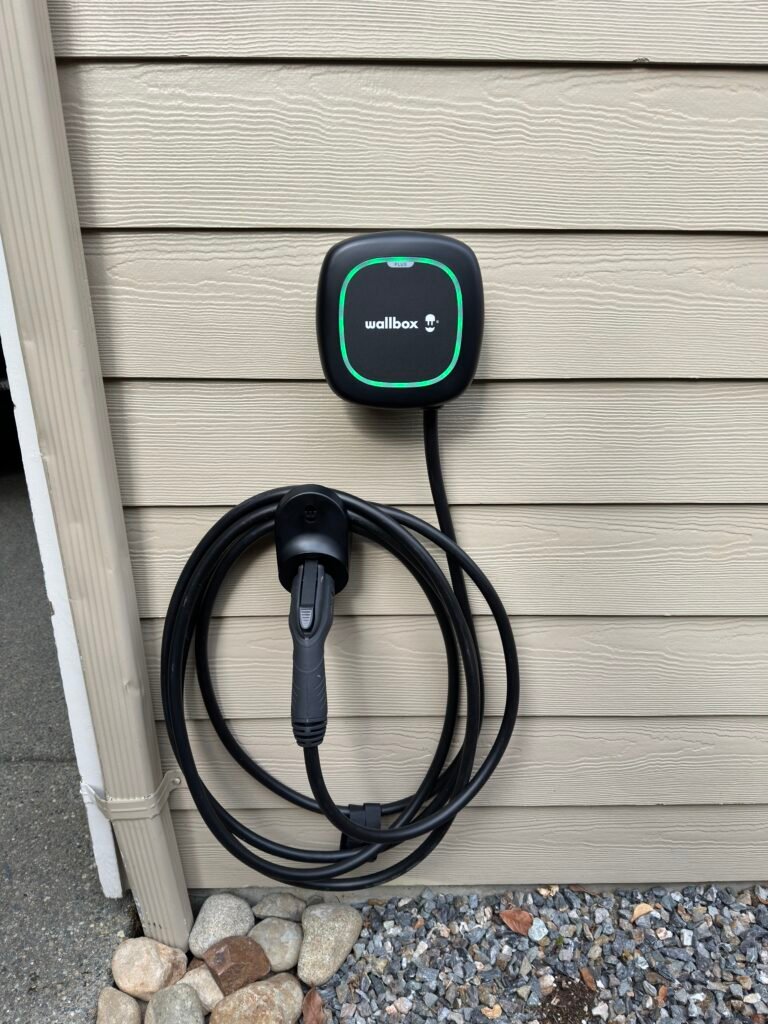
The figures below show approximate power at 240 volts. They are planning examples, not a circuit design for a specific home.
| EV charging current | Approximate power at 240 V | Common branch-circuit context |
|---|---|---|
| 16 A | 3.8 kW | Often paired with a 20 A circuit |
| 24 A | 5.8 kW | Often paired with a 30 A circuit |
| 32 A | 7.7 kW | Often paired with a 40 A circuit |
| 40 A | 9.6 kW | Often paired with a 50 A circuit |
| 48 A | 11.5 kW | Often paired with a 60 A circuit |
EV charging is treated as a continuous load under the National Electrical Code. The branch-circuit rating, conductors, terminations, EVSE instructions and local rules must all match. A licensed electrician should verify the exact design rather than treating the table as permission to select a breaker.
Breaker space is not service capacity
A spare position in a panel answers one narrow question: there may be physical room for a breaker. It does not answer whether the service can carry the added load.
The opposite mistake is also common. A panel with no open positions may still have sufficient calculated capacity. Depending on the equipment and local rules, a qualified electrician may have options that do not involve increasing service capacity. Physical space, bus rating, compatible breakers, conductor capacity and calculated load are separate checks.
What the load calculation is doing
A residential load calculation estimates the demand the service must be able to supply under the method required by the locally adopted electrical code. It considers the home and its major electrical loads rather than simply adding every breaker handle.
The inputs may include general lighting and receptacle load, cooking equipment, clothes drying, water heating, heating and cooling, EV charging, spas or saunas, and other fixed appliances. The permitted calculation method and demand factors depend on the home, the proposed work and the code edition in force.
That is why two homes with “100-amp service” can reach different answers. One may have gas space heat, gas water heat and modest electrical loads. Another may have electric resistance heat, an electric range, a dryer, a spa and future electrification plans.
Four possible outcomes
1. The existing equipment and service can support the selected rate
If the calculation passes, the equipment is suitable and the installation can be routed and permitted, the project may be a new branch circuit and EVSE installation—without replacing the panel or enlarging the service.
2. A lower charging rate meets the household’s real need
Reducing the EV charging current can materially change the added load. This is often the simplest answer when overnight dwell time is generous. The current must be established using the EVSE’s approved configuration method; choosing a lower value in a phone app is not automatically equivalent to an installer-set maximum recognized by the equipment instructions or code.
3. Listed load management may keep charging within a limit
Some listed systems monitor or control electrical load and reduce EV charging when other household demand is high. When the other loads fall, the system can allow charging to increase up to the commissioned limit.
This can help some homes avoid an increase in service capacity. It is not a universal loophole. The complete system must be appropriate for the installation, installed and commissioned to its instructions, and accepted under the locally adopted rules. Load management also does not repair damaged, corroded, overheated or otherwise unsuitable equipment.
4. Panel replacement, service work or both are justified
Equipment or service work may be appropriate when the existing equipment is damaged, improperly modified, incompatible with the proposed circuit, lacks a suitable connection arrangement, or does not have enough capacity after the available charging and control options are evaluated.
Future plans matter too. A homeowner adding an EV now and a heat pump, electric water heater or second EV soon may choose a larger coordinated project even if a narrower solution could serve today’s charger.
Panel replacement and service upgrade are different
A panel replacement changes a panelboard or service-equipment assembly. The service rating may remain the same.
A service upgrade changes the capacity or configuration of the service. It may involve the main disconnect, meter equipment, service conductors, utility coordination, grounding and bonding work, and a new panel—but the exact scope varies by property and utility.
A useful proposal should state:
- the existing and proposed service rating;
- which major components are being replaced;
- the EVSE output and branch-circuit rating;
- whether load management is included and how it is commissioned;
- who handles the permit, inspection and utility coordination;
- which future loads, if any, were included.
What to gather before the site visit
Do not remove the panel cover or enter energized equipment. Safe preparation usually includes:
- the EV make, model and model year;
- typical daily distance and overnight parking time;
- the exact EVSE model being considered;
- clear photographs of the outside of the panel, main disconnect and meter area;
- the panel directory;
- a list of major electric appliances and planned additions;
- the parking location and likely wiring route;
- the serving utility and permit jurisdiction.
Questions to ask the electrician
- What charging current are you designing for, and why?
- What load-calculation method applies to this home?
- Does the existing equipment have suitable capacity and condition?
- Would a lower charging current still meet the driving need?
- Is a listed load-management option appropriate and accepted here?
- Is the proposal a branch circuit, panel replacement, service upgrade or a combination?
- What assumptions should be revisited if the home adds another major electric load?
Frequently asked questions
Does a 200-amp panel label prove I have 200-amp service?
No. The panelboard rating is one part of the system. The main overcurrent device, service conductors, meter/service equipment and utility arrangement must be verified.
Does a 100-amp service automatically require an upgrade?
No. Existing loads, charging rate, equipment condition and permitted control options determine the result.
Is a 60-amp circuit required for Level 2 charging?
No. Level 2 charging covers a range of outputs. The vehicle’s needs, the EVSE, the home and the adopted rules determine the circuit.
Can load management replace a damaged panel?
No. Load management controls load. It does not correct damaged or unsuitable equipment.
Should I buy the charger before the electrician visits?
Usually it is safer to confirm the charging requirements and exact model with the installer first. The product’s wiring method, output, listing, controls and environmental rating can affect the design.
The bottom line
The correct answer is not “every EV needs a 200-amp service,” and it is not “an open breaker space means the job is fine.” A useful design starts with the driver’s charging need, proves the home’s capacity, checks the equipment condition and compares allowed alternatives. Upgrade only what the evidence supports.
Sources
- Home Charging — U.S. Department of Energy Alternative Fuels Data Center; accessed 2026-10-03.
- Solutions for Electrical Panel Constraints — U.S. Department of Energy / NREL; accessed 2026-10-03.
- Article 130 u2014 Energy Management Systems — UL Solutions; accessed 2026-10-03.
- 2026 NEC Key Changes — NFPA; accessed 2026-10-03.
- 50A Circuit Share Installation Instructions — simpleSwitch; accessed 2026-10-03.
- Dynamic Power Management — Tesla; accessed 2026-10-03.
Need a qualified professional?
Trusted Pros will use visible verification states and will not rank paid listings above other results.