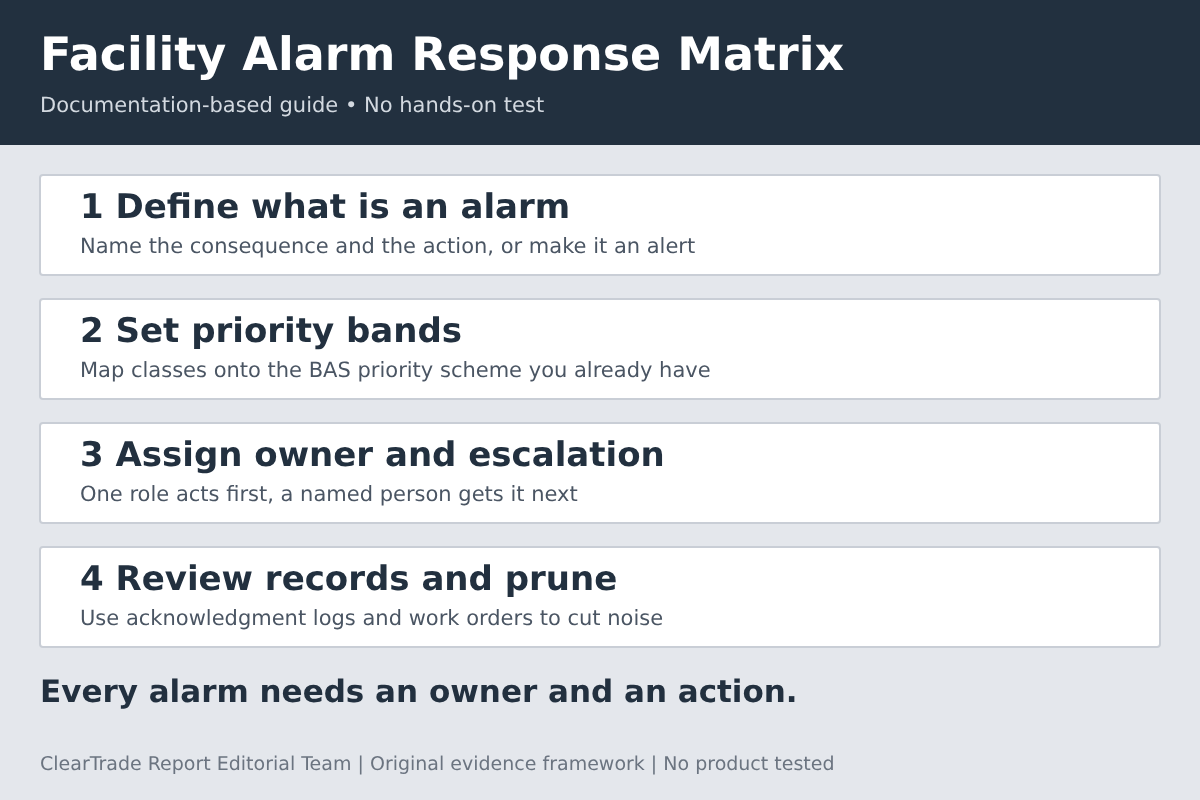
Before adding more building alerts, decide for each alarm class what the condition means, who owns it, how fast the facility expects a response, who gets it next if nobody acts, and what record proves it was handled. That decision record is a response matrix. Alarm management guidance from ISA and EEMUA treats these as deliberate choices, and the BAS alarm tools we checked give you places to record them. Without those choices, more alerts mostly add noise.
Evidence label: Documentation-based guide. ClearTrade Report Editorial Team checked International Society of Automation (ISA), EEMUA, Johnson Controls, Siemens, Tridium, Schneider Electric, U.S. General Services Administration (GSA), Pacific Northwest National Laboratory (PNNL), The Joint Commission and NFPA documents on November 11, 2026. No hands-on testing, site visit or outside professional review was performed. Organizations and products named below are documentation examples, not recommendations. This guide contains no affiliate links.
Why more alerts can make response worse
Alarm fatigue has been studied most closely in hospitals, so we use that work only as an analogy. The Joint Commission’s Sentinel Event Alert, Medical Device Alarm Safety in Hospitals (Issue 50, April 2013), names “Alarm fatigue” as “the most common contributing factor” among the factors behind alarm-related sentinel events, and says “clinicians become desensitized or immune to the sounds.” It describes harm from “a failure to respond to appropriate alarm signals in a timely manner.”
None of the sources we checked measure alarm fatigue in commercial buildings, but every alert added without an owner competes with the few that matter.
ISA’s InTech article Applying alarm management (January/February 2019) warns that “Basic alarm capabilities may not deliver the alarm to the person who needs to respond to it on the operating team.”
Write down what counts as an alarm before you add one
The ISA-18.2 approach starts with a written alarm philosophy. ISA’s 2016 InTech update, ISA18 alarm management standard updated, describes “activities grouped into the alarm management life cycle.” It says rationalization “encompasses several significant activities, including alarm justification, documentation, prioritization, and classification,” and that each alarm “is prioritized and classified according to the philosophy.”
ISA’s 2018 InTech item on the alarm philosophy technical report says alarm identification and rationalization are used “to determine the alarm set point, consequence, operator action, priority, and class.” Use that list as a checklist: if you cannot name the consequence and the action for a new building alert, it may not be an alarm.
ISA-18.2 also separates alarms from alerts. The 2019 InTech article says “ISA-18.2 defines alerts as notifications that share some of the characteristics of alarms,” and gives as examples notifications that “may not represent abnormal situations or may not require a timely response.”
EEMUA publishes a parallel guide, EEMUA 191. Its publisher page says alarm systems “provide vital support to the operators by warning them of situations that need their attention.” Both ISA-18.2 and EEMUA 191 were written for industrial process operations, not buildings, but they treat alarm handling as a managed process.
Use the priority scheme your BAS already has
The building automation systems we checked already rank or classify alarms. Johnson Controls’ Metasys UI help page on Alarm Priority says alarm priority numbers fall “within a range of” 0 to 255 and “Alarms with a lower priority number are of a higher importance.” Its sub-topics list four groups: Life Safety (priority 0 to 39), Property Safety (40 to 79), Supervisory and Trouble (80 to 139) and Other (140 to 255). It advises users to “Use a consistent priority scheme,” and notes “You can configure Remote Notifications to route alarms based on their priority.”
Siemens Desigo CC uses alarm classes and categories. Its Management Station Alarms help page says “The alarm class determines in which alarm category an alarm is displayed in the Summary bar.” A table on that page, “Alarm Class to Category Assignment in Default Profile,” maps classes to default categories that include Emergency, Life Safety, Security, Supervisory, Fault, Trouble and Status.
Map your matrix classes onto the bands or categories your system already has rather than inventing a new scale.
Give every alarm class an owner and a written response
A recipient is not an owner. An owner is a role expected to act, with a written first response. Desigo CC’s Event Handling help page says that when an operating procedure is configured for an event, assisted treatment offers a window that “provides a step-by-step checklist of actions you must complete for handling that situation.” It also says “At any given time, you can see which operators and stations are handling an event.”
The Desigo Event-Handling Commands page shows that acknowledge, silence, reset and close are separate actions with their own conditions. Your matrix should say which of those actions the owner may take and when. Acknowledging a leak alarm does not stop the leak.
Permissions are part of ownership. A Schneider Electric knowledge base article for EcoStruxure Building Operation, Prevent a user to acknowledge certain alarms?, says to make the alarm "read only" in the Software permissions for a user who should not acknowledge it.
Escalation: from screen to work order
Escalation needs a named next person, a channel and a time. The sources below show mechanisms only.
The Metasys Alarm and event management page in the system configuration guide says “The Alarm Manager and Alarm Monitor display all alarms pending acknowledgment and discarding.” Unacknowledged alarms are the natural trigger for escalation.
GSA’s National Operations and Maintenance Specification (March 2025 revision, per its change log) says contractor mobile devices must allow access to “Building Automation Systems (BAS) alarms,” and that “Work Orders may be generated automatically from interfaces to BAS, central communications service or diagnostic software.” The lesson for a private facility: an alarm that needs field work should end up as a tracked work order, not only as a cleared line on a screen.
Sample response matrix: alarm class, owner, response and evidence
The table below is a starting template. Every owner, response time target and escalation step in it is an example the facility must replace with its own decisions. None of the sources we checked set these targets for commercial building alarms.
| Alarm class | Example | Owner | Response time target (set by the facility) | Escalation | Evidence to keep |
|---|---|---|---|---|---|
| Life safety interface | Fire alarm status mirrored in the BAS | Per fire alarm plan | Set by code and the AHJ | Per fire alarm plan | Confirm the BAS point maps correctly |
| Property damage risk | Leak sensor, freeze stat trip, server room high temperature | On-shift or on-call technician | Facility sets a short target | Facilities manager, then a named contractor | Acknowledge time, responder, action, work order, photos |
| Equipment failure or loss of conditioning | Air handler or chiller failure, zone far off setpoint | HVAC technician on shift | Facility sets by space use and season | Facilities supervisor | Alarm history, trend, work order, cause |
| Security or access trouble | Door forced or held open, reader offline | Security desk | Facility and security team set | Security manager | Access log entry, response notes |
| Supervisory or communication trouble | Controller offline, sensor out of range | Controls technician | Often next business day (local choice) | Controls contractor ticket | Device, time offline, fix, recurrence |
| Maintenance or alert (not an alarm) | Filter pressure high, runtime hours reached | Maintenance planner | Scheduled work order | Weekly maintenance review | Work order completion |
This table is our editorial example built from the alarm management process the cited documents describe. It is not a code, standard or manufacturer requirement, and its targets are placeholders for the facility’s own choices.
Evidence to keep, and how to use it to prune alarms
ISA’s 2016 update says “Monitoring, assessment, and audit are essential to achieving and maintaining the performance objectives” of an alarm system.
Desigo CC’s Event Handling page says entries are recorded for “Operator’s activities relating to event handling” “(for example, initiating/suspending event handling, acknowledging/resetting an event, and so on),” available in an Activity Log report. Tridium’s Niagara 4.11 Archive Alarm Provider Q&A (November 2021) says “The acknowledger of the alarm is tracked within the alarm record as the ‘user’ field.” With those records, a monthly review can answer four questions:
- Which alarms fired most often, and did anyone act on them?
- Which alarms were acknowledged but never produced a work order?
- Which high-priority alarms missed the facility’s own response target, and why?
- Which alerts should be removed, delayed, made state-based or turned into scheduled maintenance?
Trend data helps separate a real fault from a bad setpoint. PNNL’s Guides to Re-Tuning Measures say “These guides use examples to provide details on how to detect good (normal) and bad (abnormal) operations.” A repeating alarm may point to a control problem worth fixing rather than a limit to raise.
The Joint Commission’s approach offers a governance model by analogy. Its R3 report says “leaders establish alarm system safety as a hospital priority,” and calls for policies on “Who in the organization has the authority to set alarm parameters” and “Who in the organization has the authority to change alarm parameters.” A facility can name who may add, change or disable a building alarm, and log each change.
On new systems or retrofits, give the matrix to the commissioning team so alarm points, priorities and routing are verified. Our HVAC commissioning report checklist covers what that report should show.
Fire alarm signals are out of scope
This guide covers cross-system operational alerts: BAS, HVAC sensors, leak, temperature, and access or security trouble. It does not cover fire alarm system design, monitoring or response. NFPA’s product page for NFPA 72, National Fire Alarm and Signaling Code points readers to it for “fire alarm, emergency communications, mass notification, inspection, testing, and maintenance requirements.” Fire alarm signals follow the edition of the code adopted locally and the authority having jurisdiction (AHJ). If fire alarm points are mirrored in your BAS, list them only so operators know who is responsible under the fire alarm plan.
Know the limits of this guide
We did not visit a facility, configure a BAS or test any alarm. We read publisher and magazine summaries of ISA-18.2 and EEMUA 191, not the full standards, and we did not read IEC 62682, ASHRAE standards or guidelines, or the full NFPA 72. Vendor help pages are version-specific and may differ from your installed version. Response time targets are facility decisions; contracts, insurers, codes or the AHJ may impose their own.
Primary references checked November 11, 2026: ISA InTech (2016, 2018, 2019); EEMUA 191 publisher page; Johnson Controls Metasys help (7.0.50 and 12.0); Siemens Desigo CC help; Tridium Niagara 4.11 Q&A (2021); Schneider Electric knowledge base; GSA National Operations and Maintenance Specification (March 2025); PNNL re-tuning guides; The Joint Commission Sentinel Event Alert Issue 50 and R3 Report Issue 5 (2013); NFPA 72 product page. Each is linked where it is cited above.
Frequently asked questions
What is alarm fatigue in a building automation system?
It is the facility version of a problem The Joint Commission describes in hospitals, where staff become desensitized to alarm sounds and miss or delay a response. In a BAS it shows up as operators acknowledging or ignoring a stream of low-value alerts. The fix starts with deciding which conditions need a timely response and who owns each one.
Do standards set response times for HVAC or leak alarms?
None of the sources checked for this guide set a response time for HVAC, leak or temperature alarms in ordinary commercial buildings. ISA’s summaries of ISA-18.2 describe a process in which the alarm philosophy and rationalization set priority and operator action. Response time targets in a matrix are the facility’s own choices unless a contract, code or authority having jurisdiction sets them.
What is the difference between an alarm and an alert?
ISA’s InTech magazine says ISA-18.2 defines alerts as notifications that share some characteristics of alarms but may not represent abnormal situations or may not require a timely response. If nobody is expected to act on it within a set time, it is probably not an alarm.
Should fire alarm signals go in the same response matrix?
No. Signals from a fire alarm system follow NFPA 72 as adopted locally and the authority having jurisdiction. A facility matrix can note that those signals exist and who receives them, but this guide does not cover how they must be designed, monitored or answered.
Disclaimer: This guide is general information based on standards body, manufacturer, government and accreditation documents, not professional engineering, fire protection, security or legal advice for a specific building. Alarm priorities, owners and response targets are decisions for each facility, and codes, contracts and the authority having jurisdiction may set additional requirements. AI tools assisted with drafting. ClearTrade Report Editorial Team checked the cited sources and edited this guide.
Need a qualified professional?
Trusted Pros uses visible license-verification states and never ranks paid listings above unpaid listings.