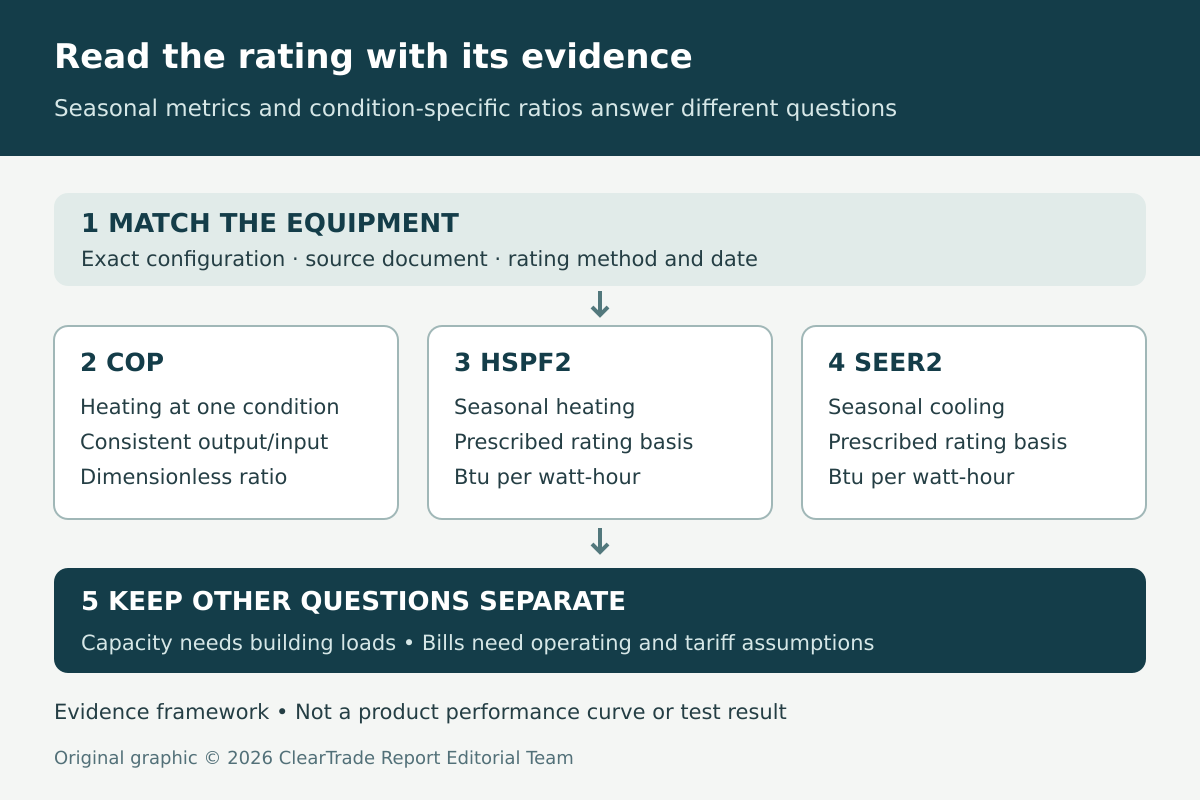
COP describes heating efficiency at a stated operating condition. HSPF2 describes seasonal heating performance under a prescribed rating method; SEER2 describes seasonal cooling performance. They answer different questions. A useful comparison identifies the exact equipment combination, the rating method and the conditions behind each number before drawing a conclusion.
This reference concerns residential air-source heat-pump rating evidence. It does not select equipment size, predict a household's bills or certify an installation. No heat pump was tested by ClearTrade for this article, and no named model is recommended.
Start with the metric, mode and units
ENERGY STAR's heat-pump criteria defines heating COP as a dimensionless ratio at one set of operating conditions. It defines HSPF2 using seasonal heating and electrical energy, with the stated Region IV basis, and SEER2 using seasonal cooling and electrical energy. HSPF2 and SEER2 are expressed in Btu per watt-hour, not the dimensionless units of COP.
Write the units beside the value. A column labeled only “efficiency” conceals whether it describes heating, cooling, a season or a particular test condition. A larger number is useful only after the numbers being compared represent the same thing.
| Metric | What it describes | Question to ask with the value |
|---|---|---|
| Heating COP | Heating output divided by electrical input at a stated condition, using consistent units | Which temperatures, operating point and input boundary apply? |
| HSPF2 | Seasonal heating performance under its rating procedure | Which region and procedure apply to this exact system? |
| SEER2 | Seasonal cooling performance under its rating procedure | Is this the certified value for the proposed combination? |
| EER2 | Cooling efficiency at the specified rating conditions | Are both values based on the same condition and method? |
Do not compare a heating COP of 3 with an HSPF2 value of 9 as though one system were three times as efficient. Different units and a different time basis prevent that reading. Likewise, the heating and cooling ratings of the same machine are not competing scores for one task.
Read COP as a condition-specific ratio
For a separate reference to the COP terminology, see the ENERGY STAR definitions glossary. This article uses its metric definition, not its historical tax-credit guidance.
For a simple arithmetic illustration, suppose a hypothetical heating data point reports 6 kW of heat delivered and 2 kW of electrical input on the same basis. Heating COP is 6 divided by 2, or 3. The numbers are invented to demonstrate the calculation; they are not a measured product result or an expected operating value.
A second hypothetical point reports 4 kW of heating output and 2 kW input, giving COP 2. That point has both lower output and a lower ratio. The arithmetic alone does not tell you whether the points describe different outdoor temperatures, different compressor operation or different equipment. Keep those labels with the values.
Ask the provider for the source row or report, the outdoor and indoor conditions, the stated operating level, heating output and input power. Confirm that output and input belong to the same point. Dividing an attractive maximum capacity from one row by a low input from another row creates a number the source never reported.
Also ask what the input includes. If a table distinguishes equipment input, fan power or another system boundary, retain that qualification. Do not silently treat unlike boundaries as equivalent. The useful deliverable is a traceable calculation or published COP value with its conditions, not a ratio detached from its footnotes.
Keep seasonal ratings separate from one cold-day data point
HSPF2 and SEER2 summarize performance through their prescribed seasonal methods. They are not a photograph of the machine at one outdoor temperature. A single low-temperature COP value therefore cannot replace the seasonal heating rating, and a seasonal label does not supply every performance point a designer may need.
The Department of Energy's residential heat-pump acquisition guidance explains that the testing and naming transition introduced HSPF2 and SEER2 in 2023. Its published purchasing examples also state their climate, usage, price and calculation assumptions. Those examples are not a quote for the reader's home or a current ranking of all available equipment.
If one bid includes only seasonal ratings and another includes extended data, request equivalent evidence rather than assuming the longer packet means better equipment. Put the seasonal comparison in one part of the worksheet and the condition-specific comparison in another. Mark unavailable data as unavailable.
Ask a provider making a local performance claim to identify how the source supports it. “Higher HSPF2” is an efficiency-rating statement. “Will meet this home's heating demand at the selected design temperature” is a different claim requiring the building and equipment evidence discussed below.
Preserve the rating generation and test-method label
Retain the numeral 2 in SEER2, HSPF2 and EER2. ENERGY STAR's definitions distinguish Appendix M1 representations from the older Appendix M metrics. Do not strip the suffix to make a comparison table look simpler, or apply an undocumented universal conversion to older labels.
DOE's current central air-conditioner and heat-pump page describes amendments to Appendix M1 incorporating AHRI 210/240-2024, as well as a separate Appendix M2 procedure with SCORE and SHORE metrics. The page distinguishes those newer metrics from the present SEER2/HSPF2 framework and ties their required use to applicable compliance requirements. This article does not determine a manufacturer's enforcement obligations or a particular product's regulatory status.
For a proposal, keep the certificate date, reference number and metric names as shown. If two documents disagree, ask the provider which document controls the proposed equipment and why. Do not select the higher number from an older brochure while retaining the newer document's model description.
Equipment substitution deserves the same check. A revised indoor unit or other configuration change should come with the evidence for the revised combination. Treat a change note as a request to reconcile the packet, not permission to carry forward every prior rating unchanged.
Match the proposal to the performance record
AHRI's directory guidance identifies its public directory as a route for finding certified product-performance information by product line, ratings or brand. Use the actual directory record and certificate for the proposed system; a brand logo in a sales document is not that record.
Ask the bidder to identify the outdoor unit and indoor equipment exactly as quoted, along with the reference number used for the ratings. Keep suffixes, configuration descriptions and applicable notes. If the proposal contains several zones or options, ask which document corresponds to each option rather than treating a family brochure as an exact match.
Check whether the same identity appears in the equipment schedule, certificate and supporting performance tables. Resolve differences before using the numbers to compare bids. This is a document-matching workflow, not an assertion that ClearTrade has performed an interactive directory lookup for any named model.
The record should also show when the information was retrieved. Save the actual certificate or report with the proposal so a later reviewer can see what supported the decision. A link to a general search page is helpful for discovery but does not preserve the specific result used.
Ask for performance data at comparable conditions
PNNL's cold-climate sizing and selection guide explains why manufacturer extended-performance data matters at design conditions and distinguishes minimum and maximum capacity across temperatures. This article uses that distinction to organize evidence; it does not perform the guide's sizing process or select a design temperature.
Have the responsible designer identify the relevant conditions and provide the corresponding manufacturer data. For each point, retain the temperature, operating level, capacity, electrical input or reported COP, and the table notes. Ask whether the value is directly reported, interpolated or otherwise estimated, and keep the method with the result.
NEEP's cold-climate product-list page provides another route to performance information and states its specification versions. At this check it lists Version 4.0 as current and Version 5.0 as in development. A resource's eligibility criteria and the data available for one product are separate questions; this guide does not infer an exact model's listing or incentive eligibility.
Avoid mixing a maximum-output point for one system with a different operating level for another and calling the result a like-for-like comparison. If equivalent points are not available, retain the gap and ask the designer how it affects the decision. Missing evidence should not become an assumed advantage.
Keep efficiency, capacity and cost in separate columns
Capacity states how much heating or cooling output is available at the described condition. Efficiency describes output relative to input. A high ratio by itself does not establish enough output for a building, and a large output number by itself does not establish low energy use.
Our heat-pump sizing proposal checklist covers the building-load and selection documents. Keep those documents alongside the rating comparison. Do not turn this rating reference into a square-footage sizing rule or use a seasonal score to approve tonnage.
Cost needs another set of assumptions. If a proposal includes a bill forecast, ask for the modeled loads, weather assumptions, operating strategy, backup-heating treatment, electricity tariff, period and exclusions. Keep the calculation separate from the certified rating. A forecast can be useful while still depending on assumptions that differ between bids.
For a purely hypothetical seasonal comparison, 12 units of useful output per input unit requires less input than 9 units per input unit when the useful output and all other assumptions are identical. The input ratio is 9 divided by 12, or 0.75. That is an arithmetic illustration, not a claim that changing a label will cut a real home's bill by 25 percent. It supplies none of the building or operating inputs needed for that prediction.
Use a comparison packet that keeps qualifications visible
The following is ClearTrade's original evidence checklist. Complete it for each proposed configuration, keep the supporting documents attached and leave unknowns visible. It is not a performance test or an installation acceptance certificate.
| Packet item | Record to request |
|---|---|
| Equipment identity | Exact outdoor and indoor models and configuration |
| Seasonal ratings | Metric names, values, units, region where applicable and source |
| Certificate | Reference number, retrieved date and exact system record |
| Point performance | Conditions, operating level, capacity, input and COP basis |
| Data limitations | Missing points, estimates, assumptions and source footnotes |
| Building selection | Separate load and equipment-selection documents |
| Cost forecast | Separate tariff, weather, operating and backup assumptions |
When proposals use different formats, ask each provider to answer the same questions rather than reformatting uncertain data into a false match. A short note explaining a missing input is more useful than an apparently complete table that silently combines incompatible ratings.
Retain the final equipment schedule and any substitutions with the comparison. At handover, ask the provider to reconcile what was installed with the final proposal documents. This is a record check; it does not establish measured operating efficiency, commissioning results or regulatory compliance.
Frequently asked questions
Is a COP of 3 the same kind of number as HSPF2 of 9?
No. Heating COP is dimensionless and applies to a stated operating condition. HSPF2 is a seasonal heating metric expressed in Btu per watt-hour under its rating method. Keep units, conditions and time basis with each value.
Does the highest SEER2 establish the best heating performance?
No. SEER2 describes seasonal cooling. Review the seasonal heating rating and relevant heating performance data separately, using the exact proposed equipment combination and comparable conditions.
Can an older SEER value be compared directly with SEER2?
Keep the rating generation and test-method labels intact. Ask for comparable source documentation rather than stripping the suffix or assuming a universal conversion between the older and newer metrics.
Does this comparison predict my annual electricity bill?
No. A bill forecast needs building, weather, operation and tariff assumptions beyond the rating. Ask the provider to document those assumptions and keep the forecast separate from certified and condition-specific performance data.
Sources and editorial method
Primary references checked October 28, 2026: ENERGY STAR metric definitions; DOE acquisition and current test-procedure guidance; AHRI directory guidance; PNNL's extended-performance discussion; and NEEP's specification/product-list page. DOE's acquisition guidance states a December 2024 update; its example savings are not reused as current market results. NEEP's historical HSPF background is not asserted as a description of every current HSPF2 test.
This is source-led explanation and an original comparison framework. No named certificate, manufacturer model, performance map, recall clearance, rebate eligibility or installed system was verified. The numerical examples are hypothetical arithmetic, not measured results. No outside professional review or ClearTrade hands-on test is claimed.
AI tools assisted research organization and drafting. ClearTrade Report Editorial Team is responsible for the article. The original graphic is an evidence framework, not a product performance curve or laboratory result.
Need a qualified professional?
Trusted Pros uses visible license-verification states and never ranks paid listings above unpaid listings.