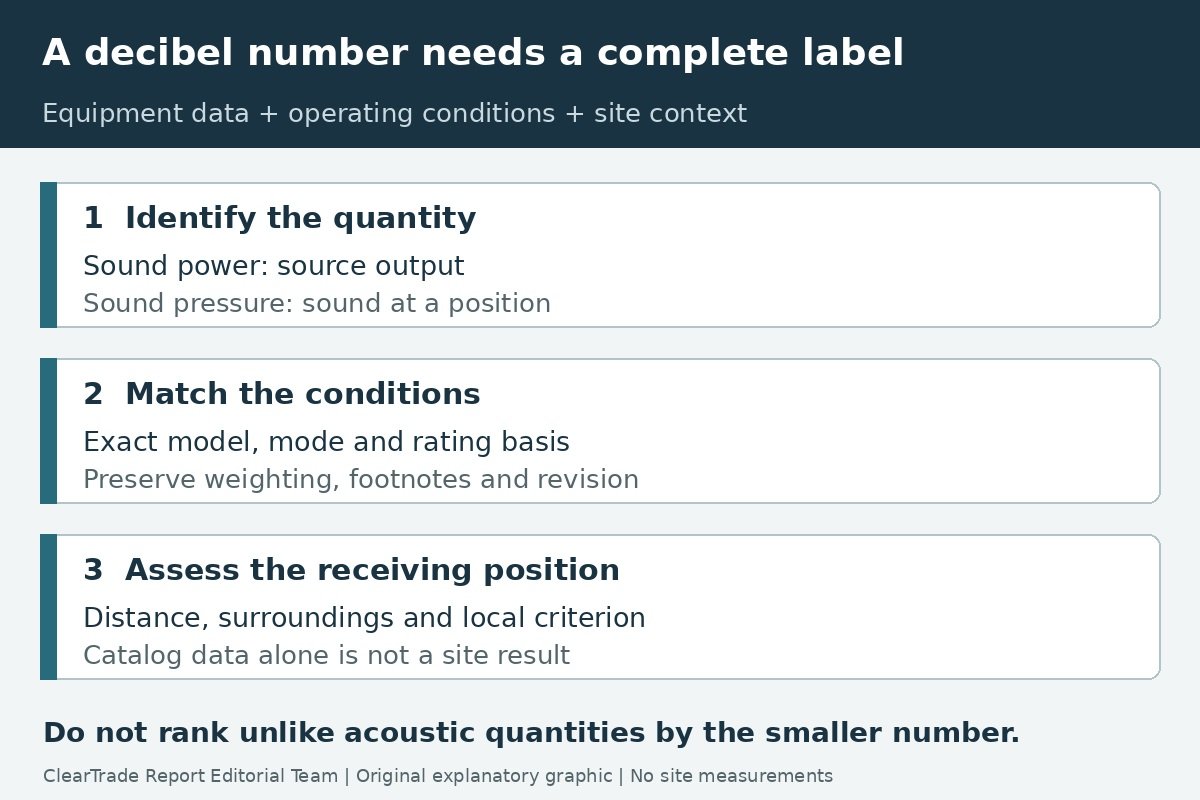
A heat pump’s decibel number is useful only when you know what it measures, how the equipment was operating and where the value applies. Sound power describes a source’s acoustic output; sound pressure describes sound at a position. Both can be expressed in decibels, but they are different quantities. Do not rank two units by unlabeled numbers or treat a laboratory value as the sound level at a bedroom window.
This explainer helps homeowners and neighbors organize acoustic evidence before equipment selection or a noise investigation. It is documentation-based reporting, not a measured comparison of heat pumps. No ClearTrade sound test or site assessment was performed.
Start with the complete label
Copy the number together with its heading, unit, footnotes, model and document revision. Keep the surrounding page. A sales summary reading “as low as” may omit the operating condition that produced the number. Ask for the original acoustic table or report rather than filling the gap with a guess.
AHRI Standard 270-2025 covers sound-performance ratings for outdoor unitary equipment within its stated scope. Its definitions distinguish sound power level, Lw, from sound pressure level, Lp. Its rating provisions distinguish standard conditions and application conditions. A reference to a standard needs the applicable edition and conditions; it is not evidence that a particular installation meets a local noise rule.
When asking a provider about a number, use a specific question: “Is this sound power or sound pressure, with what frequency weighting, at what operating condition, and from which document?” If those fields cannot be supplied, mark the comparison incomplete.
Separate source output from the receiving position
The FHWA Noise Measurement Handbook defines sound power as acoustic energy radiated per unit time and sound pressure as a pressure variation at a point. The handbook concerns transportation noise, but these physical distinctions help explain why an equipment source rating and a receiver measurement are not interchangeable.
A sound-power rating is not a value measured “at the fence.” A sound-pressure value needs a stated position and measurement conditions. The sound reaching a particular place depends on the source, the path between source and receiver, and the surrounding environment. Preserve that distinction in a proposal: source data, prediction assumptions and a measured site result are separate evidence.
The A in an A-weighted value describes frequency weighting. It does not identify whether the quantity is power or pressure. FHWA also distinguishes an equivalent level over a stated period from a maximum level during an event. A number without its descriptor or observation period can leave out information needed for a valid comparison.
A manufacturer example shows why the footnotes matter
Daikin’s RXTA-AAVJU Engineering Data, EDUS332501-D, cover identifier 202501, lists separate reference-data sound-pressure and sound-power values. For RXTA24AAVJU cooling, the specification page labels sound pressure as 56 dBA and sound power as 74 dB. Preserve those labels rather than relabeling both as the same measurement.
Its printed page 24 identifies cooling sound-reference data for RXTA24–48AAVJU, an anechoic chamber, operating conditions and a microphone diagram showing 1 m horizontally and 1.5 m vertically. The note warns that actual installation conditions can produce higher values because of environmental noise and reflection.
These are two published descriptions of the same product context, not competing “quietness scores.” The example illustrates document reading only. It is not a product recommendation, certification audit, recall clearance or a claim that every unit or operating mode has those values. Confirm the exact current selection and applicable documentation with the provider.
Match operating conditions before comparing equipment
Ask which modes the acoustic information represents: heating, cooling, a stated capacity or speed, a selected quiet setting, or another condition. A value for one mode does not automatically answer what happens during another. Keep the exact manufacturer wording and identify which expected operating conditions remain undocumented.
AHRI 270-2025 identifies published sound-power ratings at specified operating conditions and allows additional data for fan-only operation. This is one reason a fan-only value must not silently stand in for a complete operating unit. Request the supporting report when a proposal depends on a claimed rating basis.
If a quiet setting is proposed, ask how it is enabled, when it applies and what the manufacturer says about equipment operation in that setting. Do not assume it is always active or that its acoustic number represents unrestricted operation. Have the provider resolve any interaction with the required heating or cooling service.
Acoustic evidence complements the heat pump sizing proposal checklist. Capacity selection and sound evidence answer different questions; neither is a substitute for the other.
Use an acoustic comparison worksheet
For each proposed unit, retain these fields. A missing field is a question to resolve, not permission to select whichever figure looks smallest.
| Evidence field | What to retain | Question for the provider |
|---|---|---|
| Exact equipment identity | Outdoor model, configuration and document revision | Does this page apply to the quoted unit? |
| Acoustic quantity | Power or pressure; exact published label and unit | Are the two proposals reporting the same quantity? |
| Frequency information | Weighting and any available band data | Is the overall value sufficient for the question being assessed? |
| Operating condition | Mode, rating condition and stated setting | Does it represent the operation expected at this site? |
| Pressure measurement position | Distance, height, direction and acoustic environment | Where does the reported value actually apply? |
| Proposed site | Drawing, relevant surfaces and receiving positions | How will source data be translated into a site assessment? |
| Applicable criterion | Current jurisdiction, descriptor, time period and assessment position | What evidence is required to demonstrate compliance? |
| Verification plan | Responsible person, method and acceptance record | What will be checked after installation? |
For a simple document exercise, imagine one quote says “65 dB sound power” and another says “45 dBA sound pressure at a specified position.” Those invented labels do not establish that the second heat pump is 20 dB quieter. The quantities, weighting and context have not been matched. Obtain comparable source data or a properly stated site assessment before drawing a ranking.
Likewise, two pressure values recorded at different distances cannot simply be ordered as if the positions were identical. Do not insert a generic distance correction into a project decision without verifying that the underlying propagation assumptions fit the site.
Review the installation context with the designer
Provide a drawing showing the proposed outdoor unit and the positions of concern. Identify walls, corners, nearby equipment, windows and property boundaries relevant to the assessment. Have the designer address the acoustic path as well as the equipment’s required airflow, clearances and service access.
Ask what assumptions the prediction makes about reflecting surfaces, screening and other sound sources. If a barrier or enclosure is suggested, request a design compatible with the equipment and its manufacturer requirements. Do not promise a reduction from an improvised screen, or trade required operating space for an unsupported acoustic claim.
For a concern heard indoors, identify the room and when it occurs. A provider may need to investigate paths and conditions beyond a single outdoor overall number. Describe what you hear and the operating circumstances rather than diagnosing its mechanism from a recording alone.
Before agreeing to a solution, ask for a written explanation connecting the proposed change to the identified issue. “Quieter unit,” “add a barrier” and “change the mount” describe different interventions; the evidence should show why the proposed intervention addresses the actual concern.
Confirm the local assessment rules
Use the current authority for the installation address. Record the relevant assessment position, time period, acoustic descriptor and any applicable treatment of particular sound characteristics. Request the actual reference and revision date. A nearby city’s rule, a foreign planning calculator or an occupational exposure value is not automatically the criterion for this property.
As one routing example, Washington’s Department of Ecology noise page directs noise-rule and enforcement questions to local government. It explains that local ordinances may apply and identifies state regulations used where a locality has not adopted its own ordinance. This is a Washington starting route, not a nationwide numerical limit or a determination about a specific installation.
Keep the acoustic and planning conclusions separate. An equipment rating alone does not establish a permit outcome, legal compliance or whether a neighbor’s concern has been resolved. Obtain a written project-specific assessment when the proposal depends on such a conclusion.
Keep a useful record of an existing concern
A short observation log makes a service request more useful. Record the date and time, where you were, the duration and character of the sound, the apparent operating state if known, and other audible sources. Do not enter private property or change equipment settings to obtain evidence.
| Observation | Useful detail |
|---|---|
| Receiving position | Room or accessible outdoor location; window state if relevant |
| Timing | Start, end, repetition and relation to observed operation |
| Sound description | Steady, intermittent, tonal, rattling or another plain description |
| Context | Weather observations and other audible equipment or activity |
| Requested response | Inspection, acoustic assessment or explanation of the proposed next step |
A phone recording can communicate the character and timing of a concern, but does not by itself demonstrate that the required measurement procedure was followed. For a formal measurement, have the responsible assessor identify the instrument, calibration, settings, positions, weather, background treatment and reporting method appropriate to the question. Preserve their report and limitations.
Frequently asked questions
Are sound power and sound pressure the same thing?
No. Sound power characterizes acoustic output from a source; sound pressure characterizes sound at a position. A comparison needs the quantity, conditions and measurement context.
Does dBA mean the number is sound pressure?
No. A-weighting describes frequency weighting. Read the stated acoustic quantity and supporting document instead of identifying it from the A alone.
Does a low catalog number prove the installation will meet local noise rules?
No. The applicable criterion, assessment position, operating conditions and site context must be addressed separately.
Can I rank heat pumps using the smallest number in each brochure?
Only after establishing that the figures are comparable. Match the quantity, weighting, operating condition and applicable test or prediction context; mark missing information as unresolved.
Sources and scope
Sources checked October 27, 2026: AHRI 270-2025 official landing page and linked standard; Daikin EDUS332501-D, specification and sound-reference pages; FHWA Noise Measurement Handbook, June 2018, terminology and reporting context; and Washington Ecology noise guidance. Selected primary-source sections were reviewed; direct automated access limitations are preserved in the source audit. No site measurements, equipment testing, individual certification or recall audit, installation diagnosis, legal determination or outside professional review is claimed.
AI tools assisted with drafting. ClearTrade Report Editorial Team checked the cited sources and edited this guide. No hands-on inspection or testing was performed.
Need a qualified professional?
Trusted Pros uses visible license-verification states and never ranks paid listings above unpaid listings.