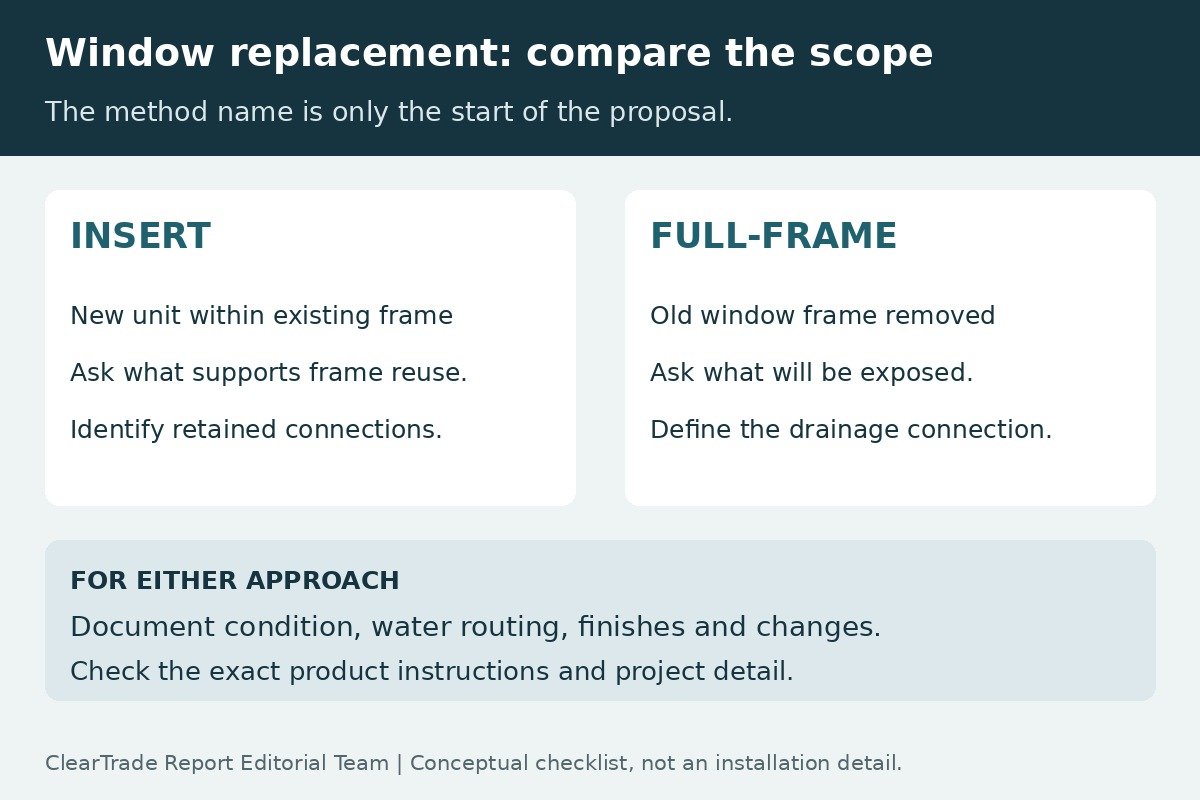
An insert replacement places a new window within an existing frame. A full-frame replacement removes the old window frame and installs a new unit at the opening. The decision is therefore about the condition and treatment of the surrounding assembly, as well as the window being purchased.
Before comparing prices, ask each bidder to identify what stays, what comes out and how the new installation connects to the wall’s water-management system. Two quotes for the same number of windows can cover substantially different work. A lower price is meaningful only after those differences are visible.
ClearTrade Report Editorial Team reviewed PNNL guidance and manufacturer documents for this source-led comparison. No property assessment, hands-on testing or outside professional review was performed. This guide helps readers compare scope; it does not choose an installation method for a particular opening.
Start with what each method retains
Marvin’s comparison of insert and full-frame replacement describes inserts as a way to retain an existing structurally sound frame and preserve trim. It notes that the light opening may be reduced. Full-frame work removes more of the existing assembly and gives the installer an opportunity to inspect and address damage around the opening.
Treat those descriptions as starting points for a written scope, not guarantees about every proposal. Ask which frame, sill, stops, trim, exterior casing and adjacent finishes are retained or replaced. Ask the contractor to identify the new unit and installation approach for each opening rather than using “replacement window” as the complete description.
For a mixed project, number the windows on a simple schedule. An upstairs bedroom, a fixed living-room window and a previously repaired opening may have different conditions. Ask whether the same method is proposed throughout and, if so, what assessment supports that choice.
Separate a new window from repair of the old opening
PNNL’s window-replacement checklist distinguishes installation within an existing frame from a full-frame scope that can address air gaps and flashing around the opening. It highlights the possibility that an existing frame was not originally air sealed behind the trim or equipped with pan flashing. Its full-frame checklist calls for integrating flashing with the wall’s weather-resistant barrier.
The practical question is what the contractor will actually reach and treat. If a proposal leaves the existing frame and surrounding wall layers in place, ask how their condition was assessed and which existing connections will remain unverified. A new unit does not, by its description alone, establish that concealed water-entry paths have been corrected.
Likewise, opening more of the assembly creates an opportunity for investigation; it is not proof that every defect will be found or repaired. The proposal should identify the inspection and repair scope, the limits of access and the process for additional findings.
Read the exact instructions behind the proposal
Manufacturer documents can make distinctions that a broad sales label misses. Marvin’s Full Frame Tear Out Installation Instructions, document 19971052 dated June 16, 2023, describe a particular replacement approach without removing exterior cladding. The document conditions that approach on an effective existing water-management system and the installer’s ability to integrate the new window with it. It also states that the illustrated procedure is one example and conditions can vary.
That example prevents an oversimplified assumption: “full-frame” does not necessarily tell you exactly how much siding a particular quote removes. Ask for the project-specific detail and the product instructions that support it. If the contractor plans to retain cladding, ask how the necessary connection will be made and documented.
This is a document-scope example, not an endorsement of a Marvin product or a direction to use that installation method. The cited date identifies the reviewed document; it is not a claim that the instructions apply to every current window or wall system.
Compare bids using the same questions
Use this original worksheet for each proposal. Record both an answer and its evidence. An unknown concealed condition should remain identified as unknown until it is investigated.
| Scope item | Insert proposal: ask about retained work | Full-frame proposal: ask about opened work |
|---|---|---|
| Existing frame | What condition assessment supports reuse? | Which frame components are removed and replaced? |
| Water management | Which existing connections remain in service? | How will the new unit connect to the wall drainage system? |
| Air sealing and insulation | Which gaps are accessible and included? | Which opening areas will be exposed and treated? |
| Opening and appearance | What light opening, frame profile and trim remain? | What opening dimensions, casing and finish changes are included? |
| Concealed damage | What triggers a change in the proposed method? | What investigation and repair are included before additional pricing? |
| Completion evidence | How will retained-condition limits be recorded? | What photographs and records will be made before concealment? |
Ask bidders to attach their assumptions to the window schedule. For example, a quote may assume a reusable frame at every opening. If an assessment has not established that assumption, request the decision process if one opening proves unsuitable. Do not compare that quote with one that already includes opening reconstruction as if the scopes were identical.
Keep product selection and installation scope linked in the records. A change in window model, frame configuration or method should trigger review of the relevant detail and price, rather than a silent substitution under an unchanged line item.
Check fit and appearance before ordering
Request the proposed unit dimensions, frame profile, visible glass area and interior and exterior finish treatment. Ask to see how the new frame will relate to the existing opening. Compare a drawing or documented measurement with the result you expect, rather than relying on the overall catalog size alone.
Marvin’s Narrow Frame and Insert Window Measuring Instruction, document 19970684 dated May 21, 2020, applies to specified Ultimate product types. It calls for inspecting the exterior for deterioration and contains product-specific measurement and sizing information. It illustrates why an allowance or deduction from one instruction should not become a universal homeowner ordering rule.
Have the responsible supplier and installer establish the correct order size using the applicable instructions. This article does not provide measurement deductions, opening tolerances or an ordering formula. Keep the approved schedule with the quote so a later delivery can be checked against the actual order.
If the project changes the opening size, operation or glass, ask the responsible team to confirm applicable permit, structural, safety-glazing and emergency-escape requirements. This national comparison does not determine which local rules apply or whether a particular opening complies.
Make finishes and concealed conditions part of the scope
Ask who will remove, protect, reinstall or replace interior trim, exterior trim, wall finishes and affected cladding. Identify painting, staining and matching work separately. “Trim included” is easier to assess when the proposal names the material, finish and extent.
For concealed conditions, request a clear stopping point: what will be photographed, who receives the finding, who proposes the remedy and who authorizes a change before work proceeds. Distinguish a fixed included repair from an allowance, a unit price or work excluded entirely. The article does not supply a regional cost estimate or a universal contingency percentage.
Ask how the opening will be protected during the work and how weather-sensitive tasks are sequenced. Where roofing or another wall transition is involved, coordinate the interfaces rather than leaving each trade to assume another will finish them. The roof-wall flashing repair guide explains a related water-routing problem; its details should not be substituted for a window-specific installation detail.
Ask what will demonstrate completion
Before work starts, agree on the completion records you expect: installed model identification, relevant instructions, progress photographs of accessible concealed work, the final window schedule and disposition of additional findings. Ask the installer to demonstrate normal operation and explain owner maintenance using the delivered documents.
If inspection or testing is part of the contracted scope, retain the method, conditions, results and limitations. Do not convert a limited observation into a blanket assurance that every concealed connection was examined. A signed checklist should identify the work actually performed, not just repeat the selected method’s name.
Keep product and installation warranty documents separately and ask who handles each type of service issue. This guide does not promise coverage, claim that a particular warranty is transferable or conclude that a manufacturer will pay for a future repair.
Sources and review scope
Sources checked October 27, 2026 Pacific: PNNL’s Home Improvement Expert window-replacement checklist; Marvin’s insert/full-frame overview; and the two dated Marvin documents linked above. The PNNL checklist references older standards and regulatory text; this article does not present those citations as current local law or reproduce their installation specifications.
Manufacturer examples are used to explain scope and conditions, not to rank brands or recommend a model. No product certification, recall status, availability, energy savings, payback or property suitability was established. No building photographs, condition report or project detail was supplied. The comparison worksheet and bid-review questions are original editorial aids.
Frequently asked questions
Can an insert replacement fix every problem around an old window?
No. Ask which existing frame and wall connections will remain, how their condition was assessed and what repair work is included. A new unit alone does not establish that concealed problems were corrected.
Does full-frame replacement always require removing all surrounding siding?
The name alone does not define the cladding scope. Ask for the applicable product instructions and project detail showing what is removed and how water-management connections are made.
Should every window in a house use the same replacement method?
Do not assume so. Ask for an opening-by-opening schedule with the condition assessment, proposed method and any exceptions identified.
What should I compare before choosing the cheaper bid?
Compare the product schedule, retained and removed components, water-management and air-sealing scope, finishes, concealed-damage procedure and completion evidence on the same basis.
AI tools assisted with drafting. ClearTrade Report Editorial Team checked the cited sources and edited this guide. No hands-on inspection or testing was performed.
Need a qualified professional?
Trusted Pros uses visible license-verification states and never ranks paid listings above unpaid listings.