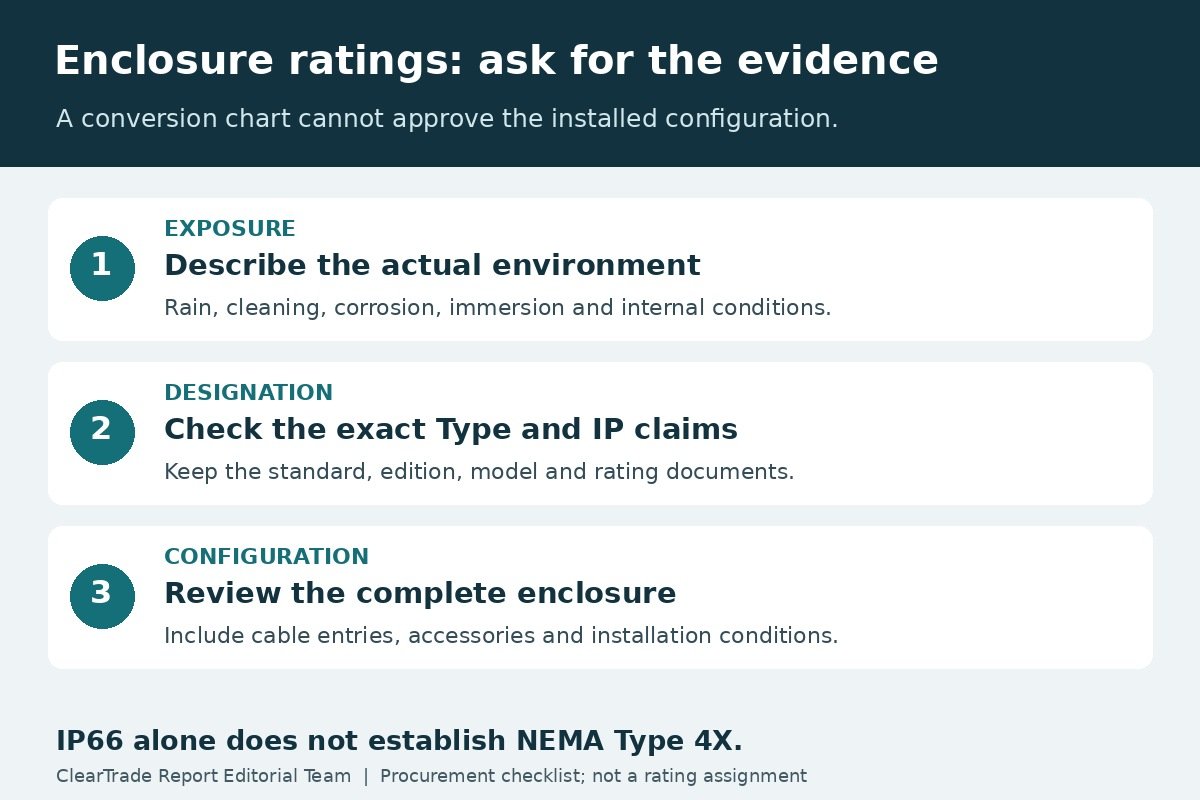
An IP rating and a NEMA enclosure Type describe different sets of protection requirements. A comparison chart can help you screen an enclosure, but it cannot turn an IP-only claim into a NEMA Type rating. Specify the exposure, then obtain documentation for the exact enclosure and installed configuration.
For example, IP66 alone does not establish Type 4X corrosion protection. And an immersion rating alone does not establish water-jet protection. Those distinctions matter when a purchasing decision changes from a sheltered utility room to a washdown area or a coastal installation.
This guide is for specifiers and facility managers comparing environmental-protection evidence in ordinary, nonhazardous applications. It does not select equipment for a classified location or certify an installation. ClearTrade Report Editorial Team reviewed public standards information and manufacturer documents; no enclosure testing or outside professional review was performed.
Read the designation before comparing the numbers
The IP code’s first numeral concerns access to hazardous parts and solid-object ingress; the second concerns harmful water ingress. IP66 therefore addresses dust-tight protection and powerful water jets under the applicable test conditions. A number is a defined test designation, not a promise that every form of moisture or contamination is excluded forever. Eaton’s enclosure reference explains the two numerals and illustrates common cross-references.
NEMA Types group environmental requirements differently. Type 4 includes hose-directed water protection; Type 4X adds corrosion protection. Type 3R addresses outdoor precipitation, while Type 3S includes operation of external mechanisms when ice laden. These are useful distinctions, rather than steps on a single better-to-worse ladder. See Schneider Electric’s Type descriptions, updated April 20, 2026.
Read the complete designation in the supplier’s document. Record its standard, edition, enclosure model, material and configuration. If the quotation says only “weatherproof,” ask the supplier to replace that adjective with the actual documented rating and its conditions. Keep the response with the approved submittal, rather than relying on a sales conversation.
Why the conversion works in only one direction
The NEMA enclosure-Type summary, approved November 2005 and based on NEMA 250-2003, explicitly limits its comparison table: it cannot convert IEC classifications into NEMA Types. The systems have different tests and additional environmental requirements. This older summary is useful for understanding the distinction; it is not the current full standard.
nVent HOFFMAN’s Technical Information, printed page 9, likewise explains that its Type-to-IP table cannot be reversed. Its discussion separates corrosion considerations from IP protection. Consequently, finding a box in a chart’s IP66 column does not establish that the box satisfies every requirement in a Type 4X specification.
Use a chart to generate a question for the supplier: “Does this exact enclosure meet the specified Type and IP requirements, in the configuration being supplied?” Do not use the chart to add a missing rating to a purchase order, nameplate or acceptance report. If both designations are required, request evidence for both. A supplier’s documented dual rating is more useful than an editor’s conversion.
Separate the exposure questions
The following is a purchasing checklist, not a rating-assignment table. It intentionally asks for evidence instead of declaring one enclosure suitable for every site in a category.
| Exposure or condition | What to ask for | What not to infer |
|---|---|---|
| Rain or windblown material | Exact outdoor designation, orientation and installation instructions | A sheltered-location approval applies anywhere outdoors |
| Hose cleaning | Documented jet or hose protection plus permitted cleaning conditions | A rain designation covers the cleaning method |
| Possible immersion | Stated immersion protection, depth, duration and installation conditions | A hose rating proves immersion performance |
| Salt or process chemicals | Material, finish and gasket compatibility for the identified exposure | IP66 alone establishes Type 4X or chemical compatibility |
| Cold-weather operation | Whether mechanisms must operate while iced, and documented operating conditions | Resistance to ice damage guarantees operation while iced |
| Condensation or internal heat | A separate moisture and thermal-management review | A high ingress rating controls the internal environment |
Write down the actual cleaning process: water temperature, nozzle use, chemicals, frequency and distance, where known. “Washed weekly” leaves too much unanswered. If those details are unknown, assign someone to obtain them before approving a substitution. The resulting specification should identify the project’s requirements, rather than make the enclosure vendor guess what “industrial duty” means.
Jets and immersion are different questions
The historical NEMA summary explains that a second IP numeral of 7 or 8 alone does not establish compliance with the jet tests for numerals 5 or 6; dual coding addresses the separate exposures. Do not read IP67 as an automatic upgrade from IP66 for a room cleaned with jets.
For an immersion application, obtain the actual product’s depth and duration limits. Do not convert a catalog’s short description of IP68 into permission for indefinite submersion at any depth. If the same enclosure also encounters cleaning jets, ask for that evidence separately. Record the conditions in the same approval document so that the maintenance team can see what was purchased.
The IEC catalog identifies IEC 60529 edition 2.2 as the 1989 standard consolidated with the 1999 and 2013 amendments and listed corrigenda. Its public scope covers enclosure protection classifications for electrical equipment up to 72.5 kV. This guide reviewed that public catalog information, not a purchased full copy of the standard; it does not reproduce test procedures or offer a compliance assessment.
Verify the installed configuration
An enclosure submittal should identify the openings and accessories as well as the empty box. nVent’s Enclosure Alterations instructions, P/N 99401677, Rev. E, copyright 2019, call for agency Type-rated hubs or devices matching the enclosure rating, installation to manufacturer instructions, and spacing that avoids interference with edges or gaskets. They also qualify alterations not made by the manufacturer.
Treat this as a reason to review the complete assembly, not as blanket approval for any accessory with a similar label. Request the proposed cable entries, operators, windows, drains, vents and cooling equipment on the enclosure drawing. Identify who confirms compatibility and who retains the final documentation. This guide does not prescribe drilling, sealing or modification methods.
At handover, compare the installed equipment identification with the approved submittal and note substitutions. Keep photographs obtained through the project’s normal authorized process, the final accessory schedule and the relevant instructions together. If a rating depends on a closed door or a specified component, the maintenance record should preserve that condition.
Environmental protection is also separate from UL certification-mark scope and a machine’s short-circuit current rating. Resolving one of these questions does not resolve the others.
A practical submittal and substitution workflow
Before accepting a proposed enclosure, build one evidence record with these fields:
- Project location and exposure description, including cleaning and foreseeable water contact.
- Required Type and IP designations, with the project’s specified standards and editions.
- Manufacturer, exact catalog number, material, finish and document revision.
- Rating evidence for the supplied configuration, including the scope of any certification claimed.
- Drawing and schedule of penetrations and accessories, with unresolved compatibility questions.
- Written disposition of deviations, responsible approver and date.
For a fictional coastal pump-room purchase, suppose the specification calls for Type 4X and IP66, but a proposed substitute provides only an IP66 sheet. Mark corrosion evidence and the specified Type as unresolved. Ask for the exact model’s documentation; do not fill the gap with a generic conversion chart. This example illustrates document review, not a finding that any particular material or product fits a coastal site.
If documentation arrives after purchase, keep the original question and the supplier’s answer. That history distinguishes a resolved deviation from an assumption repeated in later work orders. When a future replacement is considered, start with the actual environment and current documentation again, rather than copying the old model number without review.
Standards and source limitations
Checked October 26, 2026 Pacific. The ANSI catalog for ANSI/NEMA EN 10250-2026 identifies it as the most recent edition, revising 2024. Its published scope stresses manufacturer instructions and excludes certain conditions arising within the enclosure or through conduit or unsealed openings. We reviewed the public scope, not the complete purchased standard. The older NEMA summary’s definitions should not be mistaken for a clause-by-clause account of the 2026 edition.
The NEMA BI 50014-2024 catalog entry describes a comparison of NEMA 250 and IEC 60529; the full document was not reviewed. Manufacturer references explain concepts and their own guidance, rather than certify another manufacturer’s product. This article makes no product recommendation, chemical-compatibility determination or hazardous-location selection.
Frequently asked questions
Is IP66 equivalent to NEMA Type 4X?
No. IP66 alone does not establish the additional corrosion protection associated with Type 4X. Obtain the exact enclosure’s documented Type rating and check the intended exposure and configuration.
Does IP67 automatically cover powerful water jets?
No. An immersion designation alone does not establish the separate jet protection. If both exposures apply, request documentation covering both rather than choosing by the larger number.
Does Type 4X prove resistance to every cleaning chemical?
No. Identify the actual chemical exposure and obtain compatibility information for the enclosure material, finish, seals and accessories. A Type designation is not a universal chemical-resistance guarantee.
Can accessories change the protection evidence needed?
Yes. Openings and accessories must be reviewed as part of the supplied configuration. Obtain the applicable manufacturer instructions and rating documentation rather than assuming the empty enclosure’s designation settles the complete assembly.
AI tools assisted with drafting. ClearTrade Report Editorial Team checked the cited sources and edited this guide. No hands-on inspection or testing was performed.
Need a qualified professional?
Trusted Pros uses visible license-verification states and never ranks paid listings above unpaid listings.