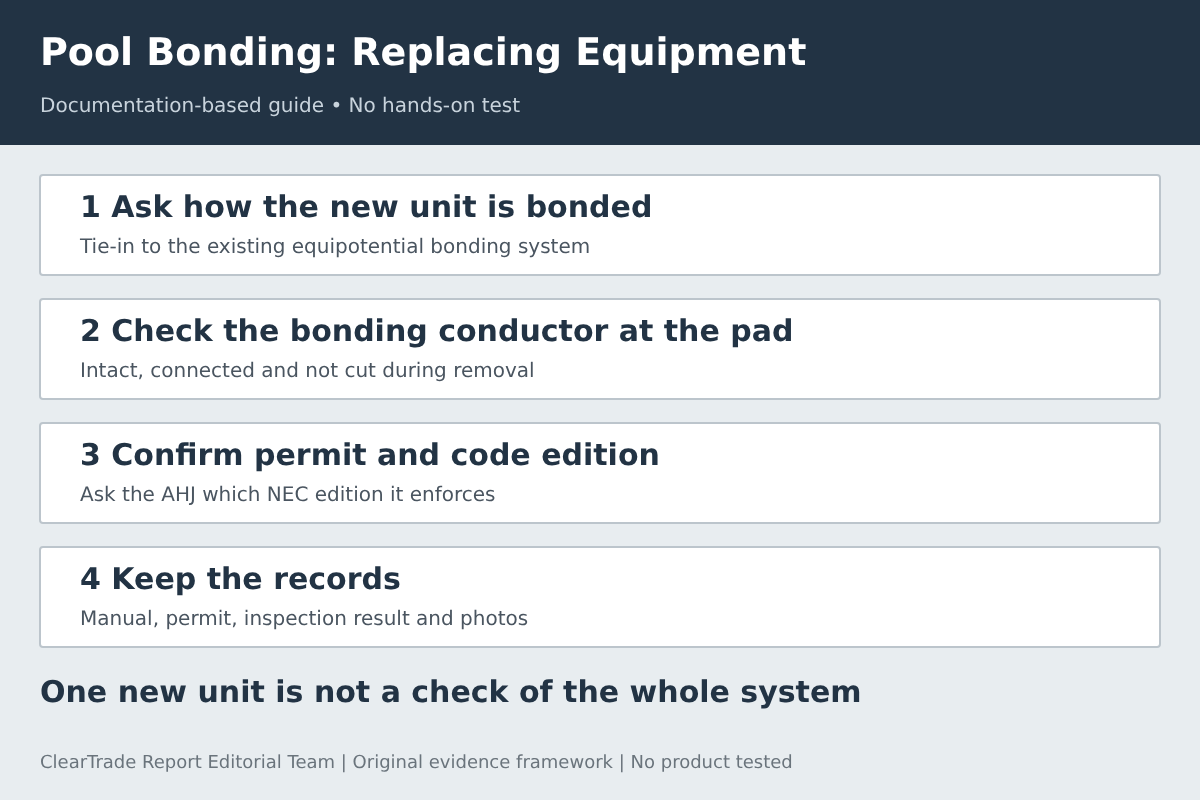
When a pool pump, motor or heater is replaced, the manufacturer manuals checked for this guide call for the new unit to be bonded to the pool’s equipotential bonding system, not just connected to power. Before work starts, ask your contractor how the new equipment will connect to that system and whether the existing bonding conductor at the equipment pad is intact. Ask whether a permit and inspection are required where you are, and which code edition your authority having jurisdiction (AHJ) enforces. An inspection of the replacement may cover only the new work, so an evaluation of the wider system is a separate request.
Evidence label: Documentation-based guide. ClearTrade Report Editorial Team checked NFPA documents, a CPSC staff meeting log, state and local agency documents, and Hayward, Pentair and Jandy equipment manuals on November 5, 2026. No hands-on testing, site visit or outside professional review was performed. Products and organizations named below are documentation examples, not recommendations. This guide contains no affiliate links.
Why a like-for-like swap can affect bonding
Equipotential bonding ties the metal parts and equipment in and around a pool together. Hayward’s Super Pump Series owner’s manual (IS26002 RevA) describes it this way: “Bonding will connect all metal parts within and around the pool with a continuous wire.”
Hayward lists “Permanently ground pump” and “Bond pump to pool structure” as separate steps. Restoring power and the equipment ground does not, by itself, restore the bond. Hayward’s warning is direct: “Failure to bond pump to pool structure will increase risk for electrocution and could result in injury or death.”
Replacement work also disturbs connections. A Buncombe County, North Carolina, health department handout lists “Disconnecting and reconnecting wires to work on pump and/or motor” as electrical work, alongside “Replacing pump” and “Replacing pump motor.”
What the code sources describe
In the National Electrical Code (NFPA 70), Article 680 covers pools, and section 680.26 covers equipotential bonding. The points below come from public NFPA documents and local agencies, not the full code text.
NFPA’s Tentative Interim Amendment 23-9 to the 2023 edition, issued by the Standards Council on March 21, 2023 and effective April 10, 2023, revised parts of 680.26. Its revised 680.26(A) says the bonding “shall be installed for pools with or without associated electrical equipment related to the pool.”
An NFPA bonding fact sheet based on the 2011 edition, posted by the Town of Merrimack, New Hampshire, lists items to bond. They include “Electrical equipment associated with water circulation, such as the pump.” It also says metal parts of equipment listed as double insulated do not require bonding.
Newer local handouts agree. The City of Murrieta, California, form DS-141 (May 2024) cites 680.26 of the 2022 California Electrical Code and lists “Metal casings of electrical equipment such as pump motors, pool water heaters” among the parts that require bonding.
Some rules plan for future replacements. A Florida Building Commission notice for Rule 9B-3.0477 (rule history “New 10-18-07”) said that where a double-insulated pump motor is installed, a conductor “of sufficient length to make a bonding connection to a replacement motor” be extended from the bonding grid to an accessible point near the motor. It is an older state notice, shown only as an example.
Edition matters. A CPSC staff log of NEC Code-Making Panel 17 task group meetings (December 21, 2020) notes that “local jurisdictions may enforce older editions, which may be current in that jurisdiction.” Ask your AHJ which edition and local amendments apply.
What pump and heater manuals say
Manuals show where the bonding point is and who should connect it.
Pumps. Hayward’s 1.65 THP VS Pump Family owner’s manual (1011781 RevA) says: “A lug for bonding is provided on the outside of the drive enclosure.” It also says to “contact a licensed electrician for information on local electrical codes for bonding requirements.” Pentair’s IntelliFlo VS+SVRS and IntelliPro VS+SVRS Installation and User’s Guide (warning page P/N 352559 Rev. C) says: “Bond the motor to the structure in accordance with the National Electrical Code.” It says the pump “must be installed by a licensed or certified electrician or a qualified pool service person.”
Heaters. Jandy’s JXi Installation and Operation Manual (H0495500 Rev A) says the maker “provides a special labeled bonding lug on the manifold side of the heater.” It also requires that the appliance “be connected to a bonding loop that includes all electrical equipment in the system and on the equipment pad.” It warns that failure to do so “may void the Zodiac Pool Systems LLC warranty.”
Pool water. Jandy’s manual notes that the NEC “requires bonding of the Pool Water,” and describes a separate conductive surface where no bonded part touches the water. If removed equipment was part of how the water was bonded, ask how that will be kept.
The manuals give conductor details in notes to the electrician, which we do not repeat. Ask your electrician to confirm in writing that the connection meets the manual and the locally adopted code.
Permits, inspections and records
Permit rules vary. Three local examples:
- The City of Marco Island, Florida, issued a notice to pool and electrical contractors, equipment installers and property owners on September 1, 2010 stating that “the installation of pool heaters and replacements of pool heaters will require a permit.” It said: “The primary purpose of the permit is to inspect the electric and bonding of the pool heater.” It is a 2010 notice, shown only as an example.
- The Town of Woodside, California, requires a building permit for remodeling, re-plastering or repairing a pool. Its sheet says: “If the pool / spa equipment is to be replaced, provide the manufactures specification sheets for the new equipment.”
- Buncombe County’s handout (revised December 2025) is aimed at public pool operators. It says “electrical work is required to be completed by a licensed electrician” and must “be inspected by the Building Permits and Inspections Department.” At operation permit inspection visits, staff check the “Replacement pump and/or pump motor compared to last year” and the bonding wire. Problems can hold up the operation permit.
The same handout explains a gap. “Typically, only the work being completed at the time, is inspected.” Its advice: “It is recommended that the operator have their swimming pool(s) evaluated for the safety of its electrical system on a regular basis.”
Questions to ask before and after the work
Before work starts:
- Is a permit required for this replacement here, and who will pull it?
- Is the installer licensed for this work here?
- Where is the bonding lug on the new unit, and how will it connect to the existing bonding system?
- Is the existing bonding conductor at the pad visible, intact and attached?
- Is the new motor double insulated, and how is bonding handled then?
- Was the old equipment part of how the pool water is bonded?
When the work is done:
- Can I have the manual, with its bonding section marked?
- Is all pad equipment still connected to the bonding system?
- What did the inspection cover?
Decision table: replacement type and evidence to request
| Situation | Question to resolve | Evidence to request | Source basis |
|---|---|---|---|
| Pump or pump motor replacement | How does the new unit bond to the existing system? | Manual bonding section, permit if required, inspection record | Hayward and Pentair pump manuals; Buncombe County handout |
| Heater replacement | Is the heater on a bonding loop with all pad equipment? | Manual bonding section, permit if required, inspection of electric and bonding | Jandy JXi manual; Marco Island notice |
| Double-insulated motor | Is a bonding conductor left accessible for future replacements? | Electrician’s written note on how bonding was handled | NFPA fact sheet (2011 edition); Florida rule notice |
| Equipment removed that touched pool water | How will the pool water stay bonded? | Electrician’s explanation tied to the adopted code | Jandy JXi manual |
| Shell, deck or remodel work at the same time | Does the permit cover bonding of altered areas? | Plans showing bonding, permit and inspection records | Town of Woodside submittal sheet; NFPA TIA 23-9 |
| Public or commercial pool | Will the operating permit inspector accept the change? | Licensed electrician invoice and electrical inspection record | Buncombe County handout |
| Older pool, unknown history | Has the wider system been evaluated since construction? | Separate evaluation by a licensed electrician | Buncombe County handout; CPSC staff log on older editions |
The evidence column is our suggestion, not a code or AHJ requirement.
Know the limits of this guide
Evidence label: documentation-based guide. ClearTrade Report Editorial Team checked the sources below on November 5, 2026. We did not read the full text of NFPA 70; code descriptions come from public NFPA and agency documents. Local documents are examples; your rules may differ. This guide does not give installation steps or conductor sizing, and it does not cover GFCI protection. Spas and hot tubs raise their own questions; see our guide to hot tub and sauna electrical planning.
Primary references checked November 5, 2026: NFPA, Tentative Interim Amendment 23-9 to NFPA 70, National Electrical Code, 2023 edition (issued March 21, 2023); NFPA bonding fact sheet (2011 NEC), posted by the Town of Merrimack, New Hampshire, “Electrical Bonding Requirements for Pools”; CPSC, log of meeting, NEC Code-Making Panel 17, Task Group 3 (December 21, 2020); Florida Building Commission, Rule 9B-3.0477 notice, “Electrical Bonding of Pools”; City of Murrieta, California, DS-141 “Swimming Pool Inspections & Equipotential Bonding” (May 2024); Town of Woodside, California, “Submittal Requirements: Re-Plaster and or Repair of an Existing Swimming Pool or Spa”; City of Marco Island, Florida, Building Services Division, notice on permits for pool heaters (September 1, 2010); Buncombe County, North Carolina, Environmental Health, “Swimming Pool Electrical Safety” (revised December 2025); Hayward, “1.65 THP VS Pump Family Owner’s Manual” (1011781 RevA); Hayward, “Super Pump Series” owner’s manual (IS26002 RevA); Pentair, “IntelliFlo VS+SVRS and IntelliPro VS+SVRS Variable Speed Pump Installation and User’s Guide” (warning page P/N 352559 Rev. C); Jandy, “JXi Gas-Fired Pool and Spa Heater Installation and Operation Manual” (H0495500 Rev A).
Frequently asked questions
Do I need to think about bonding if I am only replacing a pool pump?
Yes. Pump manuals from Hayward and Pentair tell the installer to bond the pump or motor to the pool bonding structure, and Hayward warns that failure to bond the pump increases the risk of electrocution. Ask your contractor how the new pump will connect to the existing bonding system and whether the bonding conductor at the pad is intact.
Does a pump or heater replacement need a permit and inspection?
It depends on your jurisdiction. In a 2010 notice, Marco Island, Florida, said pool heater replacements require a permit so the electric and bonding can be inspected, and a Buncombe County, North Carolina, handout for public pool operators treats replacing a pump or pump motor as electrical work that must be inspected. Ask your local building department before work starts.
Which edition of the electrical code applies to my pool?
The one your state or local authority has adopted, which may not be the newest NFPA 70 edition. CPSC staff noted that local jurisdictions may enforce older editions. Ask your building department which edition and local amendments apply.
Does an inspection of the new pump confirm the whole bonding system is sound?
Not necessarily. Buncombe County notes that later repairs are typically inspected only for the work completed at the time. If you want the wider system evaluated, ask a licensed electrician for a separate evaluation and a written report.
Disclaimer: This guide is general information based on government, standards-body and manufacturer documentation, not professional electrical or code compliance advice for a specific pool or building. Follow the manufacturer’s installation instructions and the electrical code adopted where you are, and consult a licensed electrician and your authority having jurisdiction (AHJ) before work starts. AI tools assisted with drafting. ClearTrade Report Editorial Team checked the cited sources and edited this guide. No hands-on testing was performed.
Need a qualified professional?
Trusted Pros uses visible license-verification states and never ranks paid listings above unpaid listings.