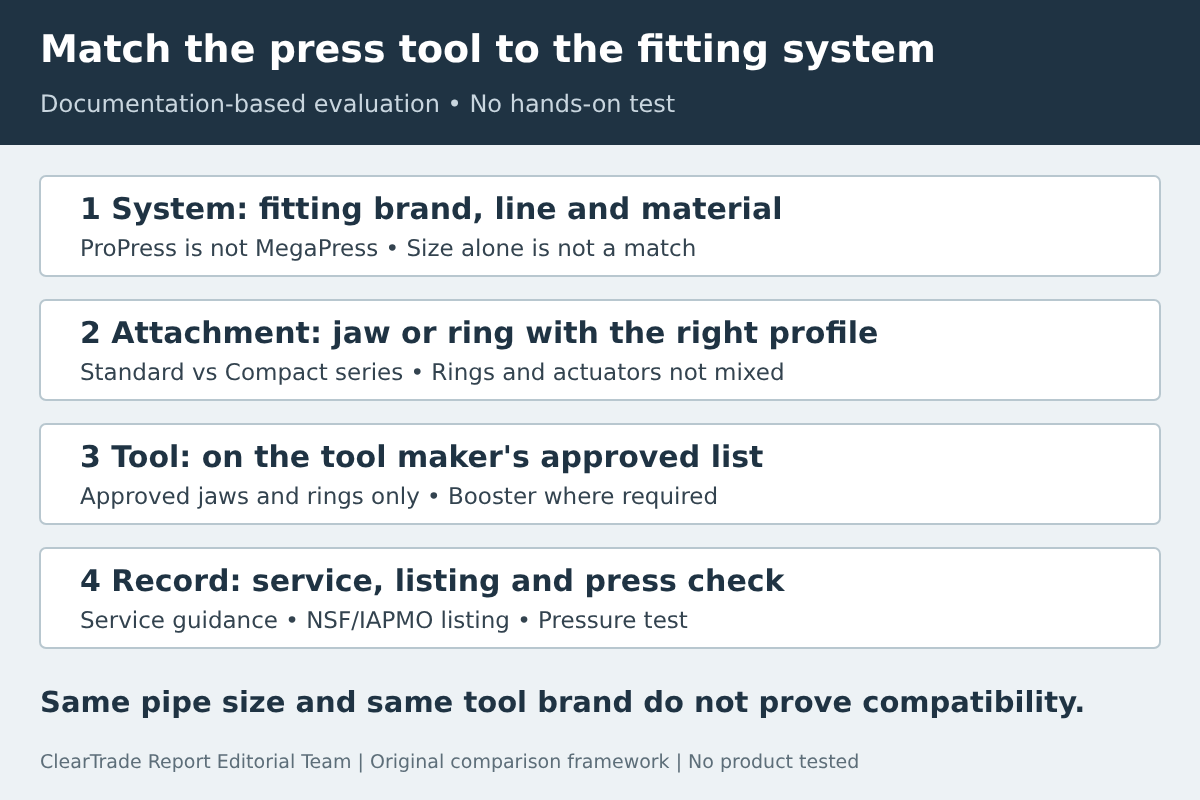
A press tool, jaw or ring is compatible only when three documents agree: the fitting manufacturer’s installation instructions, the tool manufacturer’s list of approved attachments, and the attachment’s own marking for that fitting system, profile and size. Matching the nominal pipe size or buying the same tool brand you already own does not prove any of the three.
Evidence label: Specification/documentation-based evaluation. ClearTrade Report Editorial Team checked manufacturer manuals, compatibility charts, product pages and listing information on November 1, 2026. No hands-on testing or outside professional review was performed. The named tools and fittings below are documentation examples, not recommended purchases or a ranked shortlist. No product was supplied for this article, and this guide contains no affiliate links.
Start with the fitting system, not the tool brand
Write down the exact fitting line before choosing a jaw: the manufacturer, the system name, the pipe or tube material, the size range and the application. “Copper press” or “steel press” is not specific enough, because different systems in the same material can call for different attachments.
Fitting manufacturers take different positions on tools. Viega’s tool matrix says the listed tools are “a selection” of compatible tools, that the listing does not reflect a preference, and that “Viega does not require the use of specific, approved tools to maintain the fitting warranty.” The same document puts the obligation on the installer to verify the tool platform and to determine the compatibility of the tool and its attachment. NIBCO’s instructions for its 2½-inch to 4-inch press fittings and valves are narrower: they say to install them only with the NIBCO PC-100 pressing tool, the PC-5 adapter jaw and NIBCO pressing chains.
So read the instructions for the exact fitting line and size. A rule that applies to one manufacturer’s small-diameter fittings may not apply to its large-diameter fittings, and it does not transfer to another manufacturer.
Match the profile, not just the pipe size
A press jaw is shaped for a particular fitting profile as well as a size. Viega’s ProPress manual calls for a press jaw or ring “suitable for the tube diameter and with the proper profile,” and says to use only press jaws and rings designed for ProPress fittings. Its MegaPress manual, for steel pipe fittings, says to use only MegaPress jaws and rings and states: “Do not use ProPress press jaws or rings.”
That means a ¾-inch ProPress jaw and a ¾-inch MegaPress jaw are not interchangeable, even on the same tool. When you compare jaws, record the system and profile marked on the jaw, not only its size, and keep each set with its system.
Check the tool series and the tool maker’s approved list
Tool makers group attachments by tool series, and attachments from one series do not fit the other. RIDGID describes its Standard Series jaws for ProPress as compatible only with RIDGID Standard Series pressing tools, listing the CT400, 320-E, RP 330-B, RP 330-C, RP 340 and RP 350. Its RP 351 page says that tool is compatible with all RIDGID Standard Series jaws, rings, actuators and attachments. The smaller RP 241 is described as compatible with RIDGID Compact Series jaws, rings and actuators. The RP 350/RP 351 operator’s manual adds that Standard Series attachments will only work with Standard Series tools.
Milwaukee publishes a press tool compatibility matrix. Its 2025 matrix says Milwaukee M12 and M18 Force Logic press tools “are approved for use only with the jaws and ring sets indicated in the matrix,” and tells users not to use Milwaukee press tools with any jaw or ring Milwaukee has not approved. The same matrix says it is the installing contractor’s responsibility to determine the compatibility of the pipe and fittings, and that fittings should be installed per the manufacturer’s instructions.
Read those statements together. The tool maker approves which attachments go on its tool; the fitting maker says which attachment profile makes its connection. You need both answers for the exact models.
Plan large diameters separately
Larger fittings often need a different attachment arrangement. Viega’s ProPress manual says its 2½-inch to 4-inch fittings are designed to be pressed with ProPress XL-C press rings and a V2 actuator, warns against mixing actuators and rings from different manufacturers, and says incompatible rings will result in an improper connection. RIDGID’s RP 351 page notes that a Press Booster is needed for 2½-inch to 4-inch carbon steel, and Viega’s MegaPress manual says the PressBooster requires two presses of the press tool to complete a press on those sizes, notes that a third press may be needed to start a release cycle, and also describes a Z3 actuator with XL rings as an alternative.
If your work includes these sizes, check the ring, actuator and any booster against both manufacturers’ documents before you price a tool kit, because the small-diameter jaw set does not answer the question.
Read service guidance and inspect jaws
Service guidance differs by tool, so read the manual for the model you are buying. RIDGID’s RP 351 product page lists “no scheduled maintenance” and describes a brushless motor capable of over 100,000 press cycles; its RP 350/RP 351 manual says service must be performed by a RIDGID Independent Press Tool Service Center. Milwaukee’s manual for the M18 Force Logic 2773-20 (which Milwaukee’s 2025 matrix lists as discontinued; current models in the matrix include the 2922-20, 2773-20L and 2473-20) says to return the tool, battery pack and charger to a Milwaukee service facility for inspection after six months to one year, depending on use, and that alternating red and green LEDs mean the tool must be serviced.
Jaws and rings need their own checks. The RIDGID manual says to confirm attachments are in good condition and clearly marked as to use, to check return springs in attachments with each use, and never to attempt to repair damaged pressing attachments. Milwaukee’s manual says to inspect the jaw assembly for cracks or other damage before beginning a press, and its matrix calls jaw cleanliness and inspection the installer’s responsibility.
When you buy used tools or jaws, ask for the service record and inspect the attachments against the manual. A tool that powers on is not evidence that it was serviced or that its jaws are fit for use.
Confirm the fitting’s listings for the job
Compatibility with a tool is separate from whether the fitting is listed for the application. Viega’s ProPress system data sheet lists, among others, NSF-61, NSF-372, IAPMO/ANSI/CAN Z1117, ICC-ES IC1002, ASME B16.51, ASTM F3226 and FM Class 1920. It also says the listings are shown for reference only, may not cover every item in the product line, and that the most current official listings are on the agency’s portal.
Check the exact item in the agency’s own directory, such as the NSF product listings or the IAPMO R&T product listing directory, and confirm the listing covers the size, material and service (for example potable water) on your job. The tool and jaws do not carry the fitting’s listing for you.
Know how the press will be verified
Some fittings are designed so an unpressed connection shows up during testing. Viega’s ProPress system data sheet says its Smart Connect design “allows identification of an unpressed fitting during pressure testing.” Its product instructions give a water test range of 15 to 85 psi and a compressed-air range of ½ to 45 psi for locating unpressed connections, and state that this check “is not a replacement for pressure testing requirements of local codes and standards.”
Plan for both: the manufacturer’s check for unpressed fittings and the pressure test your code or engineer requires. Keep the results with the job record, along with the tool, jaw and fitting system used.
Use a compatibility record before buying
The table below summarizes what the documented examples say. These are documentation examples, not recommended purchases, and the table does not replace the current manuals and compatibility charts for your exact models.
| Document (example) | What it says about attachments | Large-diameter note | Service or inspection guidance |
|---|---|---|---|
| Viega tool matrix and ProPress / MegaPress manuals | Installer verifies tool and attachment compatibility; no specific approved tool required for fitting warranty; ProPress jaws not for MegaPress | ProPress 2½–4 in: XL-C rings with V2 actuator; MegaPress 2½–4 in: PressBooster takes two presses | MegaPress manual: see the tool operator’s manual for tool instructions |
| NIBCO Press System 2½, 3 and 4 in fittings and valves | Install only with NIBCO PC-100 tool, PC-5 adapter jaw and NIBCO pressing chains | Applies to these sizes | Read the tool manual and fitting instructions |
| RIDGID RP 350 / RP 351 (Standard Series) | Standard Series attachments only; RIDGID or RIDGID-approved attachments | RP 351: Press Booster needed for 2½–4 in carbon steel | RP 351 page: no scheduled maintenance; service at a RIDGID Independent Press Tool Service Center; check attachment return springs each use |
| RIDGID RP 241 (Compact Series) | RIDGID Compact Series jaws, rings and actuators | Check the current chart | Check the current manual |
| Milwaukee M18 Force Logic 2773-20 (listed as discontinued in the 2025 matrix) | Matrix: only the jaws and ring sets it lists. Manual: Milwaukee or Milwaukee-approved press jaws | Check the current matrix | Inspection at a Milwaukee service facility after six months to one year, depending on use; inspect jaws before each press |
Add your own rows for the exact fitting lines, sizes and materials on your jobs. A blank cell means the manufacturer’s answer is still needed before buying.
Choosing the tool comes after choosing the piping. For the material decision itself, see our guide to PEX, copper or CPVC for a repipe.
Know the limits of this guide
Evidence label: specification and documentation-based evaluation. ClearTrade Report Editorial Team checked the documents below on November 1, 2026. We did not test any tool, jaw or fitting. Compatibility charts are revised and products are discontinued; check the current version for your exact models. We did not review every fitting brand, and we could not read some manufacturers’ documents, so a brand’s absence here says nothing about its products.
Primary references checked November 1, 2026: Viega Tool Matrix (TD-TL 0326); Viega ProPress installation manual (IM-PP 724607); Viega MegaPress installation manual (IM-MP 724992); Viega ProPress system data sheet (SD-PP 0126); Viega ProPress ½ to 4 in product instructions (PI-PP 531438); NIBCO Press System large-diameter installation instructions; RIDGID Standard Series jaws for ProPress, RP 351 and RP 241 product pages; RIDGID RP 350/RP 351 operator’s manual; Milwaukee 2025 press tool compatibility matrix; Milwaukee M18 Force Logic 2773-20 operator’s manual; NSF certified products listings; IAPMO R&T product listing directory.
Frequently asked questions
Can I use ProPress jaws on MegaPress fittings of the same size?
No. Viega’s MegaPress installation manual says to use only MegaPress jaws and rings for MegaPress fittings and not to use ProPress press jaws or rings. Match the jaw to the fitting system and profile, not just the size.
Do RIDGID Standard Series jaws fit a Compact Series tool?
No. RIDGID’s RP 350/RP 351 manual says Standard Series attachments only work with Standard Series tools, and RIDGID describes the RP 241 as compatible with its Compact Series jaws, rings and actuators.
Does a fitting manufacturer require a specific brand of press tool?
It depends on the manufacturer and the size. Viega’s tool matrix says it does not require specific approved tools to maintain the fitting warranty and makes the installer responsible for verifying compatibility. NIBCO’s 2½ to 4 inch press fittings and valves are to be installed only with the NIBCO PC-100 tool, PC-5 adapter jaw and NIBCO pressing chains.
How often does a press tool need service?
Check the exact manual. Milwaukee’s manual for the 2773-20, a model its 2025 matrix lists as discontinued, says to return the tool for inspection after six months to one year, depending on use. RIDGID’s RP 351 page lists no scheduled maintenance, and its manual says service must be done by a RIDGID Independent Press Tool Service Center.
Disclaimer: This guide is general information based on manufacturer and listing documentation, not professional, engineering, safety or purchasing advice for a specific job. Follow the fitting and tool manufacturers’ instructions and applicable codes, and use a qualified professional where a connection could affect safety. AI tools assisted with drafting. ClearTrade Report Editorial Team checked the cited sources and edited this guide. No hands-on testing was performed.
Need a qualified professional?
Trusted Pros uses visible license-verification states and never ranks paid listings above unpaid listings.