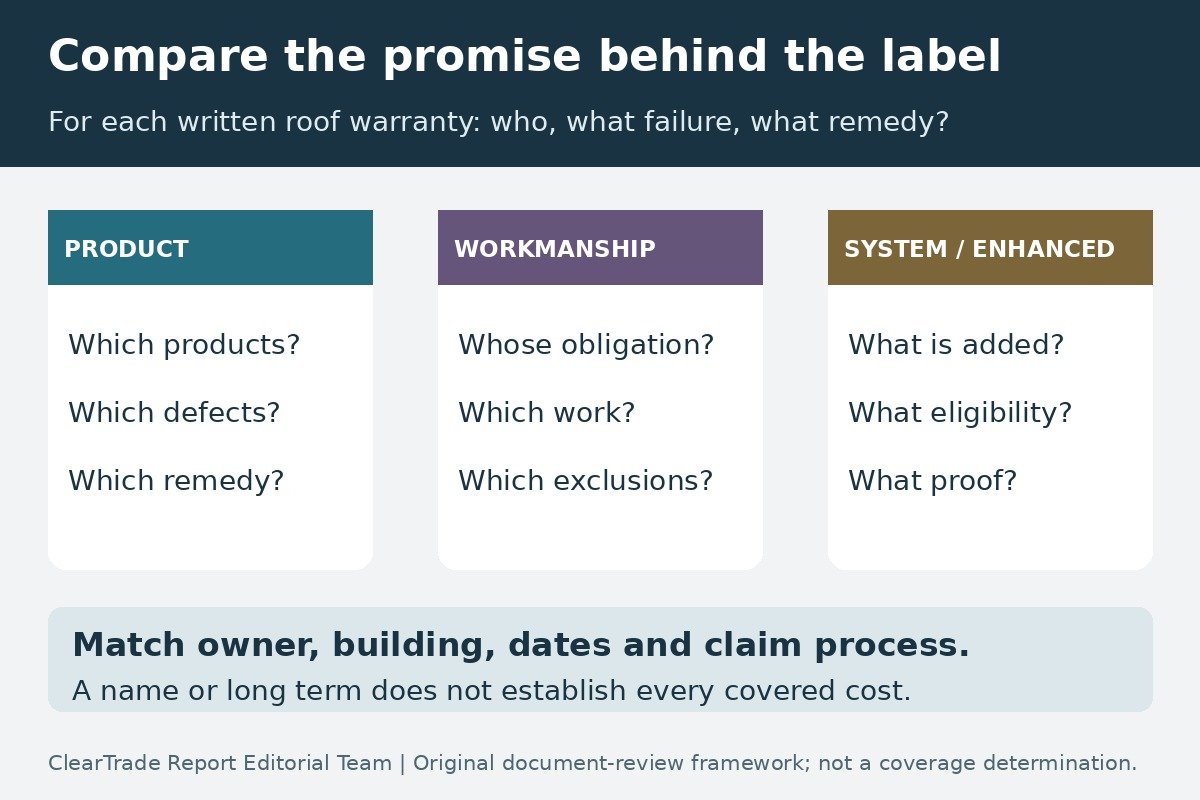
Compare roof warranties by identifying who makes the promise, which failure triggers coverage, what remedy is available and which conditions apply. A long term, a “lifetime” label or the word “system” does not establish that installation errors, every roof component or the full cost of a leak will be covered.
Before accepting a bid, request the exact manufacturer form and the contractor’s written workmanship terms. Keep them beside the proposed materials and scope. The useful comparison is the protection actually promised for this owner, building and installation, with any missing evidence made explicit.
Separate the promises before comparing bids
A roof proposal may refer to several documents. Give each its own entry in the comparison rather than combining their strongest features into one imaginary warranty.
| Document to request | Main question to resolve | Evidence that belongs in the bid file |
|---|---|---|
| Manufacturer product warranty | What product defect and remedy are described? | Exact form, applicable products and version |
| Contractor workmanship warranty | What installation work does the contractor promise to correct? | Named responsible business, term, scope and claim procedure |
| Enhanced or system warranty | What additional protection is actually included? | Issuer, eligibility, registration and complete coverage terms |
| Separately sold service agreement | What service is purchased beyond existing coverage? | Price, covered work, limitations and responsible provider |
The FTC’s Hiring a Contractor booklet, published March 2014, recommends putting material and workmanship warranty information, duration, limitations and the responsible party in the written contract. We use that documentation principle here, not the booklet as a current statement of every state’s contract law.
Ask a bidder to attach the documents, not just repeat a program name. If the contractor offers its own workmanship warranty, a manufacturer brochure does not tell you what that separate business has promised. This guide has not reviewed a particular contractor’s signed terms.
Test what the word “system” adds
Read the coverage grant and exclusions together. A warranty can cover a combination of products without covering every error made while installing them.
For example, GAF’s Roofing System Limited Warranty sample, RESWT163L-0426, has specified product-combination and purchase-documentation eligibility requirements. Its exclusions include damage caused by improper installation. The system label therefore does not establish general workmanship coverage.
GAF’s Golden Pledge sample, RESWT161L-0426, separately addresses misapplication of defined GAF products and covered flashings. Its remedies remain subject to the form’s conditions and exclusions. It also states effectiveness requirements involving eligibility, registration and full payment to the roofing contractor.
Those are different instruments from the same manufacturer, used to demonstrate a reading method. They are not a recommendation to buy a particular roof or warranty. Require the form promised for the actual job and check that the completed installation qualifies.
Read the remedy and uncovered costs
The GAF Shingle & Accessory Limited Warranty, RESWT160L-0426, illustrates the difference between a covered product problem and all the costs around a repair. It has separate coverage/remedy sections and excludes specified costs, including tear-off, disposal and building-interior damage. The text includes jurisdiction-dependent qualifications; it is not a legal ruling on an owner’s rights.
For each bid, fill in the cost questions below from its own documents. If the answer is absent, ask for clarification rather than assuming the contractor or manufacturer will pay.
| Cost or obligation | What to write down |
|---|---|
| Replacement product | Covered items, payment basis and any reduction over time |
| Repair labor | Which work is included, by whom, and during which period |
| Tear-off and disposal | Whether these are included for the relevant claim |
| Flashings and adjacent work | Defined covered items and excluded wall, siding or other work |
| Interior damage and other losses | The written treatment of consequential damage and any qualifications |
| Inspection, claim and emergency costs | Who authorizes work, pays initially and evaluates reimbursement |
Keep a remedy separate from a response-time promise. If a bidder says a crew will arrive within a specific period, ask where that commitment appears and which conditions apply. A repair remedy does not, by itself, establish an emergency service deadline.
Compare the owner, building and time periods
Ask whose ownership and which building type the offered form covers. A homeowner reading a residential headline and a procurement team buying for a multifamily property may need different documents. GAF’s warranty comparison page separates individual single-family detached ownership from commercial and multifamily coverage. Do not copy the residential lifetime headline into an association or business procurement schedule without checking the applicable form.
Then separate the overall term from the periods for individual benefits. The FTC’s warranty guidance, dated July 2023, advises checking duration, coverage, remedies and the claims process. It also recommends retaining the warranty and receipt and getting spoken promises in writing.
Use a timeline for each actual proposal. Mark when coverage starts, when any benefit changes, and what happens on a sale. Record the clause that supplies each date. Do not invent a default transfer period, assume every benefit lasts for the longest advertised term, or calculate a reimbursement using another program’s schedule.
Run a fictional claim through both bids
Suppose Bid A and Bid B both say “lifetime roof warranty.” That phrase is the only shared fact in this fictional exercise. No actual contractor, price, failure or claim determination is represented.
First ask what would happen if an installed product had a manufacturing defect. Which document would be invoked? Which party would receive notice? Which product and labor costs would be considered? Put the answers in separate columns, with the supporting clauses.
Next ask about an installation error at a flashing. Do the documents address that work? Is the promise made by the contractor, the manufacturer or both under different terms? What must be established before a remedy is available? Leave an unanswered question open instead of borrowing coverage from the other bid.
Finally, ask about damage inside the building after a leak and about a later sale of the property. A useful comparison identifies the relevant clauses and remaining questions. It does not decide that an imagined claim must be accepted. The two bids can share a headline while promising materially different things.
Verify eligibility and closeout evidence
Make each promised warranty a deliverable in the proposal and closeout file. Ask who confirms eligibility, who handles registration where required and what the owner will receive. A salesperson’s statement that the job “qualifies” is different from an issued document identifying the property and coverage.
Build a short evidence list for the actual project:
- The signed scope and contractor workmanship terms.
- Exact installed product identities and relevant purchase/installation records.
- The applicable manufacturer warranty form and any project-specific certificate.
- Registration or issuance confirmation where the offered program requires it.
- Ownership, transfer and maintenance information called for by the documents.
- Claim contacts and notice requirements for each responsible party.
For a separately purchased service agreement, the FTC’s March 2023 guidance recommends examining additional benefits, fees, limitations, provider identity and claim procedures. Treat that as another comparison, not proof that an extra charge buys broader protection. This guide does not classify every roofing warranty upgrade as a consumer service contract or decide which laws govern it.
Preserve the claim process without assuming the outcome
Know the notice route before a problem occurs. The cited GAF Shingle & Accessory form, for example, calls for notice to GAF within 30 days after noticing a problem and says notice to a contractor is not notice to GAF. That is a term of the example form, not a deadline we assign to every roof warranty.
If a problem arises, preserve dates, photographs, correspondence and the applicable documents, and follow the actual notice and repair-authorization requirements. Do not let a bid comparison become a claim determination or advice to delay necessary emergency action. A disputed obligation or unclear legal right needs advice specific to the contract and jurisdiction.
Warranty review also does not establish roof condition or insurance coverage. Our roof coating, recover and tear-off guide covers evidence behind the intervention choice. Our roof replacement and insurance guide addresses that separate contract. Keep those decisions connected through records without treating them as interchangeable protection.
When new services or equipment disturb the roof, assign responsibility for the altered interface. Our roof penetration flashing guide outlines the detail, trade-handoff and closeout records to request before treating the new work as complete.
Frequently asked questions
Does a lifetime roof warranty cover every leak cost?
No. Read the defined coverage, remedy, exclusions, time periods and owner/building eligibility. A lifetime label alone does not establish payment for every leak or related expense.
Is a system warranty automatically a workmanship warranty?
No. Identify the actual coverage grant. A warranty for a combination of products can still exclude damage caused by installation errors.
Is the contractor warranty the same as the manufacturer warranty?
No. Identify the responsible party and written obligations for each document. A manufacturer brochure does not establish the terms of a separate contractor promise.
Does this guide determine whether my claim is covered?
No. It provides a document-comparison method and limited examples. It does not evaluate an individual roof, contract, registration, legal right or claim.
Sources and evidence limits
Checked October 27, 2026. Evidence label: documentation-based comparison. The three linked GAF forms carry April 2026 form identifiers; they are examples, with the applicable issued form and installation-time terms requiring confirmation for an actual project. FTC publication dates are identified above. No hands-on testing, roof inspection, outside professional review, legal review, product endorsement or affiliate purchase link is claimed. Original product relationships in the research inventory are not recommendations.
AI tools assisted with drafting and the original diagram. ClearTrade Report Editorial Team checked the cited sources and edited this guide. No hands-on inspection or testing was performed.
Need a qualified professional?
Trusted Pros uses visible license-verification states and never ranks paid listings above unpaid listings.