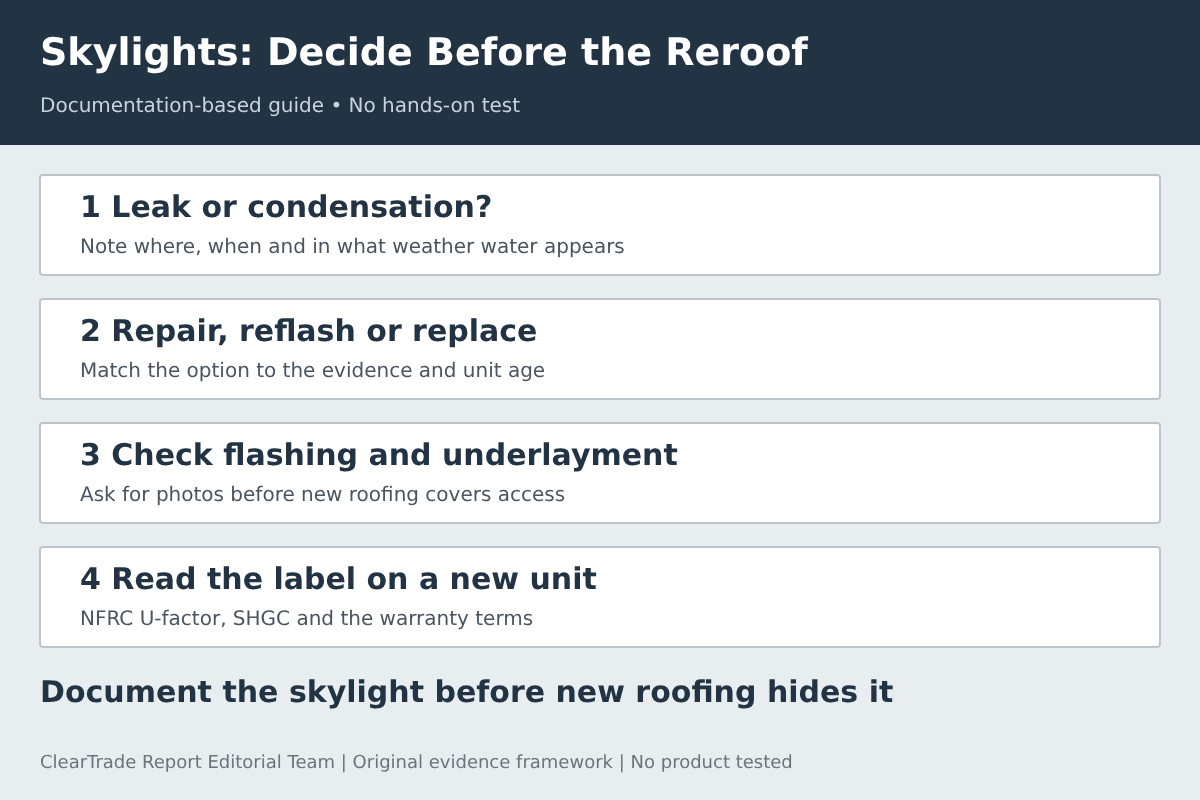
If your roof is being replaced, decide what happens to each skylight before tear-off starts. You can repair it, reflash it with new flashing and underlayment, or replace it. Base the choice on evidence: when water shows up, whether the glass is fogged between the panes, the unit’s model label, and what the maker’s warranty requires during a reroof. Condensation and leaks look alike from inside, but warranties treat them differently. Before new roofing and finishes cover the opening, ask the roofer to photograph the deck, underlayment and flashing.
Evidence label: Documentation-based guide. ClearTrade Report Editorial Team checked VELUX and FAKRO warranty and condensation documents, a U.S. Department of Energy building science page, the National Fenestration Rating Council label explanation and an ENERGY STAR criteria page on November 5, 2026. No hands-on testing, site visit or outside professional review was performed. Products and organizations named below are documentation examples, not recommendations. This guide contains no affiliate links.
Repair, reflash or replace: what each option means
Agree on these terms with your roofer in writing. The definitions are ours, not an industry standard.
- Repair: fix one part of the existing unit, such as a gasket or weather stripping, and leave the frame and flashing alone.
- Reflash: keep the existing skylight, but remove and replace the flashing and underlayment around it as part of the new roof.
- Replace: remove the unit and its flashing and install a new skylight with new flashing.
The U.S. Department of Energy’s Building Science Education page “Replacing Existing Skylights” says: “Checking for leaks and water damage is an essential step for determining whether to replace or repair a skylight.” It notes that “Weathering of components and improper installation can lessen the effectiveness of the water control layers.” It says installers should check “if proper flashing and other water management details are in place.”
The same page says a unit “should be replaced if it is damaged, relatively old” or falls short of the project’s performance goals. It names three problems: a failed insulated glass unit, which “is identified by condensation between the inner and outer panes of glass”; “leaks through joints in the frame”; and “leaks through the gaskets or weather stripping in operable units.”
Why the reroof is the decision point
Tearing off old roofing disturbs everything around a skylight. VELUX, which sells replacement skylights, says removing roofing “can jostle the skylight in its frame,” which “can lead to breaks in the flashing and weatherproofing.” Treat that as a manufacturer view, not an independent finding.
The warranty language matters more. The VELUX Limited Warranty we checked (code XUS 20194 – 0526, for products purchased on or after May 1, 2026) gives no-leak installation coverage for A21 series deck-mounted skylights “provided the Covered Product is the original installation on residential buildings with one layer of properly installed roofing material.” It also requires installation “strictly in accordance with VELUX deck-mounted skylights and related flashing instructions.” VELUX’s article “The VELUX Warranty for Glass Skylights and Flashing Explained” lists this exclusion: “Re-roofing without re-wrapping using VELUX adhesive underlayment and VELUX flashing.” For its polycarbonate unit skylights, the warranty says: “Curbs must be flashed according to roofing material manufacturers specifications.”
FAKRO’s page “Skylights and Roof Windows Limited Warranty” excludes leaks from installation “without the use of FAKRO’s original flashing designed for the given type of roofing material.” Its leak-proof installation term applies to units “installed strictly following FAKRO’s installation instructions.”
If you keep a skylight with warranty time left, ask the roofer which flashing kit and underlayment they will use and whether that matches current instructions. Terms differ by brand, model and purchase date, so read your own warranty.
Leak or condensation: read the pattern
Condensation comes from moisture in the air. The VELUX warranty says condensation “which may occur as a natural result of humidity inside or outside a building or a variation between indoor/outdoor temperatures is not a defect” and is not covered. VELUX’s warranty article puts it plainly: “Condensation is not considered a leak.” FAKRO’s warranty also excludes condensation from indoor humidity.
A leak is different. The VELUX warranty says a leak “requires the penetration of water in liquid form through the Covered Product.” FAKRO’s condensation advice page says: “A leak occurs most often due to improper installation.”
Clues worth recording before the roofer arrives (our suggestions, not a diagnostic method):
- Timing: does water appear during or right after rain or snowmelt, or on cold mornings with no precipitation?
- Location: is moisture on the inside of the glass and frame, or running down the well from above the frame?
- Between the panes: fogging inside the glass points to a failed seal, not a roof leak.
- Indoor humidity: FAKRO advises: “Keep the moisture levels on the inside of the home in check (60% or less).”
- Ice: VELUX excludes “Ice damming that results in water penetration,” so note whether water shows up when ice builds up on the roof.
Not every case is clean. If water drips in dry weather and the cause is unclear, report it to the installer or the skylight maker before you decide what to do with the unit.
Read the label before choosing a new unit
If you replace a unit, compare options by their National Fenestration Rating Council (NFRC) ratings. NFRC says U-factor “measures how well a product keeps heat from escaping a room” and “The lower the number, the better it is at keeping heat in.” For condensation resistance, it says “The higher the number, the better a product resists condensation.”
ENERGY STAR’s key product criteria page says “Performance criteria for windows and skylights are based on ratings certified by the National Fenestration Rating Council” and that criteria vary by climate zone. The skylight table there is an image, so we did not transcribe its values.
VELUX says “Low-E keeps the interior glass pane warmer, lessening the chance of condensation forming.” A better-rated unit still does not remove indoor moisture. If you keep a unit, VELUX’s warranty help page asks for “the product model number (located on the identification label attached to each product)” when contacting customer service.
What to ask the roofer to document
Once new roofing and interior drywall go on, the deck, underlayment and flashing around a skylight are hidden. Ask for this evidence before any of it is covered. Skylights are only one roof penetration. Our guide to flashing pipe boots, curbs and other roof penetrations covers the rest.
- A written scope for each skylight: repair, reflash or replace, with the skylight brand, model and flashing kit named.
- A photo of each existing unit’s identification label before removal.
- Photos of the deck around each opening after tear-off, showing any stains or rot.
- Photos of the underlayment and flashing at each stage, before the next layer covers them.
- A copy of the maker’s installation instructions the crew followed.
- The invoice or sales receipt for any new skylight. VELUX and FAKRO both say the purchase date “must be substantiated with the original invoice or sales receipt.”
- Proof of product registration, where the maker offers it.
Keep the installer’s contact details with the file. VELUX’s warranty article says owners making a claim “must start by contacting the person who installed the skylights.”
Decision table: symptom, likely path and evidence to request
| Symptom or condition | Likely path | Evidence to request or keep |
|---|---|---|
| Water during or right after rain or snowmelt, stain on the well or ceiling | Reflash or replace; inspect the deck at tear-off | Leak timing log, photos of flashing and deck at tear-off, scope naming the new flashing kit |
| Fogging or haze between the glass panes | Replace the unit, or check whether the glass seal is still under warranty | Label photo with model number, purchase date or invoice, maker’s response |
| Droplets on inside glass on cold days, no rain | Address indoor humidity first; roof work alone may not fix it | Dated humidity readings and photos; note condensation warranty exclusions |
| Drip in dry weather from the frame or gaskets | Ask the installer or maker to inspect before choosing repair or replace | Photos of the gasket area, model number, installer and maker contact |
| Leaks through frame joints or a damaged frame or glass | Replace | Photos of the damage, written scope, new unit model and flashing kit |
| Older unit, no leak signs, owner wants to keep it | Reflash with the maker’s current flashing and underlayment | Flashing kit name, stage photos, warranty terms for reroofing |
This table is our planning summary of the cited documents, not a manufacturer or code requirement. Your roofer or the skylight maker may reach a different call after seeing the opening.
Know the limits of this guide
Evidence label: documentation-based guide. ClearTrade Report Editorial Team checked the sources below on November 5, 2026. We did not inspect any roof or test any product. Manufacturer advice to replace skylights during a reroof comes from companies that sell skylights. Warranty terms quoted here come from the current VELUX and FAKRO documents; your unit may carry an older version. We give no ENERGY STAR values. This guide does not cover installation methods, code requirements or insurance claims. For a specific roof, ask your roofer, the skylight maker and your local building department.
Primary references checked November 5, 2026: VELUX, “VELUX Limited Warranty” (XUS 20194 – 0526); VELUX, “The VELUX Warranty for Glass Skylights and Flashing Explained”; VELUX, “VELUX Skylights Warranty” help page; VELUX, inspiration blog article on whether skylights leak; VELUX, “How do VELUX skylights prevent condensation from forming?”; FAKRO, “Skylights and Roof Windows Limited Warranty”; FAKRO Canada, “Condensation” advice page; U.S. Department of Energy, Building Science Education, “Replacing Existing Skylights”; National Fenestration Rating Council, home page label explanation; ENERGY STAR, key product criteria page for residential windows, doors and skylights.
Frequently asked questions
Should I replace my skylight when I replace my roof?
Not automatically. Replacement makes sense if the unit is damaged, leaks at frame joints or gaskets, is fogged between the panes, or does not meet your performance goals. If you keep it, have it reflashed with the flashing and underlayment the maker’s current instructions call for.
Does a skylight warranty cover condensation?
The VELUX and FAKRO warranties we checked do not. VELUX says condensation from humidity or indoor and outdoor temperature differences is not a defect. Fogging between the panes is different. It points to a failed glass seal, which VELUX covers under a separate 20-year warranty on the seal between the panes of glass.
Can my roofer reuse the old skylight flashing?
Check the maker’s instructions and warranty first. VELUX excludes leaks from re-roofing without re-wrapping using VELUX adhesive underlayment and VELUX flashing. FAKRO excludes leaks from installation without its original flashing for the roofing type. Get the roofer’s flashing plan in writing.
What should I keep after the roof job?
Keep the invoice or sales receipt, the model number from the unit’s label, the installation instructions that were used, and dated photos of the opening, underlayment and flashing before they were covered. VELUX and FAKRO both say the purchase date must be substantiated with the original invoice or sales receipt.
Disclaimer: This guide is general information based on manufacturer, government and rating-body documentation, not professional roofing, building code or warranty advice for a specific home. Follow the skylight maker’s installation and flashing instructions and the building code adopted where you are, and confirm warranty terms with the maker. AI tools assisted with drafting. ClearTrade Report Editorial Team checked the cited sources and edited this guide. No hands-on testing was performed.
Need a qualified professional?
Trusted Pros uses visible license-verification states and never ranks paid listings above unpaid listings.