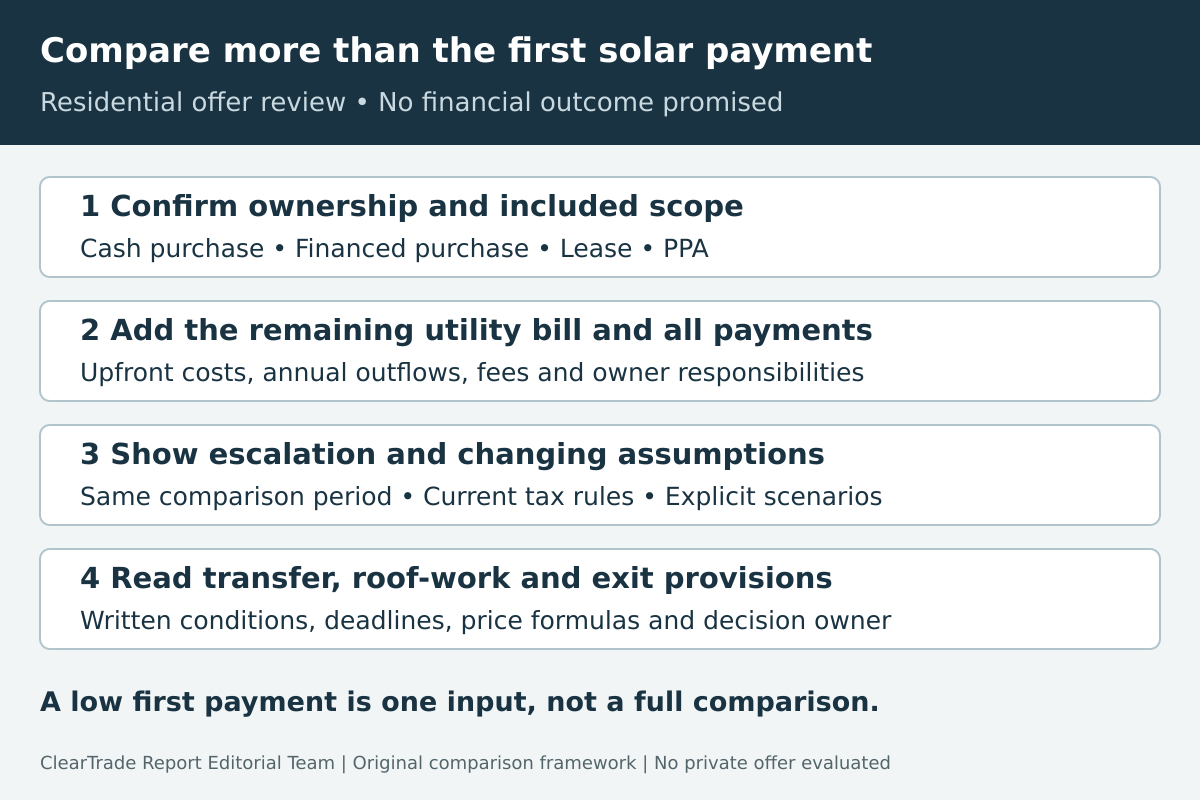
Compare solar offers by who owns the system, what you must pay over the same period, and which obligations continue if production falls or you sell the property. A low first payment does not establish the lowest total cost or a complete transfer of responsibility.
This guide addresses U.S. residential rooftop offers. Commercial projects require a separate review of business financing, tax treatment and contracting. It supplies a document-comparison method rather than a recommendation to borrow, invest or sign a particular agreement. No private offers, contracts, tax returns or customer bills were supplied, and no outside professional review or hands-on testing was performed. Primary sources were checked October 28, 2026.
Establish what the offer actually sells
A cash purchase buys the system with an upfront payment. A financed purchase adds a separate repayment obligation. A lease generally gives you use of a provider-owned system for scheduled payments. A power purchase agreement, or PPA, generally charges for energy from a provider-owned system.
The FTC’s residential solar guidance distinguishes these structures and advises comparing detailed bids, ongoing costs and utility arrangements. Use those distinctions to label each offer before comparing numbers. Read the actual agreement for exceptions, prepaid arrangements and additional charges.
| Structure | What to identify | Cost or obligation that needs its own line |
|---|---|---|
| Cash purchase | System owner and included installation scope | Upfront cost, maintenance, repairs and future removal |
| Financed purchase | Owner, lender, amount financed and repayment terms | Financing costs, changing payments and remaining balance |
| Lease | Provider ownership, term and scheduled payment | Escalation, transfer, early exit and end-of-term provisions |
| PPA | Provider ownership and chargeable energy definition | Per-kWh price, escalation, billed production and utility remainder |
Request the same equipment scope, storage scope, installation assumptions and production basis across the offers where possible. If one includes a battery, roof work or electrical upgrades and another excludes them, mark the difference before drawing a cost conclusion. This table describes questions to resolve, not terms guaranteed in every contract.
Keep the utility bill in the comparison
For the utility side of the comparison, see our guide to net metering, net billing and export tariffs.
Solar financing and electricity billing are separate arrangements. Establish the utility account, rate schedule, fixed charges, import prices and export-credit rules that apply to the address. A sales presentation’s avoided-cost estimate is not the utility’s approved tariff.
Compare the no-project utility scenario with the combined project costs: the remaining utility bill, solar payments, applicable fees and the owner’s stated responsibilities. Use the same household consumption and dates in both scenarios. Ask which assumptions change if a vehicle, heat pump, occupant or electricity rate changes.
A hypothetical annual example makes the distinction clear. Suppose the no-project bill is $2,400. An illustrative PPA charges $0.16 for each of 7,000 billable kWh, or $1,120. Add an assumed remaining utility bill of $900 and $100 of other owner costs: the total is $2,120, a $280 difference from the assumed baseline. These invented inputs are not a tariff, quote, savings forecast or evidence that all generated energy displaces retail purchases.
If the remaining utility bill instead reaches $1,300, the same illustrative total becomes $2,520, or $120 above that baseline. Production, consumption timing, export compensation and fixed charges can affect the result. Keep each assumption visible rather than letting a headline per-kWh price stand in for a complete bill model.
Separate the cash price from the financed price
Ask for the installed cash price and the financed amount for equivalent scope. Then obtain the interest rate, annual percentage rate, fees, term, payment schedule and total payments shown in the financing documents. Identify any deposit, down payment, balloon payment or expected principal reduction.
The CFPB’s August 7, 2024 solar-financing spotlight reported concerns about amounts financed above cash prices, presumed tax benefits and payment increases when expected prepayments were not made. These were documented market concerns, not findings about every current loan or an accusation against a reader’s provider.
Have the lender show the payment without an assumed tax refund or other optional lump-sum payment. Record the date and amount of any payment change and what triggers it. Ask whether the quoted monthly amount applies for the entire term or only an initial period.
A lower advertised interest rate does not resolve a higher starting balance. Compare the actual written schedules and equivalent scope. This article does not classify particular charges legally, calculate an offer’s APR or establish that an arrangement is suitable for your finances.
Update federal tax assumptions for a 2026 installation
Do not automatically subtract a new 30% homeowner federal credit from a residential system installed in 2026. Section 25D(h) ends the residential clean energy credit for expenditures made after December 31, 2025. Its expenditure-timing rule generally uses completion of the original installation, with a separate rule for construction or reconstruction.
The IRS’s 2025 Form 5695 instructions state the termination and separately discuss carrying unused eligible credit to 2026. A carryforward from earlier eligible expenditures is different from a new credit for a 2026 installation. The IRS’s August 21, 2025 modification FAQ also explains why paying before the cutoff does not qualify an ordinary installation completed afterward.
Older buyer guides and loan examples may describe the previous federal-credit timetable. Use them for their labeled historical lessons, not current eligibility. Ask a tax professional about your facts and any carryforward. Verify state or utility programs separately; this article makes no eligibility or refund promise and does not evaluate business-owner incentives.
Keep any provider-side benefit separate from a benefit payable to you. A salesperson’s statement that an owner receives an incentive does not establish your entitlement or prove that the offer passes its value through to your payment.
Calculate escalators over the actual term
For a lease, record whether the scheduled payment changes, how often and by what formula. For a PPA, identify whether the energy rate changes and what quantity is billed. Ask whether you pay for all production, only delivered energy, a minimum quantity or another contract-defined amount.
The California Public Utilities Commission’s consumer guide explains lease/PPA distinctions and escalation questions. This is a California example; its legal protections and filing rules should not be generalized nationally.
Consider a hypothetical $150 monthly lease with a 2.9% annual increase. If the first increase is in year two, the year-ten monthly payment is $150 × 1.029^9, approximately $194.01. Under those exact assumptions, 20 years of monthly payments total approximately $47,877.68 before any other charges. This is a nominal sum, not present value or a forecast.
An illustrative $0.16/kWh PPA rate with the same escalation reaches approximately $0.20695/kWh in year ten. Its total payment still depends on billable energy. Do not treat that rate schedule as a fixed monthly payment or assume utility rates will increase at the same pace.
Have the provider supply the complete schedule, including rounding, anniversary dates, caps and any initial partial year. If you compare discounted cash flows, use the same stated discount-rate assumption and cash-flow timing for every option; this article selects no discount rate or financial winner.
Assign maintenance, performance and roof responsibilities
Request the scope of monitoring, fault response, repair, labor, replacement equipment and customer access. Identify exclusions and the responsible company. Distinguish a module warranty, installation warranty, service commitment and production guarantee; one document does not automatically cover all four.
The Treasury’s Before You Sign a Solar Lease Agreement advisory recommends examining repair, damage, removal, costs and provider continuity. It also warns that a lease does not automatically leave the customer owning the equipment at the end. Read your actual agreement for the applicable duties and options.
Ask how a production guarantee is measured, which exclusions apply, what evidence is required and what remedy is offered. Keep that remedy separate from the financing payment obligation. Do not assume poor production automatically permits withholding payment; obtain advice about the agreement and applicable law.
For anticipated roof work, identify who authorizes and performs removal and reinstallation, who pays, and how the work affects each warranty or guarantee. Obtain written treatment of storm damage, insurance responsibilities and any deductible allocation. No coverage, enforceability or successful claim is established by this checklist.
Compare sale, refinance and end-of-term options
Ask what happens if you sell in year five, refinance in year ten or want the equipment removed before the contract ends. Request the actual transfer, consent, buyer-qualification, payoff and buyout provisions. Have the provider identify any deadlines, fees and valuation method.
Do not substitute a salesperson’s promise of an easy transfer for the documents. A prospective buyer’s willingness, a provider’s consent and a mortgage lender’s requirements are separate questions. Record what happens if the buyer will not assume the arrangement.
| Event | Written evidence to request |
|---|---|
| Home sale | Transfer conditions, consent process, buyer requirements and alternatives |
| Refinance | Relevant lender/provider requirements and documents needed to release or subordinate any applicable interest |
| Early exit | Eligibility, charges, calculation method and surviving duties |
| Roof replacement | Removal/reinstallation scope, scheduling, price and warranty treatment |
| Provider changes | Assignment, service contacts and continuity provisions |
| Contract expiry | Removal, renewal or purchase options, deadlines and price basis |
This is a document-request framework, not a determination that a lien exists, a transfer must be accepted or a cancellation right applies. Ask a qualified adviser about unclear legal terms before committing. State-specific rights and contract facts require separate verification.
Build one comparison record before deciding
For each offer, retain the dated proposal, installation scope, contract, financing documents, production estimate, utility-rate inputs and itemized payment schedule. Record upfront costs, annual outflows, remaining obligations at a possible sale date and the owner’s responsibilities. Mark missing information as unresolved.
Run at least a documented base scenario and a less favorable scenario using explicit assumptions—for example, lower production, a lower export value or a changed roof-work date. A sensitivity check shows what drives a result; it is not a probability estimate or a guarantee.
Compare both affordability over time and obligations that remain when plans change. The useful result is a decision record that explains the tradeoffs, not a universal claim that purchase, lease or PPA always wins.
Primary references checked October 28, 2026: FTC residential solar guidance; Treasury’s two-page lease advisory; CFPB’s August 7, 2024 financing spotlight; CPUC consumer-guide overview; current section 25D text displayed through Public Law 119-120, October 7, 2026; IRS Form 5695 (2025) instructions and FS-2025-05. General consumer material can contain legacy incentive language; the current statute and IRS modification guidance govern this article’s federal-cutoff discussion. No individual contract, credit offer, utility bill, tax position or provider was evaluated.
Frequently asked questions
Does a PPA mean I own the solar equipment?
Generally the provider owns a PPA system and sells the contracted energy. Check the actual ownership, purchase-option and end-of-term terms rather than assuming payments transfer ownership.
Does a low first-year payment prove the offer saves money?
No. Compare the remaining utility bill, payment increases, fees, responsibilities and possible exit costs over the same period and assumptions.
Should I assume a new 30% homeowner credit for a 2026 installation?
No. Current section 25D ends the credit for expenditures made after December 31, 2025, with timing generally tied to completed installation. Earlier eligible-credit carryforwards are a separate question for the taxpayer’s circumstances.
What should I request before accepting a transfer or buyout promise?
Obtain the actual written conditions, consent process, fees, deadlines and price formula, including the alternative if a future buyer will not assume the agreement.
AI tools assisted with drafting. ClearTrade Report Editorial Team checked the cited sources and edited this guide. No hands-on inspection or testing was performed.
Need a qualified professional?
Trusted Pros uses visible license-verification states and never ranks paid listings above unpaid listings.