On this page
The U.S. Cyber Trust Mark is a voluntary federal labeling program for qualifying wireless consumer Internet of Things products. The label is intended to help buyers identify products that meet the program’s cybersecurity requirements and to connect them with current product information through a QR-linked public registry.
The mark is useful evidence. It is not a guarantee that a device cannot be hacked, that it will remain secure forever, or that it is appropriate for a particular home or business network.
What the label includes
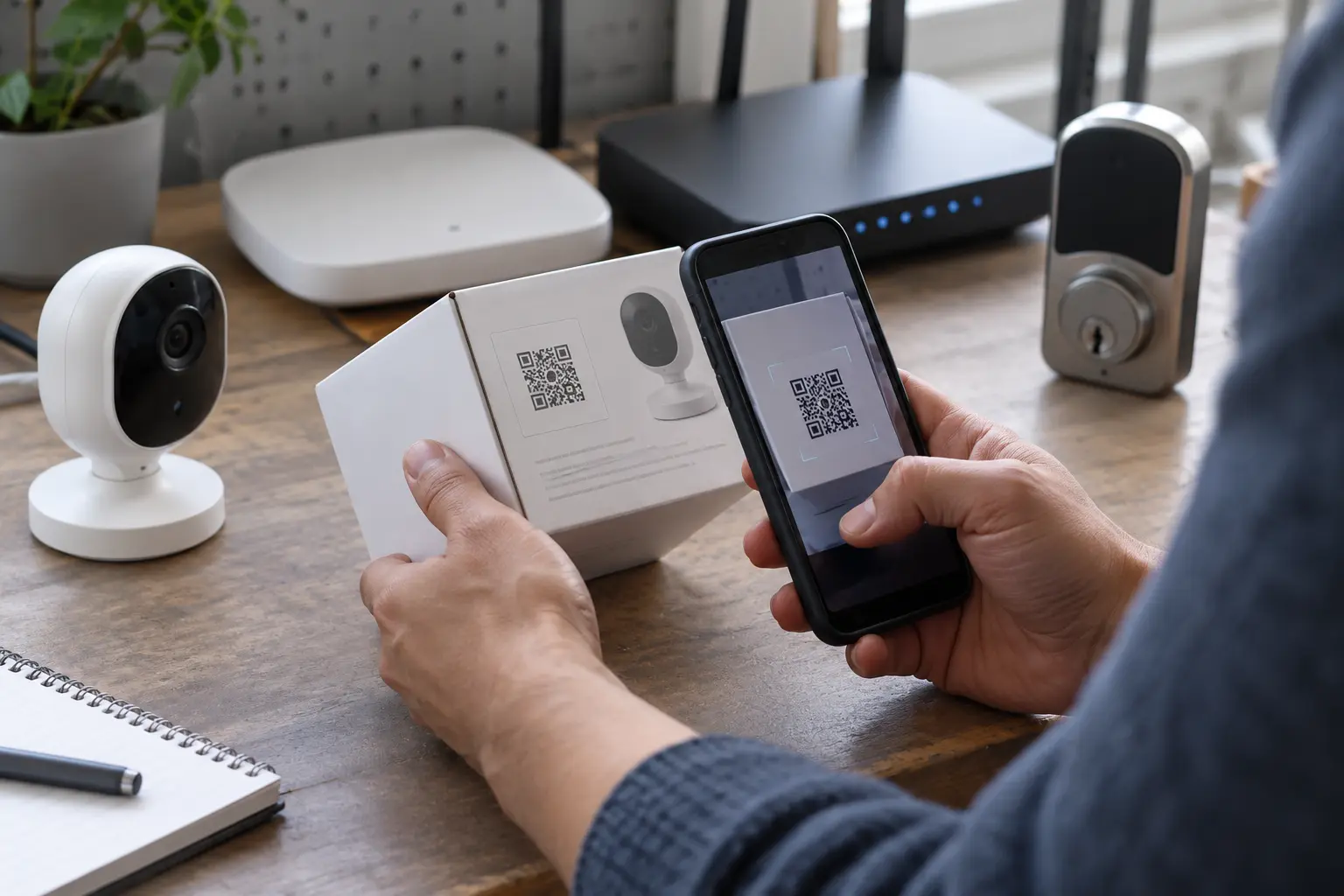
The FCC program pairs the U.S. Cyber Trust Mark with a QR code. The QR code links to registry information that can include consumer-readable details such as the product’s support period and whether security updates are automatic.
The FCC’s program materials describe a binary label decision: a product qualifies to bear the label or it does not. The registry supplies context that cannot fit in a small physical mark.
What the program is based on
NIST IR 8425 describes cybersecurity capabilities commonly needed for consumer IoT products. Its profile covers the product as a system, not only the physical device. Apps and other components necessary for basic operation may be part of the product scope.
The FCC created the voluntary program in 2024 and continues to publish implementation information. Because the program is current and evolving, buyers should use the live FCC page and registry rather than relying on an old screenshot or retailer description.
What the mark can tell you
A valid mark and registry entry can help confirm:
- the product participated in the program;
- it met the applicable program requirements at the relevant time;
- the registry identifies the exact product;
- the stated support period;
- whether software patches or security updates are automatic; and
- other program-required consumer information.
Use the QR code and registry entry together. The logo alone does not provide the full record.
What the mark cannot tell you
The mark does not by itself prove:
- the device has no vulnerabilities;
- the manufacturer will support it beyond the stated period;
- the product fits a commercial, industrial, or life-safety use;
- the installer configured accounts, passwords, updates, and network access correctly;
- the local router, wireless network, or cloud account is secure;
- the product will remain usable if a cloud service ends; or
- the product is compatible with every camera, access-control, automation, or building-management system.
Cybersecurity is a lifecycle. Purchasing evidence matters, but commissioning, updates, accounts, network design, and end-of-support planning remain separate responsibilities.
How to verify a label
- Scan the QR code or use the official program path.
- Confirm the registry entry matches the exact brand, model, and version.
- Read the support period.
- Check whether updates are automatic and whether the buyer must enable them.
- Review the manufacturer’s current security and privacy documentation.
- Record the support end date in the asset inventory.
- Recheck the registry before a large purchase or deployment.
Do not rely only on marketplace photos, packaging copied from another model, or a seller’s unlinked claim.
Questions for cameras, access points, and connected building devices
For a field deployment, the label is one input. Also ask:
- Does the device require a cloud account or subscription?
- Can default credentials be changed before use?
- How are administrator roles and multifactor authentication handled?
- What happens if internet connectivity fails?
- Can the device operate on an appropriate network segment?
- How are firmware and app updates delivered?
- What data leaves the premises?
- What happens at end of support?
- How will the device be reset and removed from service?
Lavender Electric LLC can provide company-level context on structured cabling, PoE, wireless access points, UPS/PDU coordination, and physical deployment. Those field topics do not convert the company into the source for cybersecurity-certification claims, which remain grounded in FCC and NIST materials.
A mark is not a substitute for commissioning
A qualified product can still be deployed badly. Buyers should document:
- device ownership and administrator access;
- unique credentials;
- update settings;
- network placement;
- dependencies on apps and cloud services;
- backup-power needs;
- logging or alert expectations; and
- replacement or isolation at end of support.
For small businesses and facilities teams, add the registry record and support date to the same asset register used for maintenance.
Frequently asked questions
Is the U.S. Cyber Trust Mark mandatory?
No. The FCC program is voluntary.
Does the mark guarantee a product is secure?
No. It indicates qualification under the program; it does not eliminate vulnerabilities or replace secure deployment and maintenance.
Should I scan the QR code before buying?
Yes. Use the registry to confirm the exact product and read current support and update information.
Does the mark cover every connected product?
No. Check the current FCC program scope and registry. The initial program focuses on qualifying wireless consumer IoT products.
Sources
- FCC: U.S. Cyber Trust Mark — accessed October 4, 2026.
- FCC: Cybersecurity Labeling for Internet of Things, FCC 24-26 — accessed October 4, 2026.
- FCC: Cyber Trust Mark program materials — accessed October 4, 2026.
- NIST: Consumer IoT Cybersecurity — accessed October 4, 2026.
- NIST IR 8425 — accessed October 4, 2026.
Need a qualified professional?
Trusted Pros uses visible license-verification states and never ranks paid listings above unpaid listings.