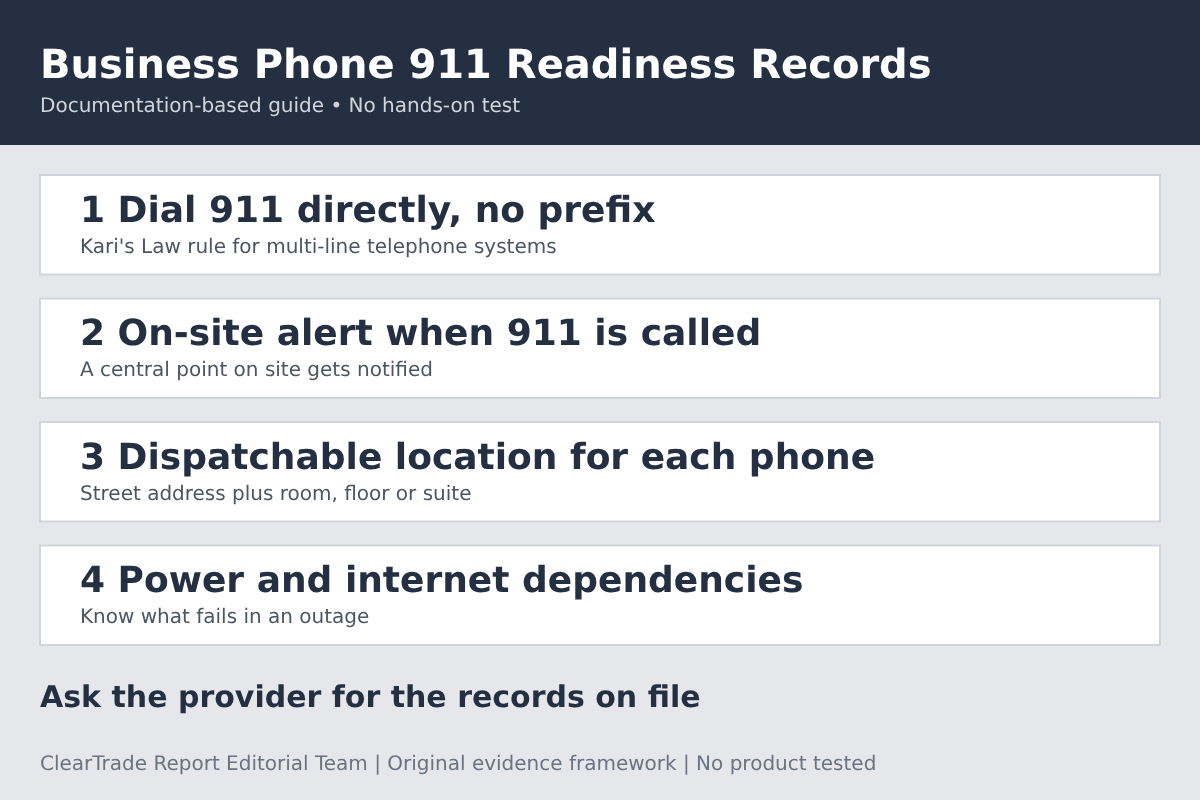
Check three things before and after a phone migration. First, every phone must reach 911 with no prefix, and, where the system can do it without a hardware or software upgrade, it must alert a person or desk when a 911 call is made. Second, each phone should send a usable location to 911, including floor or suite where needed. Third, you need a written answer on what happens to 911 when the power or internet fails. The evidence is the provider’s 911 disclosure, your signed acknowledgment, location records from the admin portal, warning labels and a test log.
Evidence label: Documentation-based guide. ClearTrade Report Editorial Team checked documents from the Federal Communications Commission, the Office of the Federal Register and U.S. Government Publishing Office (Code of Federal Regulations and Federal Register text on govinfo.gov), RingCentral and Microsoft on November 19, 2026. No outside professional review was performed and nothing was tested. Companies named are documentation examples, not recommendations. This guide contains no affiliate links.
Why 911 belongs on the migration checklist
Emergency calling depends on settings that are easy to miss in a migration: dialing rules, the address on each line, alert targets and outage behavior.
The FCC built its current rules on two federal laws. Its Multi-line Telephone Systems page says “In August 2019, the Commission adopted rules implementing two federal laws that strengthen emergency calling.” Those laws are Kari’s Law and Section 506 of RAY BAUM’S Act.
The definition of a multi-line telephone system in 47 CFR 9.3 includes “network and premises based systems, such as Centrex and VoIP, as well as PBX, Hybrid, and Key Telephone Systems.”
Kari's Law: dial 911 directly and tell someone on site
The FCC says “Kari’s Law requires direct 911 dialing and notification capabilities in multi-line telephone systems (MLTS).” It also says “Compliance with the rules implementing Kari’s Law is required beginning February 16, 2020.” The rule text in 47 CFR 9.16 (October 1, 2025 edition) gives the same date in Section 9.17(b): “The compliance date for this subpart F is February 16, 2020.” The 2019 order applies it to systems “manufactured, imported, offered for first sale or lease, first sold or leased, or installed after” that date.
Direct dialing. Section 9.16(b)(1) says a business that installs, manages or operates a system may not install, manage or operate it unless “a user may directly initiate a call to 911” “from any station equipped with dialing facilities, without dialing any additional digit, code, prefix, or postfix,” “including any trunk-access code such as the digit 9.”
Notification. Section 9.16(b)(2) requires the system to be configured “to provide MLTS notification to a central location at the facility where the system is installed” “or to another person or organization regardless of location,” where the system can do so without a hardware or software improvement. The notification “must not delay the call to 911” and “must be sent to a location where someone is likely to see or hear it.”
Section 9.3 says the notice must include, at a minimum, “The fact that a 911 call has been made,” “A valid callback number,” and the location information the system sends to the 911 center. The callback number and location may be left out only if providing them is technically infeasible.
Dispatchable location: what the FCC means and when it applied
Section 9.3 defines dispatchable location as “A location delivered to the PSAP with a 911 call that consists of the validated street address of the calling party,” “plus additional information such as suite, apartment or similar information necessary to adequately identify” the caller’s location. The FCC’s MLTS page adds that it can include details “such as room number and floor number.” (A PSAP is a 911 call center.)
The rules separate fixed phones from devices that move. Dates below are quoted from 47 CFR 9.16 and 47 CFR 9.11, October 1, 2025 edition.
| Phone or service type | Rule and date | What the rule text says |
|---|---|---|
| MLTS: on-premises fixed telephone | Section 9.16(b)(3)(i) | “shall provide automated dispatchable location no later than January 6, 2021” |
| MLTS: on-premises non-fixed device (for example a softphone or wireless handset used inside your building) | Section 9.16(b)(3)(ii) | “No later than January 6, 2022”: automated dispatchable location “when technically feasible”; otherwise dispatchable location “based on end user manual update, or alternative location information” |
| MLTS: off-premises device (for example a softphone at home) | Section 9.16(b)(3)(iii) | “No later than January 6, 2022”: automatic dispatchable location “if technically feasible”; otherwise manual update or “enhanced location information, which may be coordinate-based” |
| Fixed interconnected VoIP | Section 9.11(b)(4)(i), on or after January 6, 2021 | “Providers of fixed interconnected VoIP services must provide automated dispatchable location with each 911 call.” |
| Non-fixed interconnected VoIP | Section 9.11(b)(4)(ii), on or after January 6, 2022 | “Provide automated dispatchable location, if technically feasible.” Otherwise a Registered Location, alternative location information, or routing to a national emergency call center |
“On-premises” in Section 9.3 means within your fixed property, such as a building or campus, under one administrative authority. A softphone used at home is an off-premises device.
Where non-fixed VoIP relies on a Registered Location, Section 9.11(b)(4)(ii)(B) says the provider must give end users “one or more methods of updating their Registered Location.”
What a VoIP provider must tell you about power, internet and moving
The FCC’s VoIP and 911 Service consumer guide lists what interconnected VoIP providers must do. They must “Automatically provide 911 service to all customers as a standard, mandatory feature” and “Obtain a customer’s physical location prior to service activation.” They must also “Obtain affirmative acknowledgement from all customers that they are aware of and understand the limitations” of their 911 service.
The rule text is more specific. Section 9.11(b)(5)(i) requires providers to advise subscribers of circumstances that may limit E911, including moving the customer’s equipment to a new location and “broadband connection failure, loss of electrical power.” Section 9.11(b)(5)(ii) requires providers to “obtain and keep a record of affirmative acknowledgement by every subscriber.” Section 9.11(b)(5)(iii) calls for “warning stickers or labels warning subscribers if E911 service may be limited or not available,” or notice “by other conspicuous means.”
The FCC’s advice to subscribers is plain: “If your power is out or your internet connection is down, be aware that your VoIP service may not work.”
Provider policies show how this plays out. RingCentral’s Emergency Services Policy (version dated June 1, 2021) says “You must register the address of the physical location where you will use each Digital Line” and “RingCentral 911 service will not function (i) in the event of an Internet or power outage.”
Microsoft’s Plan and manage emergency calling page for Teams describes an emergency address as “the physical or street address of a place of business,” and a place as “Typically a floor, building, wing, or office number.”
Backup power: where the FCC rule came from and why it may not cover you
The FCC backup power rule many people remember is 47 CFR 9.20. In the October 1, 2025 edition, it applied to “any facilities-based, fixed voice service offered as residential service” “that is not line powered.” Providers had to offer “at least one option with a minimum of eight hours of standby backup power,” and later a twenty-four hour option.
Two limits matter for a business. The rule covered residential service. And Section 9.20(g) says it “shall no longer be in effect as of September 1, 2025.” The FCC’s Delete, Delete, Delete direct final rule, published January 14, 2026, says Section 9.20 “has sunset by operation of law and ceased to be effective on September 1, 2025” and removes it, “Effective March 16, 2026 without further action, unless significant adverse comment is received by February 3, 2026.”
So do not assume a federal rule makes your provider power your business phones. The VoIP rule is the duty to tell you that power loss can limit 911. Get the provider’s outage answer in writing.
Internet loss is the other half. If the office has a second circuit or a cellular backup, confirm that the phones actually use it and that 911 calls still carry the right location. Our guide to business internet failover with dual WAN and cellular covers that side.
The records checklist: what to ask your provider and keep on file
Ask for these items in writing and keep them with your phone records.
- 911 disclosure and acknowledgment. The provider's 911 limitations notice and a copy of your affirmative acknowledgment.
- Location records for every line. An export from the admin portal showing each number, extension or device and its registered or emergency address, including floor, suite or room where needed.
- Device type for each endpoint. Which phones are fixed desk phones, which are softphones or wireless handsets used on site, and which are used off site. The table above shows why the rule differs.
- How locations update. For devices that move, how the location is detected or updated, and the end-user method the provider offers to update a Registered Location.
- Dialing plan. A screenshot or configuration printout showing that 911 dials with no 9 or other prefix from every phone.
- Notification setup. Who receives the 911 alert, by what method (screen alert, text, email), and proof it includes the callback number and location.
- Outage behavior. The provider's written answer on what happens to 911 during a power outage and an internet outage, plus which equipment you must keep powered.
- Labels and staff notice. Warning labels on or near the phones, and the notice you gave staff and visitors about 911 limits.
- Test log. The date, phone and result of any test call, done only the way your provider and local 911 authority direct.
Repeat the location check after any office move.
Know the limits of this guide
This guide reads published rules and FCC pages. It does not judge whether any system complies, and nothing was tested. Rule text was read from the October 1, 2025 edition of 47 CFR on govinfo.gov; the eCFR site did not return text to our tools. The January 14, 2026 direct final rule also removes Section 9.11(a), which covered the period before 2021 and 2022, and Section 9.20. We did not confirm whether those removals took final effect, so check the current eCFR before relying on any section number. State and local rules may add requirements. Provider policies change.
Primary references checked November 19, 2026: Federal Communications Commission, Multi-line Telephone Systems (911 requirements page); Federal Communications Commission, VoIP and 911 Service consumer guide; Code of Federal Regulations, 47 CFR 9.3 Definitions (October 1, 2025 edition, govinfo.gov); 47 CFR 9.11 E911 Service (October 1, 2025 edition, govinfo.gov); 47 CFR 9.16 and 9.17 (October 1, 2025 edition, govinfo.gov); 47 CFR 9.20 Backup power obligations (October 1, 2025 edition, govinfo.gov); Federal Register, Implementing Kari’s Law and RAY BAUM’S Act (December 5, 2019, FR Doc. 2019-20137); Federal Register, Delete, Delete, Delete direct final rule (January 14, 2026, FR Doc. 2026-00612); RingCentral, Emergency Services Policy (version dated June 1, 2021); Microsoft, Plan and manage emergency calling (Microsoft Teams documentation).
Frequently asked questions
Do we still have to dial 9 before 911 on our office phones?
No, not on a system covered by the rules. 47 CFR 9.16 says a covered multi-line telephone system must let a user call 911 without dialing any additional digit, code, prefix, or postfix, including a trunk-access code such as the digit 9. The FCC says compliance with the Kari’s Law rules is required beginning February 16, 2020.
What is a dispatchable location?
Under 47 CFR 9.3 it is the validated street address of the calling party, plus additional information such as suite, apartment or similar information needed to identify where the caller is. The FCC says this can include details such as room number and floor number.
Will our VoIP phones reach 911 if the power or internet goes down?
They may not. The FCC consumer guide says that if your power is out or your internet connection is down, your VoIP service may not work. The rules require interconnected VoIP providers to tell subscribers about limits caused by loss of electrical power and broadband connection failure.
Does the FCC require our business phone provider to supply backup batteries?
The FCC backup power rule checked here, 47 CFR 9.20, covered facilities-based fixed voice service offered as residential service. Its own text says it was no longer in effect as of September 1, 2025. Ask your provider in writing what its equipment does during a power outage.
Disclaimer: This guide is general information based on federal regulations, FCC and provider documents, not legal, regulatory or telecommunications advice for a specific business or phone system. Confirm requirements with your phone provider, a qualified telecommunications professional and your local 911 authority. Rules and provider policies may change. AI tools assisted with drafting. ClearTrade Report Editorial Team checked the cited sources and edited this guide.
Need a qualified professional?
Trusted Pros uses visible license-verification states and never ranks paid listings above unpaid listings.