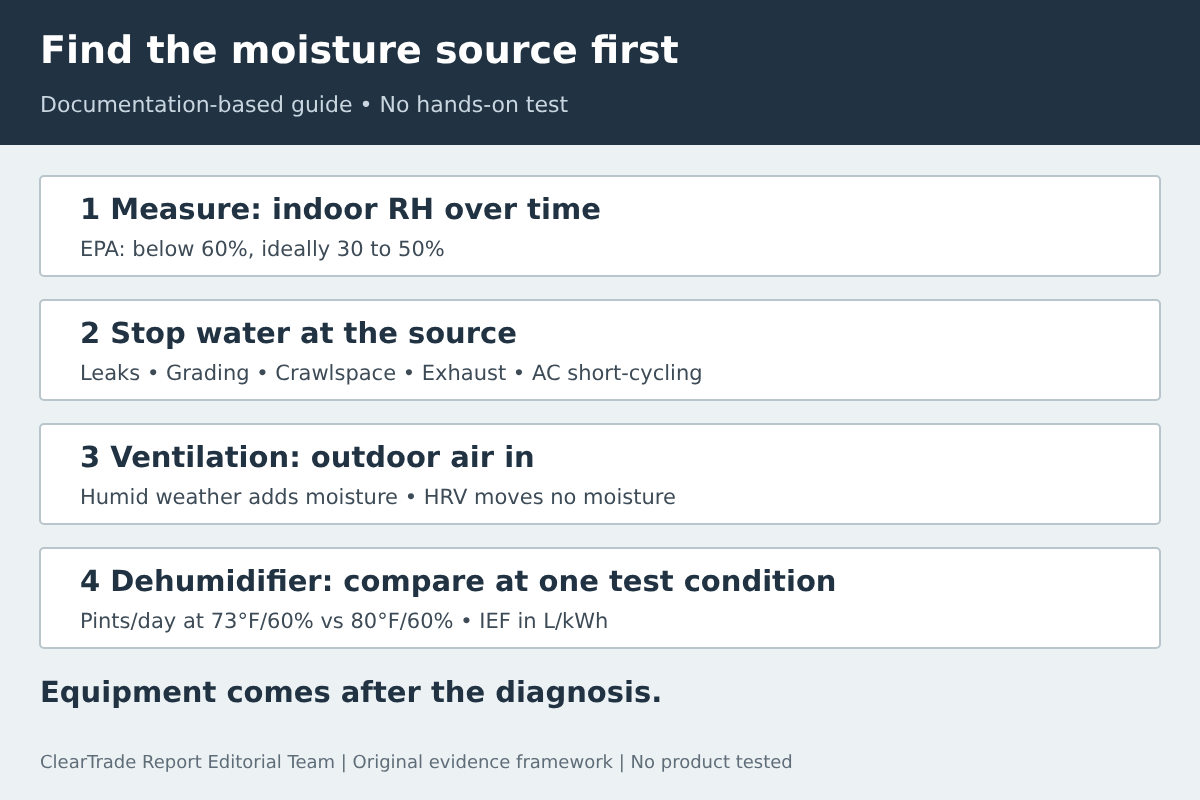
Before buying a whole-house dehumidifier or a ventilation upgrade, find out where the moisture is coming from. A leak, a wet crawlspace or an oversized air conditioner calls for a different fix than a tight house that simply carries a high moisture load in a humid summer. Measure indoor humidity for a period, rule out water you can stop at the source, and only then compare equipment. Ventilation brings in outdoor air, which helps with indoor moisture sources but can add moisture in humid weather; a dehumidifier removes moisture but does not fix a leak.
Evidence label: Documentation-based guide. ClearTrade Report Editorial Team checked U.S. EPA, ENERGY STAR, U.S. Department of Energy, federal regulation and manufacturer documents on November 2, 2026. No hands-on testing, home inspection or outside professional review was performed. Models named below are documentation examples, not recommendations. This guide contains no affiliate links.
Measure humidity before choosing equipment
EPA’s “A Brief Guide to Mold, Moisture and Your Home” says: “If possible, keep indoor humidity below 60 percent (ideally between 30 and 50 percent) relative humidity.” ENERGY STAR’s dehumidifier page says “The optimum RH level for a building is generally considered to be between 30% and 50%.”
You do not need expensive equipment to start. EPA says relative humidity can be measured with “a small, inexpensive ($10-$50) instrument available at many hardware stores.” Our suggestion, not a source requirement: record readings in the main living space, the basement or crawlspace and any problem room, at different times of day and across a few weeks of the season that bothers you. One reading does not show a pattern.
Look for physical signs too. EPA notes that “Condensation can be a sign of high humidity,” and that “When warm, humid air contacts a cold surface, condensation may form.” Note where condensation, musty odors or mold appear; location often points to the source.
Find the moisture source
EPA’s guidance puts it plainly: “The key to mold control is moisture control.” Check these sources before sizing any equipment:
- Liquid water. EPA says to “Fix plumbing leaks and other water problems as soon as possible,” to “Make sure the ground slopes away from the building foundation,” and to keep gutters clean and repaired.
- Crawlspaces and basements. The DOE Building America Solution Center lists signs such as “standing water, puddles, water stains, efflorescence,” and says “Moisture problems must be dealt with before sealing and insulating a crawlspace.” It flags crawlspace air above 70% relative humidity and wood moisture content above 18% as problems.
- Household activities and appliances. EPA notes that “Cooking and showering also can add to indoor humidity,” that combustion appliances such as stoves and kerosene heaters produce water vapor, and that moisture-producing appliances such as clothes dryers should be vented outside where possible.
- The air conditioner. The Solution Center’s whole-house dehumidification guide says “Oversizing the cooling system can cause short-cycling of the equipment,” and that the thermostat can reach its set point “before moisture can condense on the coil.” An oversized system can leave a house cool but clammy.
- Outdoor air leaking in. The same guide says to “Avoid exhaust-only ventilation as it tends to depressurize a house,” which may increase infiltration of outdoor air and indoor humidity.
If a source like these is present, fix it first. A dehumidifier sized to keep up with a leak or a wet crawlspace is treating the symptom.
What ventilation can and cannot do
Ventilation replaces indoor air with outdoor air. It helps remove moisture made indoors by cooking, bathing and people, and EPA recommends exhaust fans when cooking or dishwashing. But in humid weather the outdoor air itself carries moisture. The Solution Center notes that newer energy-efficient homes tend to have lower sensible (temperature) loads while latent (moisture) loads can be “the same or higher due to ventilation requirements,” and advises: “Don’t over ventilate during periods of extreme outdoor heat and humidity.”
Heat- and energy-recovery ventilators differ here. The Solution Center’s ventilation strategies guide says “HRVs transfer sensible heat only; they do not transfer moisture,” and that “In humid climates, the latent heat transfer capability of ERVs can help reduce moisture introduced by a ventilation system.” That reduces the moisture the ventilation adds; it does not make an ERV a dehumidifier. The same guide says “Additional dehumidification is often necessary for dwellings in humid climates,” but also that “Dehumidifiers can use a substantial amount of energy and not every dwelling needs one.” For the HRV-versus-ERV choice itself, see our guide to HRV vs ERV: what climate, moisture and controls change.
When a whole-house dehumidifier fits
For warm-humid climates, the Solution Center recommends installing dehumidification equipment “as needed to maintain indoor relative humidity (RH) below 60%,” and adding it “if indoor relative humidity levels exceed 60%,” alongside visible moisture problems with no leaks found. A DOE Building America case study of a hot-humid Florida home says a whole-house dehumidifier “is typically needed to support these latent loads when sensible heat removal is not desired,” and reports that indoor RH stayed below 60% for 99.86% of the time in that project.
ENERGY STAR says whole-home systems “can be expensive, but they carry significant benefits for relatively well sealed homes,” and that “Reducing sources of moisture can reduce your need for dehumidification.” In practice, the strongest case for a whole-house unit is a reasonably tight home with measured humidity above 60% after leaks, drainage, crawlspace moisture, exhaust and air conditioner sizing have been addressed.
Read capacity ratings at the same test condition
Dehumidifier capacity is stated in pints per day, but the number depends on the air temperature and humidity used in the test. Under the federal test procedure (10 CFR 430, Subpart B, Appendix X1), portable dehumidifiers are tested at 65°F and 60% relative humidity, and whole-home dehumidifiers at 73°F and 60% relative humidity. Many manufacturer spec sheets instead list capacity at 80°F and 60% relative humidity, a warmer and more favorable condition.
The difference can be large. Santa Fe’s Ultra98 spec sheet lists water removal of 98 pints per day “@80°F/60%RH,” while the Ultra98/120 installation manual lists the Ultra98 at 72.43 pints per day at 73°F/60%. Aprilaire’s spec sheets list the Model 1850 at 95 pints per day and the Model 1870 at 130 pints per day, rated “at 80°F/60%RH inlet air.” Compare models at the same condition, and ask which one a proposal used.
For efficiency, ENERGY STAR Version 6.0 (effective October 1, 2025) uses Integrated Energy Factor in liters per kilowatt-hour. Whole-home dehumidifiers qualify by case volume: at least 2.22 L/kWh for units with a case volume of 8.0 cubic feet or less and at least 3.81 L/kWh above 8.0 cubic feet. ENERGY STAR says certified dehumidifiers are 20% more efficient than non-certified models.
| Documentation example | Capacity as published | Test condition stated | Source |
|---|---|---|---|
| Santa Fe Ultra98 | 98 pints/day | 80°F / 60% RH | Santa Fe spec sheet (03/21) |
| Santa Fe Ultra98 | 72.43 pints/day | 73°F / 60% RH (federal whole-home condition) | Ultra98/120 installation manual (TS-2058 Rev A, 03/24) |
| Aprilaire 1850 | 95 pints/day | 80°F / 60% RH (AHAM DH-1 2008) | Aprilaire Model 1850 spec sheet |
| Aprilaire 1870 | 130 pints/day | 80°F / 60% RH (AHAM DH-1 2008) | Aprilaire Model 1870 spec sheet |
Installation details to ask about
A whole-house unit is ducted equipment with a drain, not a plug-in appliance. The Solution Center says it “can be installed in an attic, basement, crawl space, mechanical room, or closet,” that a drain line “must be routed to the outdoors or to a drain inside the home,” and that inlet and outlet grilles “should be separated as far as is practical.” It recommends a wall-mounted humidistat to measure room RH and reduce short-cycling.
Manufacturer manuals add specific requirements. Aprilaire’s Model 1870F manual says to “Always install the dehumidifier in a condensate pan when locating in or over a finished space,” to maintain “a constant downward slope from the dehumidifier to the drain,” and recommends a control mounted in the living space when the unit is in an attic or crawlspace. Santa Fe’s Ultra98/120 manual says “A drain trap is required for the dehumidifier to run properly,” that “A back draft damper is required in the supply duct,” and “DO NOT locate return in a bathroom or kitchen.” Ask the installer to show where each manual requirement is met.
A decision record before you buy
Write down the answers before comparing quotes:
- Measured indoor RH by room and season, and where condensation or mold appears.
- Leaks, grading, gutters and crawlspace or basement moisture found, and what was fixed.
- Bath and kitchen exhaust in place and used; dryer and combustion appliances vented.
- Whether the air conditioner short-cycles or was sized from a load calculation.
- Existing ventilation type (exhaust-only, HRV, ERV) and how much outdoor air it brings in.
- For a dehumidifier proposal: capacity at a stated test condition, Integrated Energy Factor, ENERGY STAR status, duct layout, drain route and control location.
If the record shows a source you can stop, stop it and measure again. If humidity stays above 60% in a well-sealed home, a whole-house dehumidifier is a reasonable option to price.
Know the limits of this guide
Evidence label: documentation-based guide. ClearTrade Report Editorial Team checked the sources below on November 2, 2026. We did not inspect any home or test any dehumidifier or ventilator. EPA pages give slightly different upper humidity limits (one says 30 to 60%, another below 60% and ideally 30 to 50%). Mold, combustion appliance safety and structural water damage need qualified professionals.
Primary references checked November 2, 2026: U.S. EPA, “A Brief Guide to Mold, Moisture and Your Home,” Mold Course Chapter 2 and “What are ten things I need to know about mold?”; ENERGY STAR, Dehumidifiers page and Program Requirements for Dehumidifiers Version 6.0; 10 CFR 430 Subpart B, Appendix X1 (eCFR); DOE/PNNL Building America Solution Center, “Whole-House Dehumidification,” “Whole House Ventilation Strategies for Existing Homes” and “Look at Crawlspace for Moisture Issues”; U.S. DOE Building America case study “Improving Comfort in Hot-Humid Climates with a Whole-House Dehumidifier” (2013); Santa Fe Ultra98 spec sheet and Ultra98/120 installation and operation instructions; Aprilaire Model 1850 and 1870 specification sheets and Model 1870F installation and operating manual.
Frequently asked questions
What indoor humidity should I aim for?
EPA says to keep indoor humidity below 60 percent if possible, ideally between 30 and 50 percent. ENERGY STAR describes 30% to 50% as generally considered optimum.
Will a ventilation upgrade lower humidity?
It depends on where the moisture comes from and the outdoor air. Ventilation removes moisture made indoors, but in humid weather outdoor air adds moisture. DOE’s Building America Solution Center says HRVs do not transfer moisture and ERVs can help reduce the moisture a ventilation system brings in, and that additional dehumidification is often necessary in humid climates.
Why do dehumidifier capacity ratings differ for the same model?
Capacity depends on the test condition. The federal test for whole-home dehumidifiers uses 73°F and 60% relative humidity, while many spec sheets use 80°F and 60%. Santa Fe lists its Ultra98 at 98 pints per day at 80°F/60% and 72.43 pints per day at 73°F/60%.
When does a whole-house dehumidifier make sense?
When measured indoor humidity stays above 60% after leaks, drainage, crawlspace moisture, exhaust and air conditioner sizing have been addressed, especially in a relatively well sealed home in a humid climate.
Disclaimer: This guide is general information based on government, regulatory and manufacturer documentation, not professional HVAC, building-science, mold-remediation or purchasing advice for a specific home. Follow manufacturer instructions and local codes, and use qualified professionals for equipment sizing, installation and moisture damage. AI tools assisted with drafting. ClearTrade Report Editorial Team checked the cited sources and edited this guide. No hands-on testing was performed.
Need a qualified professional?
Trusted Pros uses visible license-verification states and never ranks paid listings above unpaid listings.