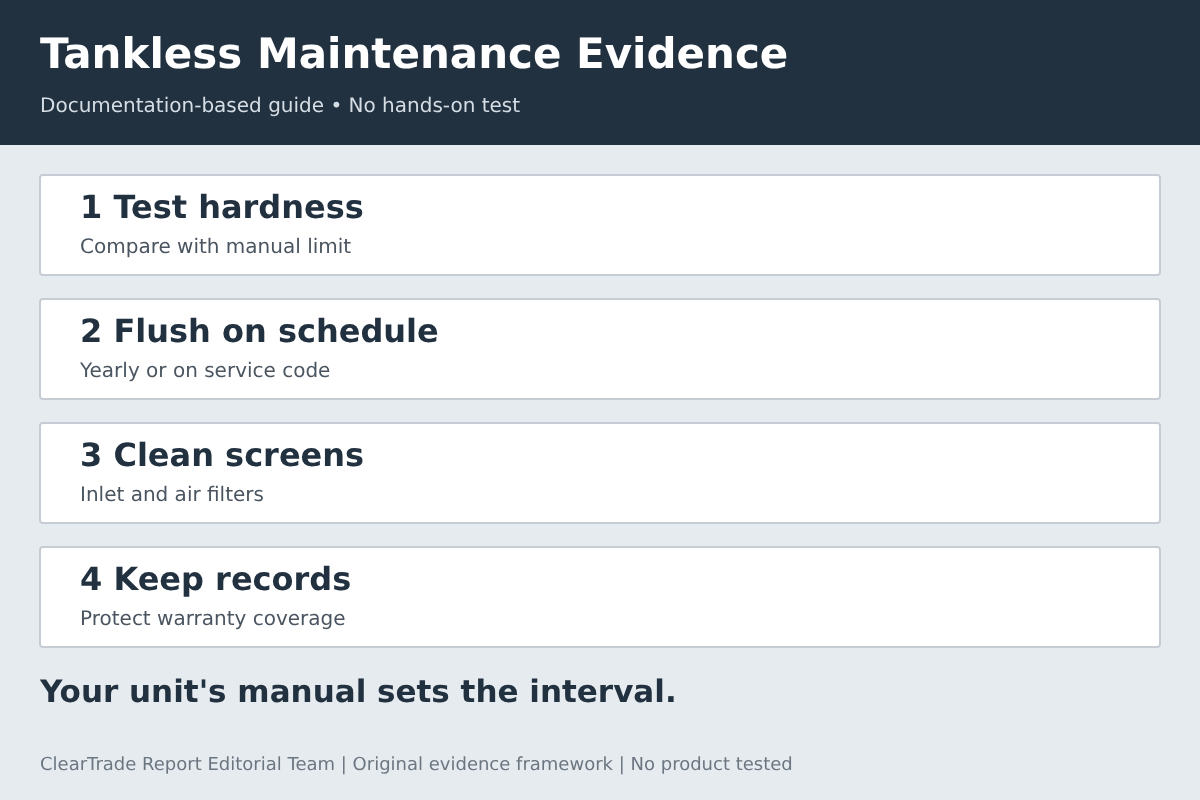
To plan maintenance for a tankless water heater you already own, gather four pieces of evidence: the installation and operation manual for your exact model, a recent hardness test of your incoming water, the manufacturer’s current warranty, and a record of past flushes and service codes. Manufacturer documents tie the flushing schedule to water hardness, use the unit’s display to flag when service is due, and exclude scale damage from warranty coverage. Intervals vary by model and water quality, and the manual for your unit governs. Owners can usually clean screens and filters. Gas, venting and internal repairs belong to a qualified technician.
Evidence label: Documentation-based guide. ClearTrade Report Editorial Team checked U.S. Department of Energy, Rinnai, Navien and Noritz manuals, technical bulletins, warranty documents and maintenance pages on November 9, 2026. No hands-on testing, site visit or outside professional review was performed. Organizations and products named below are documentation examples, not recommendations. This guide contains no affiliate links.
Start with the manual for your exact model
The U.S. Department of Energy (DOE) Energy Saver page “Tankless or Demand-Type Water Heaters” says: “Periodic water heater maintenance can significantly extend your water heater’s life and minimize loss of efficiency.” Its next instruction is the one this guide is built on: “Read your owner’s manual for specific maintenance recommendations.”
Manuals agree on one boundary. The Navien “User’s Information Manual, NPE Condensing Water Heaters” (models NPE-180A2, NPE-210A2, NPE-240A2 and the S2 versions) says: “Installation and service must be performed by a qualified installer, service agency or the gas supplier.” It adds: “Do not attempt to repair or replace any part of the water heater, unless it is specifically recommended in this manual.”
The Rinnai “Tankless Water Heater Installation and Operation Manual” (document U334-0771(02), models RU199i, RU180i, RU160i, RU130i and their outdoor “e” versions) uses the same sentence: “Installation and service must be performed by a qualified installer, service agency or the gas supplier.” It also says: “Only trained and qualified professionals are permitted to adjust parameter settings.”
In plain terms: owners do only the tasks the manual assigns to the user. Gas, burner, venting repairs, internal parts and control settings go to a qualified technician.
Water hardness and water quality limits
Scale forms from minerals in hard water. The Rinnai manual says: “Scale build-up is caused by hard water and can be accelerated if the water heater is set at a high temperature.”
The Rinnai manual publishes a water quality table. It lists “Total Hardness Up to 200 mg/L” and “pH * 6.5 to 8.5,” among other limits. Where water is hard or causes scale, it says “the water must be treated and may require a more frequent flushing schedule.”
Noritz states its threshold in its warranty. The Noritz “Limited Warranty” for tankless water heaters excludes damage from “water with high PH levels or hardness levels in excess of 12 grains per gallon (200 mg/L).”
Navien’s maintenance page “Tankless Water Heater Maintenance” (November 26, 2024) does not give a number. It says: “Your tankless water heater maintenance schedule depends in part on water hardness. If you have hard water, you may need to perform maintenance more often.”
Start with a hardness result in mg/L or grains per gallon and compare it with your manual or warranty.
Flushing intervals and the codes that call for service
Intervals. No single interval covers every unit. Navien’s maintenance page says “annual maintenance is recommended.” Rinnai’s consumer page “13-Step Tankless Water Heater Flushing Procedure” says it is “important to flush those mineral deposits at least once a year.”
Built-in reminders. Some units count the time for you. The Rinnai manual says that, when selected in the parameter settings, “an SS code will display on the controller indicating that it is time to flush and service the water heater.” The parameter offers settings of half a year, 1 year or 2 years, and the manual says: “Selection is installers preference based on water conditions or other factors.” The Navien manual lists “E760 Flushing/service alarm” with the action “Contact the installer to perform routine service.”
Codes that point to scale. Rinnai technical bulletin TB-75, “Condensing Water Heater Error Codes” (August 2010) lists “LC Scale Build-up in Heat Exchanger.” In the maintenance code history, “00” is substituted for “LC.” The remedy: “Flush heat exchanger. Refer to instructions in manual.” It notes: “The LC code is the only error code that will allow the unit to keep running.” In the Navien manual, codes E016 and E030 list the actions “Clean the cold water inlet filter” and “Flush the heat exchanger.” A Noritz “Descale Procedure” for its GQ-series models ties scale to a “C*#” code.
Code meanings differ by brand and model. Check your own manual.
What a flush involves. Rinnai bulletin TB-188, “Optimized Flushing Procedure for SENSEI Tankless Water Heaters” (May 2023) says: “Lime/scale build up can damage a water heater and reduce performance.” It calls for “four gallons of undiluted virgin, food grade, white vinegar” circulated “at a rate of 3-4 gallons per minute (11-15 liters per minute)” for “at least 1 hour.” It warns: “Power must be unplugged.” The Navien manual calls for circulating the solution “for at least 45 minutes” and says: “Flushing the Heat Exchanger is a somewhat complicated procedure.” It says to contact “an authorized technician or licensed professional” if uncertain. The Noritz descale document says it is “only intended for use by a qualified service professional or authorized Noritz Service Representative.”
These procedures differ, which is why your model’s manual governs.
Service valves, inlet screens and air intake checks
Isolation valves. A flush needs a way to close off the unit and connect a pump. The Rinnai manual says isolation valves “allow quick and easy access to flush the heat exchanger.” TB-188 says to “Close the shutoff valves on both the hot water and cold water lines” before using the service ports. If your unit has no service valves, have a technician assess the piping.
Inlet water filter screen. Navien’s page “Simple Tips for Maintaining Your Navien Unit” (September 25, 2017) says: “All Navien tankless water heaters have water screens on the cold water inlet.” The Navien manual has the owner drain the unit with power off, gas valve closed and water supply closed, then: “While the filters are removed, rinse it with clean running water (cold) and, if necessary, scrub it clean with a brush.” TB-188 says to “remove the in-line filter at the cold water inlet and clean out any residue,” and “Clean filters immediately after flush is complete.” TB-75 lists “Clean inlet water supply filter” when water flow will not start the unit.
Air intake and vent. The Navien manual says: “To properly maintain the water heater, you should clean the air intake filter every 3-4 months.” It also says: “Inspect the vent termination and air intake supply annually to ensure proper operation of the water heater.” If a vent pipe is damaged, separated or corroded, the Navien manual says to turn off and stop using the water heater.
If your system has a recirculation loop, our guide to hot water recirculation controls explains control types, which matter for the warranty terms below.
Warranty conditions tied to water and maintenance
Every warranty checked excludes scale or water quality damage in some form.
- Rinnai. The manual says: “Replacement of components due to water quality damage is not covered by the warranty.” The Rinnai Limited Warranty for SENSEI residential tankless water heaters excludes “Any damage caused by poor water quality” and “Improper maintenance (such as but not limited to scale build-up, freeze damage, or vent blockage).” Its residential heat exchanger term reads: “15 years or 12,000 operation hours, whichever occurs first.”
- Navien. The NPE-A warranty page excludes “Any damage caused by local adverse conditions including but not limited to hard water deposits, lime or mineral build-up.” It also lists “Failure to perform regular maintenance” and units “installed by a non-licensed installer.” The residential heat exchanger term is “15 Years” with standard or controlled recirculation and “5 Years” with uncontrolled recirculation, for units the page says were manufactured on or after January 1, 2016.
- Noritz. The warranty excludes hardness above 12 grains per gallon (200 mg/L) and “Improper, dangerous, or destructive maintenance procedures.” The descale document says damage is not covered when the heat exchanger was not flushed after a “C*#” code.
Keep dated records of hardness tests, flushes, filter cleanings, codes and who did the work.
Planning table: task, who does it, what the documents say
| Task | Who, per the documents | Interval or trigger in the documents | Record to keep |
|---|---|---|---|
| Test incoming water hardness | Owner or water treatment provider | Compare with the manual or warranty limit, such as 200 mg/L in the Rinnai manual or 12 grains per gallon (200 mg/L) in the Noritz warranty | Test date, result and units |
| Flush or descale heat exchanger | Manual decides; Navien points owners to a technician if unsure; Rinnai says to contact a service provider when SS appears; Noritz procedure is for qualified professionals | Often yearly; more often with hard water; or when an SS, E760, LC or C*# code appears | Date, solution used, circulation time, who did it |
| Clean cold water inlet filter screen | Owner, where the manual describes it | As needed, after a flush, or when a code or low flow points to it | Date and condition of screen |
| Clean air intake filter | Owner, where the manual describes it | Every 3 to 4 months in the Navien NPE manual | Date cleaned |
| Inspect vent termination and air intake | Owner looks; technician repairs | Annually in the Navien NPE manual | Date, findings, any repair |
| Respond to scale or service codes | Owner reads code; installer or service provider services | When the code appears | Code, date, action taken |
| Gas, burner, controls, internal parts | Qualified installer, service agency or gas supplier | When needed | Service invoice |
This table is our summary of the cited manufacturer and government documents, not a code, manufacturer or warranty requirement. Your unit’s manual governs.
Know the limits of this guide
ClearTrade Report Editorial Team read public documents on November 9, 2026. We did not flush, inspect or test any water heater or water supply. The documents cover selected Rinnai, Navien and Noritz models. Other brands and older or newer models may use different limits, codes and procedures. Rinnai TB-75 dates from 2010, and the Noritz warranty file carries no revision date, so check for current versions. This guide does not cover choosing a water heater, water treatment equipment, freeze protection or gas and venting code compliance.
Primary references checked November 9, 2026: U.S. Department of Energy, Energy Saver, “Tankless or Demand-Type Water Heaters”; Rinnai, “Tankless Water Heater Installation and Operation Manual” (U334-0771(02)); Rinnai, Limited Warranty for SENSEI residential tankless water heaters (100000655(04)); Rinnai, TB-188 flushing bulletin; Rinnai, TB-75 error code bulletin; Rinnai, “13-Step Tankless Water Heater Flushing Procedure”; Navien, “User’s Information Manual, NPE Condensing Water Heaters”; Navien, NPE-A warranty page; Navien, “Tankless Water Heater Maintenance”; Navien, “Simple Tips for Maintaining Your Navien Unit”; Noritz, “Limited Warranty” for tankless water heaters (SBA8743); Noritz, “Descale Procedure.”
Frequently asked questions
How often should a tankless water heater be flushed?
It depends on the model and your water. Navien recommends annual maintenance and says hard water may require it more often. Rinnai says to flush at least once a year, and its manual lets the installer set a service reminder of half a year, 1 year or 2 years based on water conditions. Your unit’s manual governs.
What water hardness is too high for a tankless water heater?
Check your manual and warranty. The Rinnai manual lists total hardness up to 200 mg/L, and the Noritz warranty excludes damage from hardness above 12 grains per gallon (200 mg/L). Rinnai says hard water that causes scale must be treated and may need more frequent flushing.
Can an owner flush a tankless water heater or should a technician do it?
The manual decides. Navien publishes an owner procedure but calls it somewhat complicated and says to contact an authorized technician or licensed professional if uncertain. The Noritz descale procedure is intended for qualified service professionals. Gas, burner and internal repairs belong to a qualified installer, service agency or the gas supplier.
Does skipping maintenance affect the warranty?
It can. Rinnai excludes damage from poor water quality and improper maintenance such as scale build-up. Navien excludes hard water deposits, lime or mineral build-up and failure to perform regular maintenance. Noritz excludes hardness above 12 grains per gallon and improper maintenance.
Disclaimer: This guide is general information based on manufacturer and government documentation, not professional plumbing, gas or warranty advice for a specific site. Intervals, limits and procedures vary by model and water quality, so follow the manual for your unit and use a qualified technician for gas, venting and internal repairs. AI tools assisted with drafting. ClearTrade Report Editorial Team checked the cited sources and edited this guide. No hands-on testing was performed.
Need a qualified professional?
Trusted Pros uses visible license-verification states and never ranks paid listings above unpaid listings.