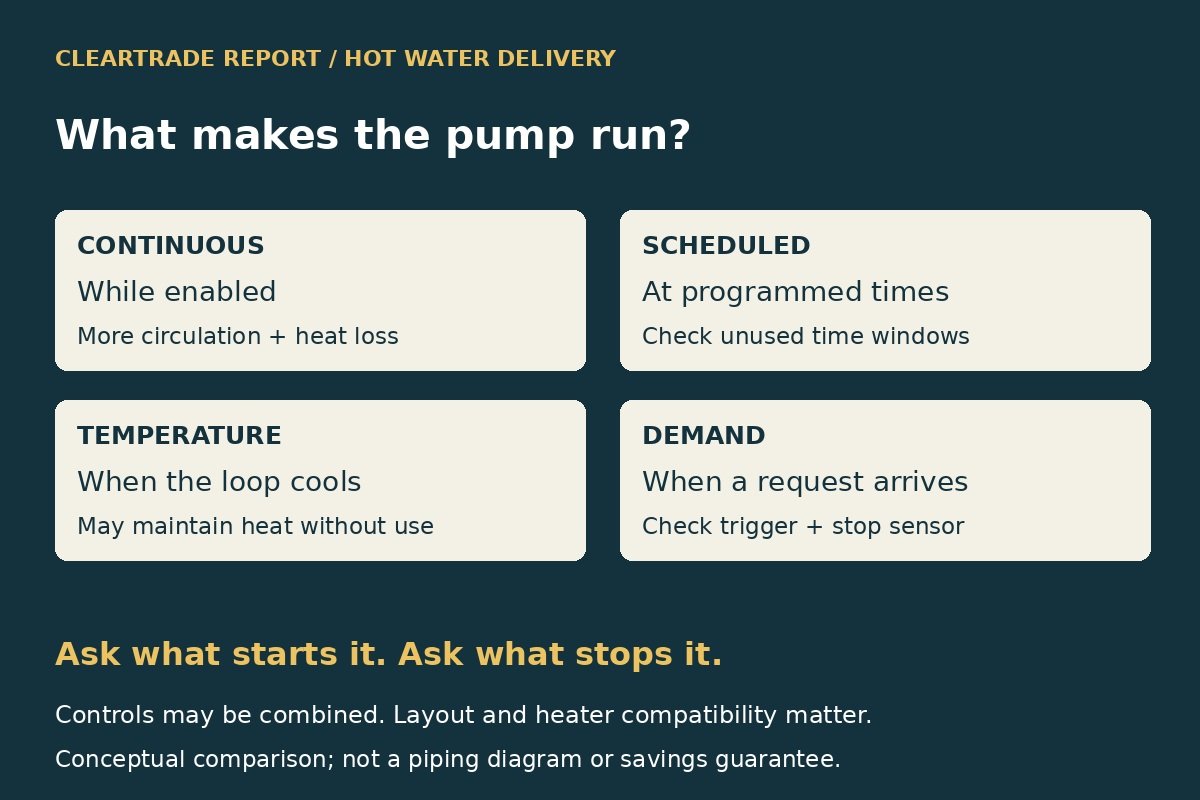
How quickly hot water reaches a fixture depends on the pipe layout, pipe volume, insulation, water use, and how the system is controlled. A recirculation pump can reduce the wait by moving water through a loop, but the pump also adds electrical use and circulating hot water can increase heat loss from the piping. For most homes, compare a shorter, well-designed hot-water route with demand-initiated recirculation before choosing a timer or continuous operation.
DOE Building America explains that a demand-initiated system starts circulation when an occupant or fixture signals a need for hot water. The design can reduce the time water waits at a fixture while avoiding circulation when there is no demand. It is not a universal energy-savings guarantee: performance depends on the layout, controls, pipe insulation, hot-water use, and water-heater compatibility.
What a recirculation system does
In a dedicated-loop system, a pump moves hot water through a supply loop and a return pipe back to the water heater. The loop keeps hot water closer to fixtures, so a user waits less for the cooled water in the branch to clear. A retrofit system may use the cold-water pipe as a temporary return path; this changes the behavior of the cold line and must be designed for the particular equipment and plumbing layout.
Recirculation does not remove the need to heat water. If hot water is kept moving or held hot for long periods, heat escapes through the piping and the water heater must replace that heat. DOE’s Building America materials identify distribution heat loss and pump energy as part of the system’s overall energy use. The useful comparison is therefore the whole delivery system, not pump wattage alone.
Compare the control strategies
| Control approach | How it operates | Main tradeoff to check |
|---|---|---|
| Continuous | Pump runs whenever the system is enabled, often maintaining a hot loop. | Fast availability can come with more pump operation and piping heat loss during low-use periods. |
| Timer or schedule | Pump runs during programmed windows. | Can match predictable routines; hot water may not be ready outside the schedule, and fixed schedules may circulate when no one needs it. |
| Temperature control | A sensor starts or stops circulation based on water temperature. | May limit pump runtime, but a warm loop can still lose heat between draws. Confirm how the specific control senses and limits operation. |
| Demand-initiated | A user switch, occupancy signal, or fixture-related signal requests circulation. | Runs in response to demand, but trigger location, wait time, controls, and return path affect the experience. |
| Adaptive schedule | A control learns or anticipates recurring hot-water demand. | May suit stable routines; verify what data it learns, how it behaves when routines change, and whether it is compatible with the water heater. |
Control labels alone do not establish performance. Ask when the pump starts, what stops it, and whether a scheduled or temperature-maintenance mode keeps the loop warm even without a fixture request. A timer combined with a temperature sensor behaves differently from a timer alone.
Start with the layout
EPA’s May 2026 Best Practices for Efficient Hot Water Delivery in Homes retains 0.5 gallons of stored water between source and fixture as a useful design benchmark. The guide explicitly says this is no longer a WaterSense homes specification requirement. It is also not a universal plumbing-code limit. Have the designer verify the actual adopted requirements and calculate pipe volume for the proposed route.
Before adding a pump, identify the fixtures with the longest wait and the piping route serving them. A compact distribution layout can reduce the amount of water sitting in the pipe before hot water arrives. The Department of Energy’s Building Science Education resources discuss compact “core” layouts and demand plumbing as alternatives or complements to recirculation.
For an existing home, map the water heater, the farthest fixtures, the pipe route, and any existing return line. Pipe insulation, branch length, fixture flow, and whether cold-water delivery is affected all matter. If only one sink has a long wait, a whole-house continuous loop may be more system than the problem requires.
Measure the baseline before promising savings
Record the affected fixture, its starting conditions, how long hot water takes to arrive and how much water is collected during the wait. Repeat under comparable conditions after changes. A recently used hot-water line will produce a different result from one left idle overnight. Keep fixture flow and the chosen usable-temperature criterion consistent.
For example, collecting 1.5 gallons during one wait and repeating that event four times per day gives 6 gallons per day for those assumed events. That is an illustration, not a measured household saving. A pump may reduce discarded water while adding electricity use and distribution heat loss. Water and energy savings must be assessed separately; a shorter wait is not evidence that total utility cost fell.
Water heater compatibility matters
Not every water heater is intended to operate with every recirculation arrangement. Storage, tankless, and heat-pump water heaters can have different control requirements and manufacturer-approved configurations. Check the exact installation manual and warranty terms before adding a pump or changing a return path. For heat-pump water heaters in particular, consult the manufacturer’s instructions and a qualified plumbing professional rather than assuming a generic pump kit will work.
Central domestic hot-water systems in multifamily or commercial buildings have different design and operation needs from a single-family home. Balancing, temperature maintenance, water quality, and maintenance procedures require a system-level review. Do not apply a home retrofit diagram to a central building loop without qualified design review.
Questions to ask before choosing a system
- Which fixtures have the longest wait, and how much water is discharged before hot water arrives?
- Can a shorter or more direct pipe route solve the problem with less equipment?
- Is there a dedicated return line, or does the proposed design use the cold-water line?
- Will the pump run continuously, on a schedule, by temperature, on demand, or using an adaptive control?
- What happens to cold-water delivery while the pump runs?
- Does the water-heater manufacturer approve the proposed recirculation method and controls?
- Are pipes insulated, and which portions of the loop remain warm between uses?
- For a shared building system, who will verify balancing, temperatures, controls, and maintenance?
Choose controls around the actual problem
A demand-initiated system is often the first recirculation approach to evaluate when the goal is reducing fixture wait without continuously circulating hot water. A timer can be reasonable where demand is predictable, while continuous operation may be selected for specific system requirements after its heat loss and pump use are considered. In every case, start with the actual piping layout and the water-heater manufacturer’s instructions. No control strategy guarantees lower total energy use in every home.
For related planning, see Heat Pump Water Heater Readiness: Space, Air, Drainage, and Electrical Planning.
Wastewater heat recovery addresses a different energy path from distribution circulation. The drain-water heat recovery project-fit guide explains how simultaneous flow, equipment layout and performance evidence support a separate assessment.
Frequently asked questions
Does recirculation guarantee instant hot water?
No. The result depends on the loop, branch length, controls and starting temperature. A demand system may need a short preparation period after activation, and water remaining in a branch still has to reach the fixture.
Is a timer the same as demand control?
No. A fixed timer enables operation during scheduled periods. Demand control responds to a request. Some systems combine several controls, so ask for the actual start and stop sequence.
Can a retrofit affect the cold-water tap?
Yes. Some retrofit designs use the cold line as a return path and can temporarily warm cold-water delivery. Confirm this behavior, the return arrangement and water-heater compatibility before selecting equipment.
Will a recirculation pump reduce my energy bill?
It may, but there is no universal guarantee. Pump electricity and pipe heat losses can offset benefits. Compare measured water use, operating schedules and total energy use for the actual installation.
Sources and editorial method
Source review: October 26, 2026 Pacific. This comparison uses government technical guidance and describes control strategies, not a tested product ranking. No ClearTrade field test, savings measurement or outside professional review is claimed. Shared central-building systems require their own water-management and operational assessment; this home-planning comparison does not prescribe central-loop temperatures or shutdown schedules.
- EPA: Best Practices for Efficient Hot Water Delivery in Homes, May 2026
- EPA: WaterSense hot-water delivery resources
- ENERGY STAR: Demand Hot Water Recirculating System
- Building America Solution Center: Demand Plumbing
- DOE: Strategy Guideline—Proper Water Heater Selection
AI tools assisted with drafting. ClearTrade Report Editorial Team checked the cited sources and edited this comparison. No hands-on testing was performed.
Need a qualified professional?
Trusted Pros uses visible license-verification states and never ranks paid listings above unpaid listings.