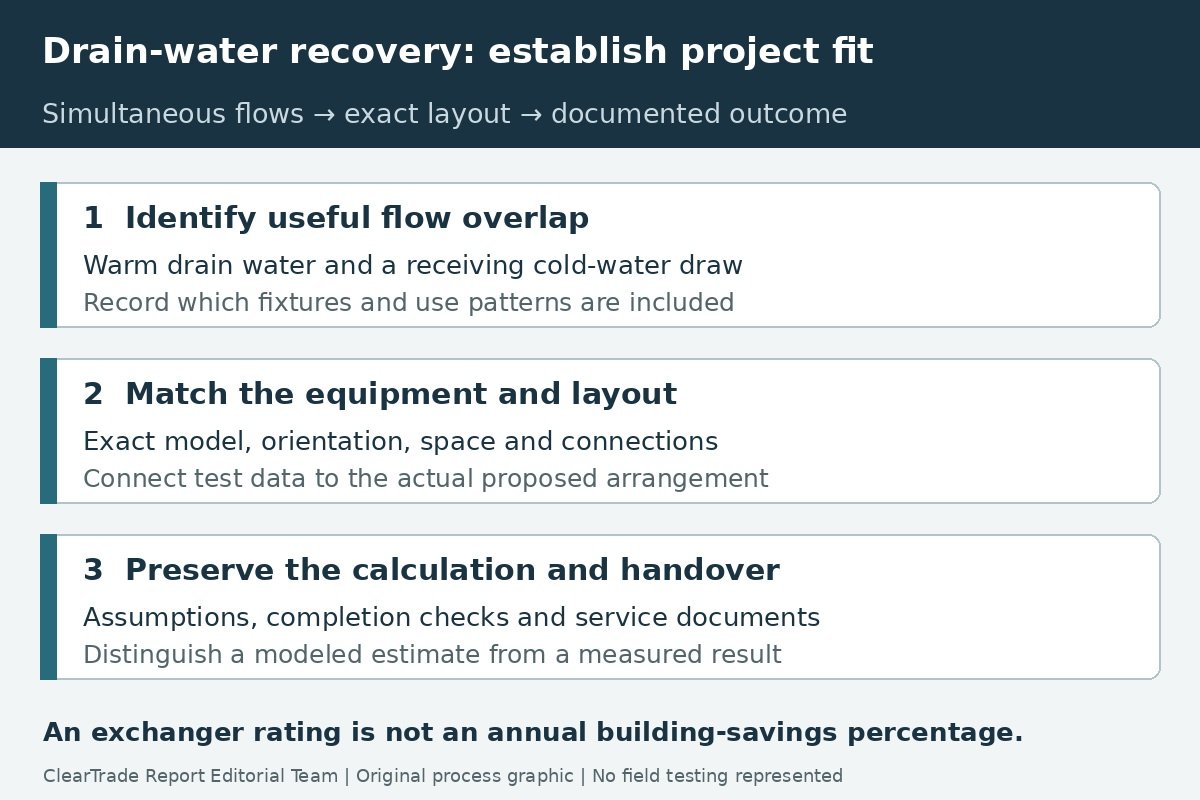
Drain-water heat recovery is worth evaluating when warm wastewater is flowing while incoming cold water can use its heat. A shower is the clearest household example. Before comparing equipment, identify the overlapping flows, the available installation space and the proposed plumbing arrangement. A high heat-exchanger rating alone does not establish annual savings for a building.
This guide helps remodelers and multifamily owners commission that evaluation. It concerns heat recovery from drain water, not a generic recommendation to add an exchanger to every drain. No ClearTrade site survey, installation or instrumented performance test was performed.
Understand which energy the device recovers
Natural Resources Canada describes a drain-water heat-recovery pipe that transfers heat from warm drain water through copper walls to an incoming freshwater supply. The streams exchange heat without mixing. Preheating reduces the remaining heating needed to reach the water-heating set temperature.
That does not mean the drain water becomes drinking water, or that the exchanger supplies all the heat a fixture needs. Ask the provider to show the two separate flow paths and where the preheated water goes. The drawing should identify the water heater, relevant fixtures, drain connections and the specific recovery device.
Keep this function distinct from hot-water distribution. The hot-water recirculation controls guide deals with delivering hot water through a building and controlling circulation. Recovering heat from wastewater addresses a different energy path. Neither measure, by its name alone, documents the performance of the other.
Look for overlapping flows rather than total water use
NRCan identifies showers as a common opportunity because warm drainage and freshwater draw occur together. Establish which fixtures feed the proposed exchanger and which cold-water demand it would preheat. A total monthly hot-water bill cannot show whether those events overlap at the relevant pipework.
A bath that fills and drains later illustrates the timing question. Do not assume that the energy in a later discharge can be reused by an instantaneous exchanger when there is no useful simultaneous receiving flow. A system with heat storage needs its own design and operating assessment.
An Oak Ridge National Laboratory report dated September 2012 distinguishes concurrent shower recovery from appliance or tub discharges whose timing may require storage. Its experimental system included a preheat tank, pump and controls. That research is not a test of the passive unit in your quote, and its historical energy and cost results should not be presented as a current savings prediction for your property.
For multifamily buildings, ask how the assessment accounts for actual use patterns and the location of supply and drainage branches. More occupants do not automatically establish useful flow through a particular exchanger at the same time. The proposed connection arrangement must support the calculation.
Build a project-fit record
| Project question | Evidence to request |
|---|---|
| Heat source | Which warm drainage streams reach the proposed unit? |
| Receiving demand | Which simultaneous freshwater draw can receive the recovered heat? |
| Timing | What observations, schedules or measurements support the assumed overlap? |
| Geometry | Available space, pipe orientation and connection dimensions |
| Plumbing arrangement | A labeled diagram of the separate supply and drain paths |
| Equipment | Exact model, installation instructions and applicable performance data |
| Site constraints | Access, service requirements, approvals and unresolved conditions |
| Result | A stated verification method and an owner handover package |
Start with existing plans and a qualified provider’s assessment. Label a design assumption as an assumption until it has been checked. If the building has changed since the drawings were produced, identify the relevant difference rather than relying on the old drawing as proof of current conditions.
An owner need not expose pipework or alter the plumbing to assemble a useful preliminary brief. Record known equipment and locations, provide available documents and ask the provider to identify what must be investigated before selection. A photograph can communicate access conditions without establishing hidden connections or the adequacy of the installation.
Match orientation and layout to the exact design
Do not treat all wastewater heat exchangers as interchangeable lengths of pipe. The UK Energy Technology List criteria for instantaneous systems distinguish standalone horizontal, standalone vertical and plant-room designs. Those categories illustrate why configuration matters; the UK scheme is not a US installation approval or a local plumbing requirement.
The US Standard Work Specifications drain-heat-recovery detail, 7.0301.3, identifies concurrent cold-water draw, adequate vertical drop and following the manufacturer’s installation specifications in its multifamily guidance. Use that as an assessment framework for the type of installation it describes, not as a universal instruction to place every model vertically.
Ask for the applicable current manual for the exact device and an explanation of how its orientation, clearances, connections and service provisions fit the project. If a proposal substitutes a different size or arrangement, request the revised documentation and calculation rather than assuming the original result carries over.
A legacy Power-Pipe installation PDF dated in its filename as 2016 was located during research but could not be retrieved through the web lookup. This article does not apply its unreviewed selection tables or installation directions. The responsible provider should supply the current applicable instructions before equipment is ordered.
Read performance evidence as a test condition
Request the exact model identifier and the source of its performance data. Keep the test method, flow conditions, configuration and pressure-loss information with the efficiency value. If two proposals use different test conditions or different connection arrangements, their percentages may answer different questions.
NRCan’s legacy product-list page explicitly says its table is not up to date and directs readers to an updated list. Do not take an old model row, manufacturer name or search snippet as proof of current availability, certification, eligibility or suitability. This guide does not publish the legacy table’s numerical ratings as current product evidence.
The UK ETL criteria also distinguish heat-recovery efficiency from a score incorporating a utilization factor for installation-related losses. That distinction is a useful reminder to ask what a performance number measures. It is not a reason to apply the UK score or eligibility thresholds to an unrelated US project.
Ask the proposer to explain how the documented equipment performance becomes a project estimate. Preserve the inputs and any adjustment for the installation rather than accepting a percentage with no calculation boundary. A laboratory efficiency is not automatically the same percentage reduction in the entire building’s water-heating bill.
Examine the savings estimate and its boundaries
A reviewable estimate should state which fixtures and use patterns it includes, what useful overlap is assumed and how recovered heat reduces the baseline heating requirement. Identify the energy source and the price basis used for any operating-cost estimate. Keep installed cost separate from equipment price.
Include access work, plumbing alterations, restoration, applicable approvals and other project costs in the comparison. Ask whether the quote covers investigation only, a defined installation or allowances for concealed conditions. An attractive equipment-only payback can change when the actual installation scope is known.
If savings depend on assumed usage, compare more than one plausible use pattern. Record which assumptions are uncertain and whether better evidence would materially change the decision. Do not present a scenario as measured annual performance or describe a historical research energy price as today’s local tariff.
The comparison should also state what is outside the estimate. A drain-water exchanger does not, by this calculation alone, resolve distribution losses, water-heater condition or unrelated plumbing problems. If those matters are part of the project, retain their separate scope and evidence.
Make installation and approval responsibilities explicit
Before approving work, identify who confirms the plumbing arrangement, equipment suitability and applicable local requirements. Ask who obtains any required permits, coordinates water interruptions and checks the completed installation. A general efficiency guide cannot make those determinations for an unidentified building.
For managed buildings, name the party authorizing access and service interruptions, and identify any affected apartments or common systems. Keep the route for reporting a leak or performance concern clear. Do not let responsibility for a shared installation disappear between the owner, installer and equipment supplier.
Request written answers to the unresolved questions before they become assumptions in a final price. If the provider needs additional investigation, specify what it will establish and how resulting changes will be authorized. Do not treat an allowance as confirmation that the selected device already fits.
Keep a verification and handover record
| Handover item | Purpose |
|---|---|
| Installed model and layout | Identify the actual equipment and connections |
| Applicable instructions | Preserve the installation and service requirements used |
| Completion evidence | Record the agreed installation checks and any required inspection |
| Performance basis | Retain test-data references, calculation inputs and limitations |
| Warranty and contacts | Identify support routes and the actual written terms |
| Follow-up plan | Assign responsibility for unresolved items and future service |
The Standard Work Specifications call for supplying owners with manuals, warranty information, installation instructions and installer contact details. Request those documents as part of the scope, rather than attempting to reconstruct the installation from a receipt later.
If the contract includes a performance check, agree on what will be measured, under which operating conditions and how the result will be interpreted. A leak-free installation check and a quantified heat-recovery measurement answer different questions. Keep the provider’s findings separate from the original modeled estimate.
Retain a record of later changes to connected fixtures or water-heating equipment. They may change the assumptions behind the original assessment. A useful handover makes that dependency visible without promising that the original estimate will remain valid under every future use pattern.
Frequently asked questions
Why are showers often discussed with drain-water heat recovery?
Warm drainage and freshwater draw commonly occur together during a shower, creating an opportunity for instantaneous heat transfer. The actual plumbing arrangement and use pattern still need assessment.
Does a high exchanger efficiency mean the same reduction in my water-heating bill?
No. The test value must be connected to project use, flow overlap, configuration and the calculation boundary before estimating energy or cost savings.
Can I apply a vertical-unit layout to a horizontal exchanger?
Use the exact model instructions and project design. Different orientations and system types are not interchangeable solely because they recover wastewater heat.
Is drain-water heat recovery the same as hot-water recirculation?
No. Drain-water recovery transfers heat from wastewater to a useful receiving supply. Recirculation concerns hot-water distribution and its controls.
Sources and scope
Primary sources checked October 27, 2026 Pacific: NRCan drain-water heat recovery guidance; NRCan legacy product list and its out-of-date notice; ORNL September 2012 report abstract; Standard Work Specifications 7.0301.3; and UK ETL instantaneous-system criteria. Captures and access limits are preserved in the source audit. No current model recommendation, listing or recall clearance, installation design, site diagnosis, guaranteed savings, outside professional review or hands-on testing is claimed.
AI tools assisted with drafting. ClearTrade Report Editorial Team checked the cited sources and edited this guide. No hands-on inspection or testing was performed.
Need a qualified professional?
Trusted Pros uses visible license-verification states and never ranks paid listings above unpaid listings.