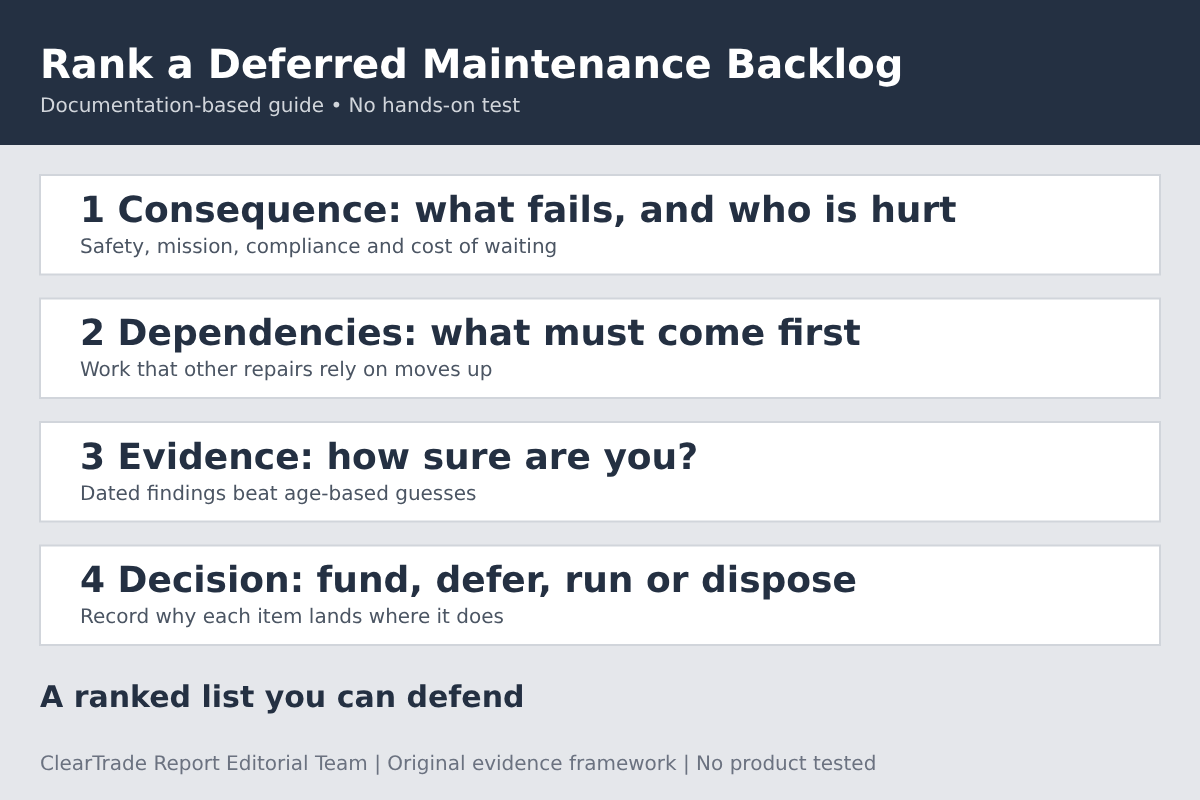
Rank a deferred maintenance backlog with three tests, in order. First, consequence: what happens to life safety, the building and the mission if this item fails. Second, dependencies: which repairs must come first because other work, or other systems, rely on them. Third, evidence: how well a condition assessment, work order history or test result supports the claim. Federal documents from DOE, NASA, Interior and GAO use these building blocks: periodic condition assessments, mission criticality and a written method to prioritize work. The result is a ranked list you can explain to an owner, budget office or auditor.
Evidence label: Documentation-based guide. ClearTrade Report Editorial Team checked documents from the U.S. Department of Energy (including its Federal Energy Management Program), Pacific Northwest National Laboratory, NASA, the U.S. Government Accountability Office, and the U.S. Department of the Interior on November 19, 2026. No outside professional review was performed and nothing was tested. This guide contains no affiliate links.
Why a flat backlog list fails
A backlog sorted by age, by trade or by whoever complained last hides the items that matter.
In Federal Real Property: Agencies Should Provide More Information About Increases in Deferred Maintenance and Repair (GAO-24-105485), GAO writes that “deferring needed maintenance and repair can ultimately result in significantly higher maintenance, repair, and operating costs, or premature replacement.” GSA officials told GAO that funding limits had “further exacerbated problems as repairs turn into replacements, with the potential for system failures that result in cascading impacts to occupant agency missions.”
One deferred item can raise the cost or risk of several others. The Federal Energy Management Program’s Operations & Maintenance Best Practices guide (Release 3.0) treats the backlog itself as a signal. It lists backlog of corrective maintenance as a metric and describes it as “An indicator of workload issues and effectiveness of preventive/predictive maintenance programs.” It tells you the program is not keeping up, not what to fix first.
Separate deferred maintenance from repair needs
DOE Order 430.1C, Real Property Asset Management, defines deferred maintenance and repair as “Maintenance and repairs that were not performed when they should have been or were scheduled to be and which are put off or delayed for a future period.” It defines repair needs as “The estimated cost to restore a real property asset’s component system failures noted during a condition assessment survey to a state substantially equivalent to the most recently configured capacity, efficiency, or capability.” It adds: “Repair needs will always equal or exceed DM; the difference between the two depends on each noted deficiency’s optimum period and acceptability to management.”
In plain terms, repair needs are everything the assessment found wrong. Deferred maintenance is the part that is already overdue. The Department of the Interior’s policy on deferred maintenance and repairs (DOI-AAAP 0192) also says the definition excludes “activities directed towards expanding the capacity of an asset or otherwise upgrading it.”
Tag each backlog line as overdue repair, future repair or upgrade. Mixing in upgrades muddies the ranking.
Rank by consequence first
Consequence decides what cannot wait. NASA’s NPR 8831.2F Chapter 7, on reliability centered maintenance, says “The most important consequence of failure is a threat to safety.” Its Table 7-3 sets reactive maintenance priorities by the consequence of failure. Priority 1, Emergency, is “Safety of life or property threatened. Immediate serious impact on mission.” Priority 2, Urgent, is “Continuous facility operation threatened. Impending serious impact on mission.” Priority 3’s criteria begin “Degrades quality of mission support.” Priority 4, Routine, applies where “Redundancy available. Impact on mission insignificant.”
The same consequence ladder works for a backlog. Ask of each item: if this fails next month, is anyone at risk, does the building stop working, or is it an inconvenience?
Next is mission. GAO’s leading practices say “agencies should identify assets as mission-critical and mission-supportive to help establish where maintenance and repair investments should be targeted.” For a commercial owner, mission means tenant operations, revenue and occupant health.
Pacific Northwest National Laboratory’s O&M best practices page Prioritizing O&M Actions pairs consequence with likelihood. It says “The impact that failure in systems and components may have on health and safety should also be considered,” and “the probability of failure should also be considered in the prioritization process.”
Map dependencies: what has to go first
Dependencies set the order of work. This is where a portfolio view, across all trades, beats a single-trade checklist.
A dependency exists when one repair is needed before another can last, be done safely, or be done at all. The patterns below are this guide’s own planning reasoning, not rules from any cited source. The GAO examples only show that such systems appear in real backlogs:
- Envelope before interior. In an example of a GSA records center, GAO notes that original building systems, “including roofs and retaining walls,” are still in operation and that the entire roof needs replacement. Interior work under an active leak risks being redone.
- Utility source before downstream loads. At a DOE laboratory, GAO found aging “electrical switching, pumping, and heating, ventilation, and air conditioning equipment” included in deferred maintenance and repair estimates. A failing upstream switch, pump or plant puts every system it serves at risk.
- Enabling repairs first. Isolation valves, shutoffs and lockout points must work before trades can safely repair what sits behind them.
- Parts and lead time before the outage. If a critical item cannot be repaired without a long-lead part, ordering it is the first task. See our guide to critical spare parts stock levels and lead time.
Record each dependency as a link between backlog lines. A low-consequence item that blocks a high-consequence item should move up.
DOE Order 430.1C lists “a master equipment list” among the parts of a maintenance management program. Without one, you cannot trace which equipment serves which systems.
Grade the evidence behind each item
Identical-looking backlog lines can rest on very different proof.
Condition assessments. DOE Order 430.1C directs DOE elements to “perform physical condition assessments on each real property asset at least once every five-year period,” and “more frequent assessments for real property assets identified as mission unique or critical, or assets that pose an increased risk to life safety or the environment.” Interior’s policy and NASA’s NPR 8831.2F Chapter 1 also set a five-year minimum. An item last seen more than five years ago is weaker evidence than one seen this year.
Work order and failure history. NASA’s Chapter 7 says “The CMMS and work order form shall include fields for failure codes to maintain historical data.” The PNNL brief offers two ways to rank probability of failure: “the first is based on CMMS data, and the second is based on operator experience (when CMMS data is not available).” Repeat failures on the same asset are strong evidence of likelihood.
Testing and inspection. NASA’s NPR 8831.2F definitions appendix defines predictive testing and inspection as “The use of advanced technology to assess machinery condition.” A dated test reading is stronger than an opinion.
Documentation gaps. The FEMP guide notes that “building operators may not have proper documentation.” Flag missing records rather than guessing.
| Ranking factor | Question to answer for each backlog item | Stronger evidence | Weaker evidence |
|---|---|---|---|
| Consequence: safety | Could failure threaten life or property? | Condition assessment finding tied to a life safety system; code inspection report | Undated note or verbal concern |
| Consequence: mission | Would failure stop operations, tenants or revenue? | Asset tagged mission-critical in a master equipment list; documented loads served | Assumed importance with no system map |
| Dependency | Does other work, or another system, rely on this repair? | Linked backlog items; one-line diagrams or riser drawings; parts lead time quote | “Probably connected” with no drawing |
| Likelihood | How likely is failure soon? | CMMS failure codes showing repeat failures; dated test or inspection readings | Operator recollection only (still usable when CMMS data is absent) |
| Evidence age | When was this condition last observed? | Assessment within the last five years, or sooner for critical assets | Older than five years or source unknown |
| Category | Is it overdue repair, future repair or upgrade? | Tagged using written definitions such as DOE’s DM and repair needs | Untagged line items mixing repairs and improvements |
Turn the ranking into defensible decisions
A ranked list is only useful if it leads to a decision on every line.
Fund it now. High consequence, items that block other work, and items with strong evidence of near-term failure go first.
Defer it on purpose. DOE Order 430.1C expects a maintenance program to include “a method to determine for each asset the minimum acceptable level of condition,” “methods for categorizing deficiencies as either DM or RN; management of the DM backlog,” “and a method to prioritize maintenance work.” A written deferral with a reason and a recheck date is a decision. An item that simply sits is not.
Run it to failure. NASA’s Chapter 7 says “In RCM, run-to-failure is a conscious decision and is acceptable for some equipment.” The PNNL brief gives an example: “systems with low capital costs and for which failure will not affect the facility mission or occupant safety may be more cost effective to replace at failure than to expend resources during preventive and predictive maintenance tasks.”
Dispose or consolidate. One GAO leading practice is to “Align Portfolios with Mission Needs and Dispose of Unneeded Assets.”
Another GAO leading practice is to “Structure Budgets to Separately Identify Funding to Address Maintenance and Repair and DM&R Backlogs.” Interior’s Asset Priority Index weights mission heavily: “80% of the 100-point score is reserved for criteria that reflect the bureau’s unique mission.”
Know the limits of this guide
This guide summarizes federal documents. Most were written for government portfolios and do not bind a private owner. Applying NASA’s reactive maintenance priorities to a backlog is this guide’s suggestion. The dependency patterns listed here are this guide’s own planning reasoning, not rules from a cited source. Condition indexes and scoring methods differ by agency, so confirm which formula any report uses before comparing numbers. Nothing here replaces a qualified condition assessment or an engineer’s judgment.
Primary references checked November 19, 2026: U.S. Government Accountability Office, Federal Real Property: Agencies Should Provide More Information About Increases in Deferred Maintenance and Repair (GAO-24-105485); U.S. Department of Energy, DOE O 430.1C Chg 2, Real Property Asset Management (as hosted by WBDG); U.S. Department of Energy Federal Energy Management Program, Operations & Maintenance Best Practices: A Guide to Achieving Operational Efficiency, Release 3.0; Pacific Northwest National Laboratory, Prioritizing O&M Actions; NASA, NPR 8831.2F Facilities Maintenance and Operations Management, Chapter 1, Chapter 7 and Appendix A; U.S. Department of the Interior, DOI-AAAP 0192 Standards for Deferred Maintenance and Repairs, Repair Needs, Investment Categories, and Other Requirements (as hosted by the Bureau of Indian Affairs).
Frequently asked questions
What is the difference between deferred maintenance and repair needs?
DOE Order 430.1C defines deferred maintenance as maintenance and repairs not performed when they should have been and put off to a future period. Repair needs are the estimated cost to restore component system failures noted during a condition assessment. DOE says repair needs always equal or exceed deferred maintenance.
How often should a building’s condition be assessed?
DOE, the Department of the Interior and NASA each require condition assessments at least once every five years for their own assets. DOE also calls for more frequent assessments of mission-critical assets and assets with increased risk to life safety or the environment. Private owners are not bound by these rules but can use them as a benchmark.
Is it ever acceptable to let equipment run to failure?
Yes, when it is a deliberate choice. NASA says run-to-failure is a conscious decision and acceptable for some equipment. A PNNL O&M best practices page says low-cost systems whose failure will not affect the mission or occupant safety may be cheaper to replace at failure.
Does a property condition assessment rank my backlog for me?
Not by itself. An assessment records deficiencies, and DOE defines repair needs as the estimated cost to restore failures noted during a condition assessment survey. Ranking those items by consequence, dependencies and evidence is a separate step for the owner.
Disclaimer: This guide is general information based on government documents, not professional engineering, facilities or financial advice for a specific building or portfolio. Confirm priorities with qualified facility assessors, engineers and your local code official. Standards and agency guidance may change. AI tools assisted with drafting. ClearTrade Report Editorial Team checked the cited sources and edited this guide.
Need a qualified professional?
Trusted Pros uses visible license-verification states and never ranks paid listings above unpaid listings.