On this page
- Start with the contract’s process
- Record the trigger without assigning blame prematurely
- Define the actual scope change
- Make the price basis visible
- Address time as well as money
- Keep requests, proposals and approvals distinct
- Close the loop in the project record
- A compact change-order checklist
- Frequently asked questions
- Sources
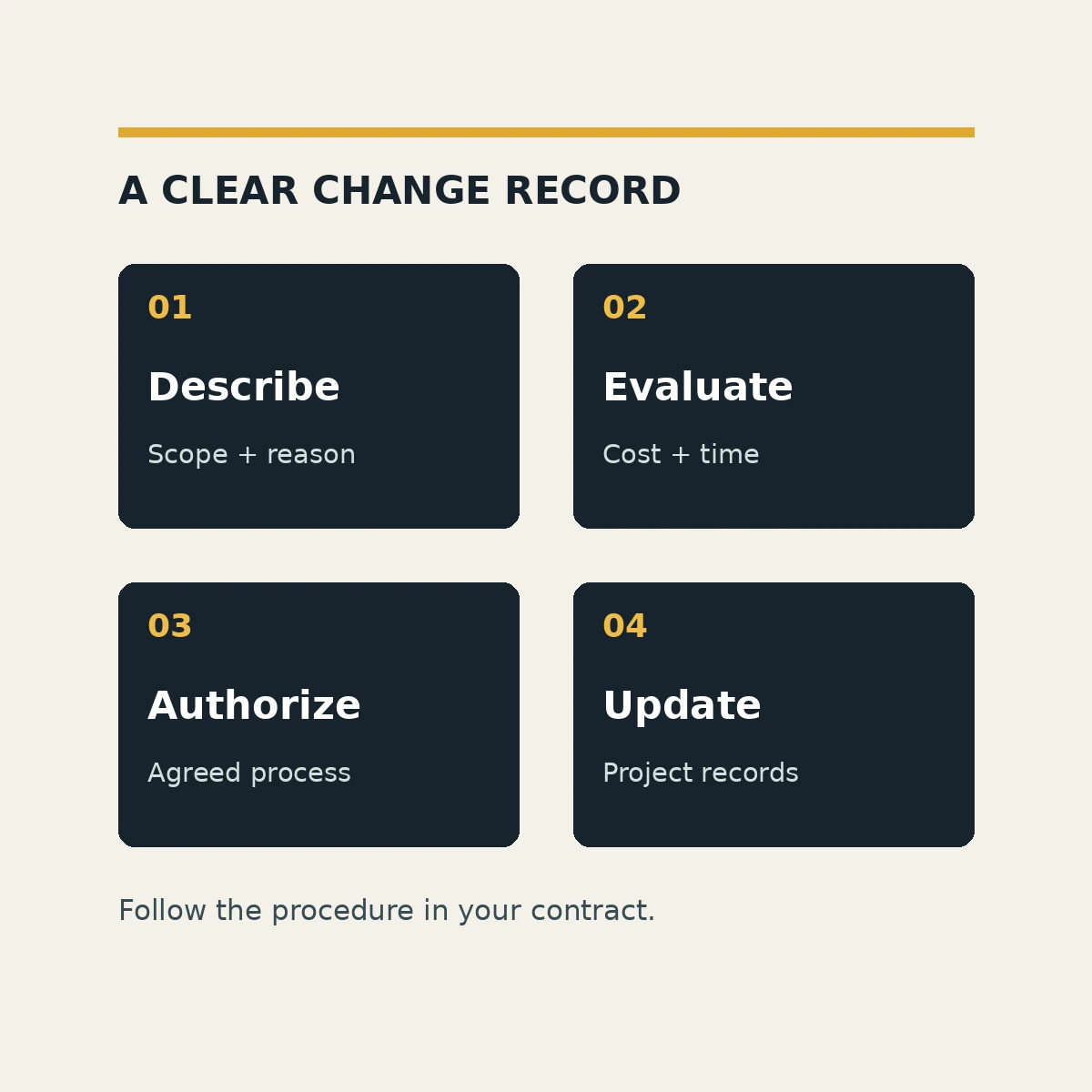
A useful change order makes a project change understandable before the work, price and schedule drift apart. It identifies what changes, why it changes, how it will be priced, who can approve it and what happens to the project schedule.
It is not merely an extra charge added to the final invoice. A request for pricing is not automatically authorization to proceed.
The checklist below is ClearTrade’s documentation framework. Apply the procedure in your own contract; it does not establish legal rights or replace project-specific advice.
Start with the contract’s process
Before work starts, identify the contract’s change procedure and the people allowed to give direction. Confirm how proposals, approvals and disputed changes will be documented.
An owner’s conversation with a field worker may express a preference without resolving price, schedule or approval authority. Route the request through the agreed process.
Washington L&I’s consumer guidance recommends written contracts that identify scope, materials, payment terms, warranties and change-order processes. That is a useful documentation principle; legal requirements and remedies vary by project and jurisdiction.
Record the trigger without assigning blame prematurely
A change may begin with an owner selection, an unexpected condition, revised design information or a coordination problem. Describe the observed facts and reference the affected drawing, specification, allowance or original scope.
Avoid writing “not included” as the entire explanation. Show what the original documents said and what new work is proposed.
Photographs and field notes can help preserve context. Do not remove or disturb evidence merely to improve the paperwork, and do not delay necessary emergency action while waiting for an ordinary approval cycle.
Define the actual scope change
State additions, deletions and unchanged work. Identify quantities, locations, products and interfaces where they matter.
For example, “add lighting” is incomplete. A useful description identifies the fixtures, control changes, wiring scope, finish-repair responsibility and any work explicitly excluded.
If discovery is required before a firm scope can be written, authorize that discovery separately. Explain its limit and the point at which further approval will be required.
Make the price basis visible
Identify whether the proposal is fixed-price, time-and-materials, unit-price or another agreed basis. State the assumptions, allowances and limits.
Show credits for deleted work where applicable. Record taxes, permit costs and other components consistently with the contract.
A not-to-exceed amount should explain what happens when the limit is approached. It is not a substitute for defining what work is authorized.
Address time as well as money
Ask whether the change affects procurement, access, inspections, sequencing or completion. Some effects may be known immediately; others may need confirmation.
Do not treat “no schedule change” as the default when nobody has evaluated it. If an effect remains unresolved, record the uncertainty and the next decision needed.
ClearTrade’s explanation of permit timelines shows why approval milestones and elapsed project time are different.
Keep requests, proposals and approvals distinct
Use an identifier and revision for each change. Keep the request, supporting records, proposal and actual authorization together.
If approval occurs by an allowed electronic method, preserve the message and exactly which revision it approved. Do not assume that silence, receipt of a proposal or an informal discussion has the legal effect of authorization.
Contract rights and enforceability are legal questions. For a significant dispute or unclear direction, seek qualified contract advice.
Close the loop in the project record
After an approved change, update the scope log, budget and schedule records. Give affected trades the current information.
At completion, confirm that the installed work, inspection records and final invoice reflect the authorized changes. If an issue is still disputed, label it rather than blending it into an apparently settled total.
A compact change-order checklist
A workable record includes:
- Project, change number, date and revision.
- Reason for the change and original-document reference.
- Added and deleted scope.
- Price basis, assumptions and exclusions.
- Schedule effect or stated unresolved impact.
- Authorized approval and date.
- Supporting documents and completion records.
For a proposed specification change after a federal policy announcement, see the 2026 FHA and USDA energy-code reversal and its separate permit, financing and contract checks.
Related reading: roof replacement and claim documentation.
A ceiling-fan replacement can uncover support work that was not included in the original scope. Our ceiling-fan support planning guide explains what to verify before purchase and which access or ceiling-repair questions to include in the project record.
For concealed roof-deck work, connect the requested change to a location-linked condition record and a defined billing unit. Our roof-deck replacement evidence and unit-pricing guide explains what to retain before the area is covered and how to reconcile included work, quantities and extras.
For a structural opening, keep the proposed change tied to issued drawings and responsibility for temporary conditions. Our load-bearing wall design and permit guide explains the assessment, coordinated scope and closeout records to request.
Frequently asked questions
Is a request for a price the same as approval?
No. Keep pricing requests and authorization separate under the project’s agreed process.
Can hidden conditions justify a change?
They may lead to one, but scope, responsibility and entitlement depend on the facts and contract. Document the condition rather than assuming the legal outcome.
What if work must happen before the final price is known?
Use the contract’s procedure to document the authorized scope, pricing basis and limits. Obtain advice when the authority or risk is unclear.
How does an allowance differ from a change?
An allowance is part of the original pricing structure; a change alters agreed work or terms. See allowances versus fixed selections.
Sources
Checked October 25, 2026.
- Washington L&I: Hire Smart Step-by-Step — written scope and change-process guidance.
- AIA Contract Documents: G701–2017 instructions — supporting scope documents, changes to cost and time, and agreement under that form. This does not mean every project uses an AIA contract.
- Washington State Auditor: Best Practices for Change Orders — supporting public-sector pricing/process context; indexed text reviewed, direct PDF retrieval unavailable. Not private-contract law.
This guide explains documentation, not legal entitlement or contract enforceability.
Need a qualified professional?
Trusted Pros uses visible license-verification states and never ranks paid listings above unpaid listings.