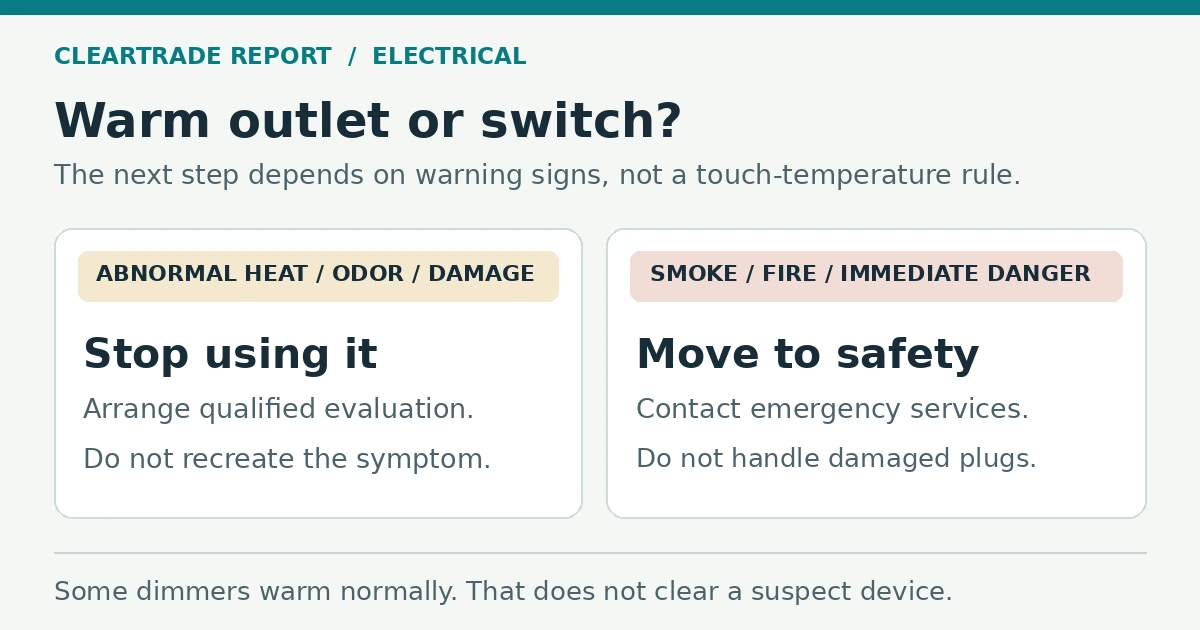
An outlet or switch with abnormal heat, discoloration, a burning smell, crackling or damaged parts should not remain in service while you experiment with it. Stop using the affected equipment and arrange qualified evaluation.
If there is smoke, fire or immediate danger, move to safety and contact emergency services. Do not handle a hot, melted or sparking plug to investigate it.
“Warm” does not identify the cause
Heat can involve the connected appliance, plug, receptacle, switch or wiring connection. A hand on a wall plate cannot tell you which part is responsible.
Some electronic controls have manufacturer-described heat behavior. That does not make an unfamiliar hot spot safe, and it does not justify applying a universal “comfortable to touch” rule.
Use the exact product instructions and qualified assessment rather than a temperature guess from an online article.
Lutron’s wallbox-dimmer heat letter explains that heat can pass through a dimmer’s front plate and wallplate during operation. That explanation concerns dimmers used within their instructions and ratings; it does not clear a warm receptacle, damaged device or unidentified control. This article does not turn the letter’s test conditions into a household touch test.
Look for accompanying warning signs
Without touching or opening suspect equipment, note visible discoloration, deformation, loose-fitting plugs, unusual sounds, odors and changes in operation.
Tell the electrician what was connected and how long it had been operating. Do not deliberately reconnect the load to show the symptom.
A breaker that has not tripped does not establish that an outlet or connection is safe.
Do not move the problem to an adapter
Adding a power strip, extension cord or plug adapter does not repair a suspect receptacle. Avoid bypassing protective devices or substituting a higher-rated breaker.
If equipment appears damaged, keep it out of use until its condition has been assessed. The evaluation may need to include the appliance and its cord, not just the outlet face.
Do not remove the cover to tighten connections or perform energized testing based on this guide.
What the observation can tell you
| Observation | Useful response | Limit |
|---|---|---|
| Abnormal heat, odor, discoloration or noise | Stop using the affected equipment and arrange qualified evaluation | Do not reconnect a load to reproduce the symptom |
| Warmth at a dimmer with no other reported symptom | Identify the model from existing records and check its instructions | Normal warmth in some dimmers does not clear this installation |
| Smoke, fire or immediate danger | Move to safety and contact emergency services | Do not handle damaged or sparking equipment |
| No breaker trip | Still report the observed warning signs | It is not a safety clearance |
Make the service request specific
Record:
- The outlet or switch location.
- Connected equipment and normal use.
- When the heat or other symptom appeared.
- Whether a plug fit loosely.
- Visible damage, smell, sound or protective-device operation.
- Recent changes to the appliance, control or wiring.
Safe photographs can document visible condition. They cannot establish the condition of concealed terminals or wiring.
Ask what was checked
After service, ask for a plain-language explanation of the finding, the repair and whether connected equipment was also evaluated.
Replacing a faceplate does not address an electrical defect. Replacing a receptacle may be appropriate, but the actual cause and surrounding condition should determine the scope.
Keep the report and any equipment recommendation. If symptoms recur, stop use and report the recurrence rather than assuming the new device proves the problem is solved.
Frequently asked questions
Is every warm switch dangerous?
Not every control has identical operating behavior. Abnormal or unexplained heat needs model-specific assessment; this article sets no universal temperature threshold.
Can I keep using it because the breaker did not trip?
No. Breaker behavior alone does not clear the condition.
Should I pull out a hot or melted plug?
Do not handle damaged, sparking or dangerously hot equipment. Move to safety and obtain appropriate help.
Does a new cover plate fix it?
No. A cosmetic replacement does not identify or repair the underlying electrical condition.
Related reading: how to describe flickering-light patterns and LED dimmer compatibility checks.
Sources
Checked October 25, 2026.
- ESFI: Electrical Safety Dos — warning-sign section retrieved directly; qualified inspection for discoloration, warmth, buzzing or burning odor.
- CPSC: Preventing Home Fires—AFCIs, Publication 5133 — conventional breakers need not respond to early arcing; supports not treating absence of a trip as safety clearance. No AFCI retrofit or code mandate inferred.
- CPSC staff: Home Electrical Safety Checklist, Publication 513, July 2008 — printed pages 6–7, malfunctioning and unusually warm outlets/switches; historical consumer guidance, not current code.
- Lutron: Wallbox Dimmer Heat Letter — undated manufacturer explanation, not a universal temperature limit or current model-selection guide. Use the actual control’s current instructions.
When the replacement proposal involves older ungrounded outlets, see what to ask about protection and equipment grounding.
Source-based editorial verification is recorded internally; no professional technical-review attribution is claimed.
The explanatory graphic was created with AI-assisted drawing code for ClearTrade Report; it is not a photograph or evidence of a tested installation.
Need a qualified professional?
Trusted Pros uses visible license-verification states and never ranks paid listings above unpaid listings.