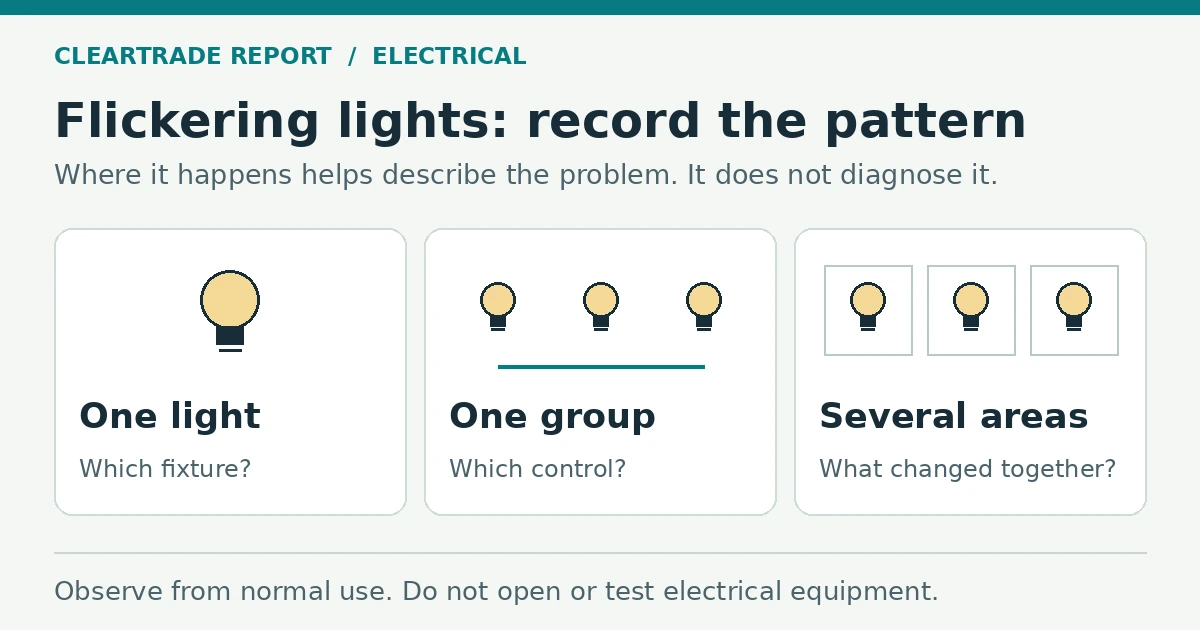
Flickering is a symptom, not a diagnosis. Record which lights are affected and when it happens, but do not assume the pattern proves a loose connection, an overloaded circuit or a utility fault.
Start with safety. Flickering accompanied by smoke, a burning smell, discoloration, crackling or abnormal heat is not a dimmer-shopping problem. Stop using the affected equipment and get qualified help. For fire, smoke or immediate danger, move to safety and contact emergency services.
Record the scope without opening equipment
Note whether the symptom affects one lamp, a group controlled together or lights in several parts of the building. Write down when it began and whether anything changed: lamps, controls, appliances or recent work.
Observe from normal use. Do not remove covers, probe energized wiring or deliberately run a suspect load to reproduce a problem.
A short video can help show an intermittent symptom if recording is safe. Include the time and the affected fixtures rather than only a close-up of one lamp.
Pattern notes to share
These are observation prompts, not diagnoses or instructions to reproduce a fault.
| Observation | Record | Does not establish |
|---|---|---|
| One light | Location, lamp model and presence of dimmer | That the lamp is the only problem |
| A group of lights | Which lights change together and share a control | Circuit layout or a specific failed connection |
| Only during dimming | Control position and models from existing records | Compatibility of a particular combination |
| Several areas or partial power | Timing, brightening/dimming and affected appliances | Whether the fault belongs to the building or utility |
One light is a starting point, not proof
If one replaceable lamp is affected, record its model, the fixture and any dimmer. A lamp/control compatibility issue is one possible investigation path. A connection or equipment problem still cannot be ruled out from the room.
Do not reach into a hot, damaged or suspect fixture. Follow the fixture’s instructions for ordinary lamp replacement and involve a qualified electrician when the condition is unclear.
A dimming pattern may point to compatibility questions
Flicker limited to part of a dimming range can be useful information for the manufacturer or installer. Lutron’s Maestro LED+ guidance identifies low-end dimming limits as one possible explanation for that product family. It is not a diagnosis for every dimmer. Confirm whether the lamp is dimmable and whether the exact lamp/control combination is documented as compatible. Use packaging, receipts or existing product records for model numbers; this guide does not ask you to remove a wallplate.
Do not install random components until the symptom disappears. Model identity, supported lamp quantity and the control’s instructions matter.
Several areas need a broader investigation
When lights in multiple areas change together, tell the electrician or utility exactly what you observed. Do not infer the electrical topology solely from room locations; different rooms can share circuits and one room can contain several.
Report unusual brightening as well as dimming, appliance changes and any partial loss of power. Let the appropriate professional determine whether the issue belongs to a fixture, branch circuit, building service or utility supply.
Use your serving utility’s outage or voltage-problem reporting channel when supply problems are suspected. For example, PG&E accepts reports of flickering lights and partial power. Its investigation process applies to its own customers; it is not a nationwide service promise.
Prepare a useful service request
Provide:
- Affected locations and equipment.
- First occurrence and frequency.
- Relationship to normal dimming or appliance operation.
- Recent work or equipment changes.
- Any heat, odor, noise, discoloration or breaker operation.
- Safe photographs or video.
Do not reset a breaker repeatedly, bypass a protective device or continue using damaged equipment to gather more evidence.
Frequently asked questions
Does flickering prove I need a new panel?
No. Diagnosis must establish the cause before a project scope is chosen.
Does one flickering LED prove the wiring is safe?
No. Lamp behavior alone cannot clear the electrical installation.
Should I open the switch to inspect it?
This guide does not direct homeowners to open or test electrical equipment.
What information is most useful?
The scope, timing, recent changes and accompanying warning signs.
Related guides: when a warm outlet or switch needs attention, LED dimmer compatibility, and the limits of whole-home surge protection.
Sources
Checked October 25, 2026.
- ESFI: Electrical Warning Signs — warning symptoms and qualified evaluation; full text retrieved.
- CPSC staff: Home Electrical Safety Checklist, Publication 513, July 2008 — printed pages 6–7 on malfunctioning or unusually warm outlets and switches. Historical consumer guidance, not current code.
- Lutron: LED Compatibility Tool — lookup destination only; no exact bulb/dimmer pairing checked for this article.
- Lutron: Maestro LED+ flickering guidance — manufacturer-specific dimmability and low-end limitations; no universal adjustment procedure inferred.
- PG&E: Report a Voltage Problem — reporting flickering and partial power; service-area-specific process.
No cause is diagnosed from a photograph or symptom pattern.
The explanatory graphic was created with AI-assisted drawing code for ClearTrade Report; it is not a photograph or evidence of a tested installation.
Need a qualified professional?
Trusted Pros uses visible license-verification states and never ranks paid listings above unpaid listings.