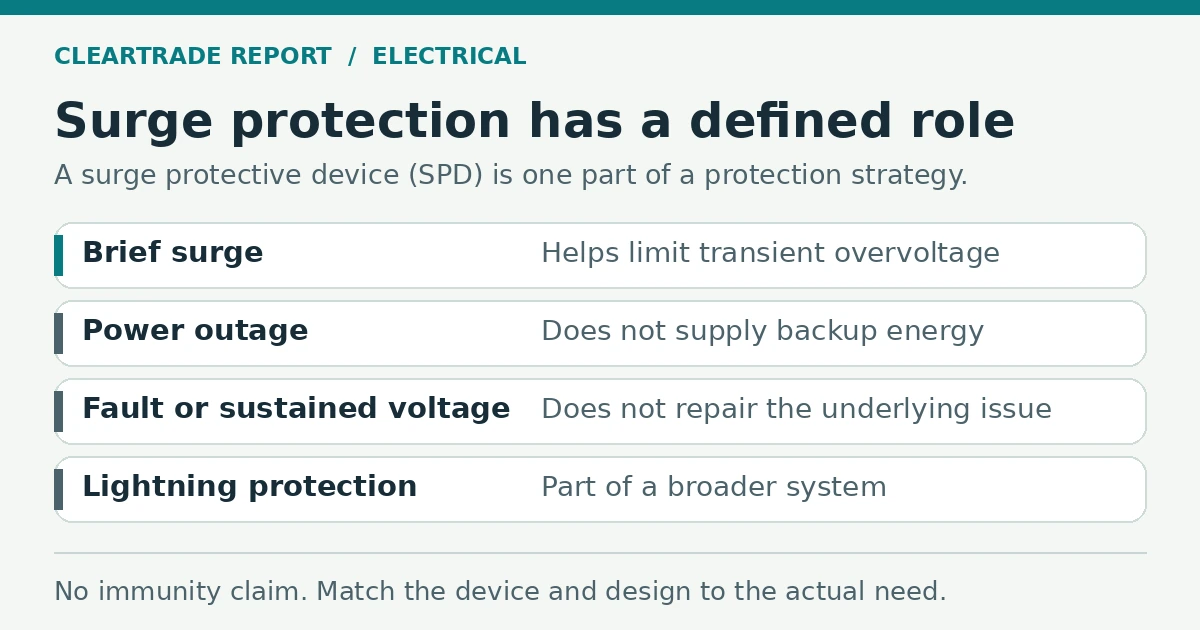
A whole-home surge protective device helps limit transient overvoltage on the electrical system. It is not backup power, a repair for faulty wiring or a guarantee that every connected device will survive every electrical event.
The useful decision is about a coordinated protection approach and its limits—not a promise printed as “whole-home.”
Define the disturbance
A surge is a brief voltage disturbance. An outage, a sustained abnormal voltage condition and an electrical connection fault are different problems.
If equipment is flickering, overheating, repeatedly resetting or showing other unusual behavior, have the cause evaluated. Buying surge protection should not replace that investigation.
Describe the symptom before choosing a solution. A device intended for one electrical condition should not be marketed as the cure for all of them.
Match the problem to the protection
| Problem or goal | Role of a surge protective device | Separate question to resolve |
|---|---|---|
| Brief overvoltage surge | Helps limit the transient within its application and event limits | Which device, location and coordinated measures suit the system? |
| Outage | Does not supply backup energy | Which loads need a UPS or other backup source, and for how long? |
| Sustained abnormal voltage or faulty connection | Does not repair the underlying condition | What investigation and repair are needed? |
| Direct lightning strike risk | May be one part of a broader protection design | Does the structure need a specialist lightning-protection assessment? |
Look beyond the label
Ask the installer which device is proposed, its intended application, ratings, listing and installation requirements.
The electrical system and the device must be suitable for one another. This article does not specify a universal breaker, conductor size or connection method.
Use the actual product documentation and adopted requirements. Do not treat an older diagram or a generic shopping-page image as installation instructions.
Consider more than one entry path
Sensitive equipment may connect to power and to communications or other conductive systems. Have a qualified professional evaluate the relevant paths and how protective measures are coordinated.
Service-level and point-of-use devices serve different locations in a protection strategy. Do not assume that one product eliminates every reason for another protective measure.
A power strip is not automatically a surge protective device, and a surge device is not automatically a UPS.
Keep backup power separate
A surge protective device does not supply energy during an outage. A UPS or other backup system may support selected loads, but its surge, power-quality and runtime characteristics are product-specific.
If your goal is to keep communications or equipment running, define that continuity requirement explicitly. Do not choose by a joule or surge-current number alone.
For network equipment, include the devices supplied by a PoE switch when defining which loads must keep running. Record the actual system load for backup sizing; this article supplies no runtime estimate.
Do not promise complete lightning protection
Lightning protection is a broader subject than a panel-mounted device. No ordinary surge-protection purchase should be described as making a building or every appliance immune to lightning damage.
Ask what risks the proposed system addresses and what remains outside its scope. Where a building needs a structural lightning-protection assessment, use an appropriately qualified specialist.
Plan for status checks and replacement
Read the indicator and maintenance instructions for the selected device. Do not assume every light color means the same thing across brands.
Ask how a loss of protective function will be identified and who will replace the device. A connected-equipment warranty is a contract with conditions, not proof that a future loss will be paid.
Keep the model, installation date, manual and warranty terms with the building records.
Frequently asked questions
Will it keep the lights on in an outage?
No. Surge protection is not an energy source.
Will it repair a loose connection?
No. The underlying electrical condition needs evaluation and repair.
Does “whole-home” guarantee every device?
No. Protection has application and event limits.
Should I choose the biggest rating?
Not in isolation. Suitability, listing, installation and coordinated protection matter.
Related guides: recording flickering-light symptoms, responding to abnormal outlet or switch heat, and comparing battery backup, generators and UPS systems.
Sources
Checked October 25, 2026.
- Mansoor and Martzloff, The Dilemma of Surge Protection vs. Overvoltage Scenarios, October 1998, hosted by NIST — historical technical paper distinguishing transient protection from extended temporary overvoltage; not a current installation standard.
- NEMA SPI FAQs — industry guidance on application, coordinated protection and multiple conductive paths. Historical code editions, numerical rules of thumb and installation details are not adopted here as current requirements.
- Eaton: UPS vs. Surge Suppressor — manufacturer explanation of the backup-power distinction; no universal UPS performance or wiring arrangement inferred.
- National Weather Service: Lightning Rods — structural lightning protection is a complete system, with surge protection among its components.
- Use the current selected-product manual for status indications, maintenance and any model-specific proposal.
No product was tested or ranked. No affiliate relationship or professional technical review is claimed.
The explanatory graphic was created with AI-assisted drawing code for ClearTrade Report; it is not a photograph or evidence of a tested installation.
Need a qualified professional?
Trusted Pros uses visible license-verification states and never ranks paid listings above unpaid listings.