On this page
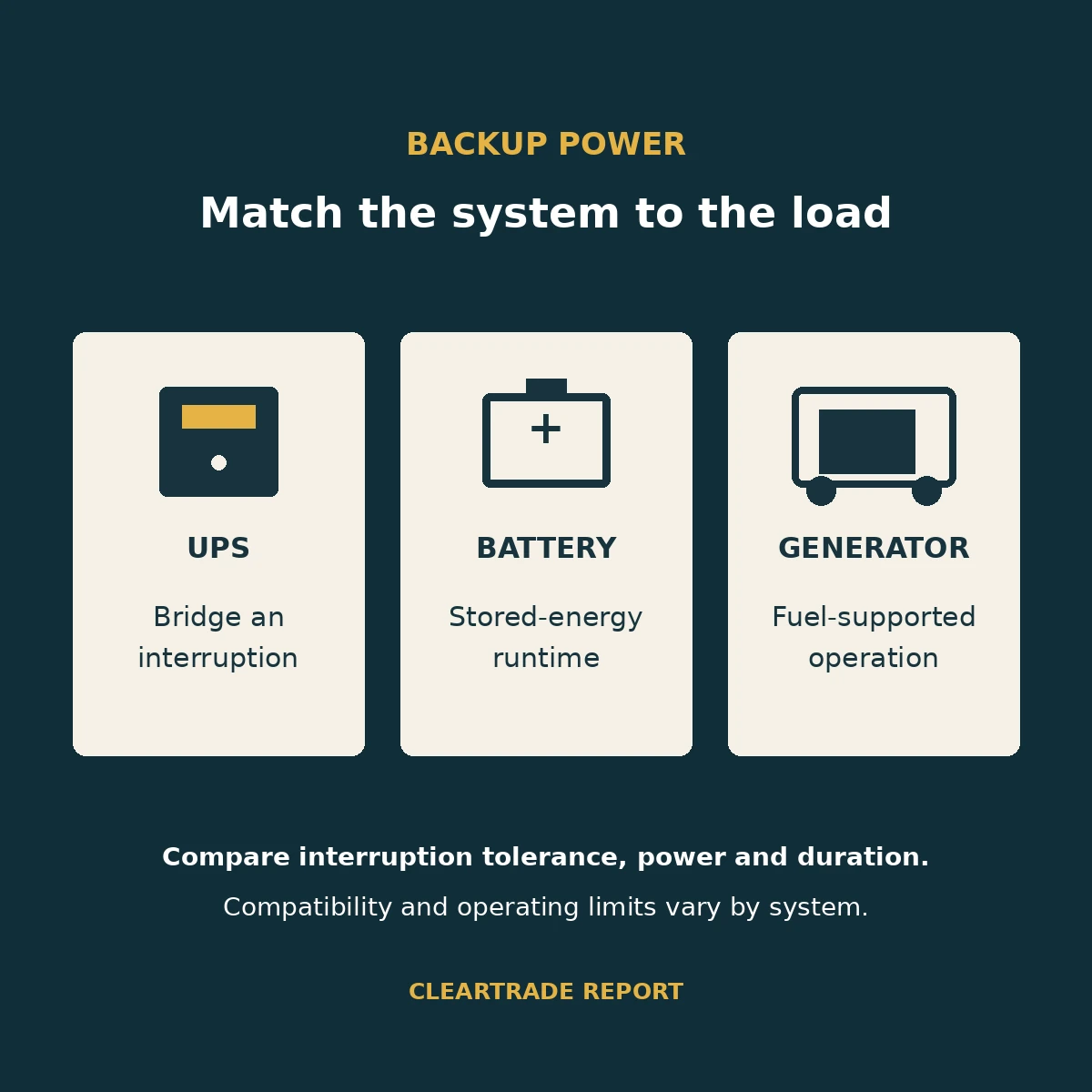
A UPS, a battery backup system and a generator solve different parts of an outage problem. Choose by the equipment you must support, how much interruption it can tolerate and how long you need it to operate.
The answer may be a combination. A generator can support extended operation while a compatible UPS bridges an interruption for sensitive equipment.
Start with the required service
Write down the protected loads and the acceptable outage behavior. A router, refrigerator, sump pump and production machine do not create the same requirements.
Ask two separate questions: how much power must be available at once, and how much energy or fuel is needed over time?
Also identify the intended outcome. Saving work and shutting down cleanly is different from operating a building through a long outage.
UPS: continuity for selected equipment
An uninterruptible power supply is often used to maintain power to selected electronics or other compatible loads during an interruption or power disturbance.
UPS designs differ. Do not assume every UPS provides the same transfer behavior, waveform, power conditioning or runtime. Check the specific equipment’s tolerance and the selected UPS documentation.
Compare both watts and volt-amperes, supported input/output connections, battery condition, runtime at the actual load and shutdown controls. A large VA number alone does not establish the available real power or duration.
For a network closet, include the switch’s PoE demand rather than counting only its base electronics. See PoE power budgets.
Battery backup: stored energy within limits
A stationary battery system or portable power station stores energy for later use. Its inverter and outlets or building interface determine which loads it can supply.
Compare usable energy, continuous output, short-duration limits, supported voltage and recharge behavior. “Whole-home” requires an explicit load plan; it is not a promise that every appliance can run together indefinitely.
Solar recharge is equipment- and condition-dependent. Verify outage-mode capability rather than assuming that an existing solar array will continue charging any battery.
Generator: operation depends on fuel and conditions
An engine-driven generator produces electricity while operating. Its usefulness depends on load compatibility, starting and transfer arrangements, fuel supply, maintenance and safe siting.
Portable and permanently installed generators have different instructions and installation requirements. Never apply a portable-generator illustration as a complete standby-system design.
For portable units, CPSC says to operate outdoors only, at least 20 feet from homes/buildings with exhaust directed away from openings. A garage or shed is not a safe indoor substitute, even with doors open. Follow current safety guidance and the actual equipment instructions.
Do not connect a generator to building wiring through improvised backfeed arrangements. Have the building interface designed and installed by qualified professionals.
Compare failure and maintenance behavior
Ask what happens when the battery is depleted, the generator fails to start, fuel is unavailable or a component is being serviced.
A UPS battery requires attention; a generator needs an operating and fuel plan; a storage system needs its documented maintenance and software/support arrangements. No category is maintenance-free simply because it is normally idle.
Ask whether the critical loads remain protected during service and whether a shutdown procedure is needed.
Evaluate combinations as systems
A UPS and generator can complement one another, but compatibility is not automatic. Have the supplier evaluate the generator output, UPS behavior, recharge demand and actual load.
Do not add nameplate ratings from several boxes and assume the combination is coordinated. Get the operating sequence and responsibilities documented.
A proposal checklist
Request:
- Protected loads and interruption tolerance.
- Equipment models and compatibility basis.
- Runtime or fuel assumptions.
- Transfer and restart behavior.
- Installation, permitting and safe-access scope.
- Maintenance and replacement obligations.
- Failure response and support contacts.
Related reading: critical-load battery sizing.
Frequently asked questions
Is a UPS just a small home battery?
Both may store energy, but their intended applications, interfaces and continuity behavior can differ.
Will a generator prevent every interruption?
Not necessarily. Starting, transfer and equipment behavior must be evaluated.
Can a large battery rating guarantee runtime?
No. Runtime depends on usable energy, actual load and operating conditions.
Can these systems be combined?
Yes in suitable designs, but compatibility and operating sequence require verification.
Sources
Sources rechecked October 26, 2026.
- Eaton: UPS Sizing Guide — load and runtime considerations.
- Eaton: UPS Fundamentals — UPS categories and power terminology.
- DOE: Solar Energy and Storage Basics — storage integration.
- CPSC: Generator and Engine-Driven Tool Safety — portable-generator hazards.
- CPSC: Hurricane-Season Generator Safety, May 27, 2026 — outdoor placement, exhaust and maintenance.
- CPSC: Portable Generator Hazards — September 2017 revision, linked by the current safety hub; backfeed and carbon-monoxide precautions.
For generator connection choices, compare panel interlocks, manual transfer switches and automatic transfer systems.
This is comparative research, not hands-on testing or a product recommendation.
Need a qualified professional?
Trusted Pros uses visible license-verification states and never ranks paid listings above unpaid listings.