On this page
- Separate power from energy
- Write the outage mission
- Build a load inventory
- Check the power constraints
- Test the duration assumptions
- Do not count solar recharge twice
- Ask for a documented design
- Before comparing battery prices, compare what each warranty actually covers. See our guide to battery warranties: throughput, retained capacity and operating restrictions.Frequently asked questions
- Sources
Home battery planning has two separate questions: can the system supply the power your equipment needs, and can it store enough energy for the outage you are planning around?
Start with the loads and the required service—not the number of battery boxes.
Separate power from energy
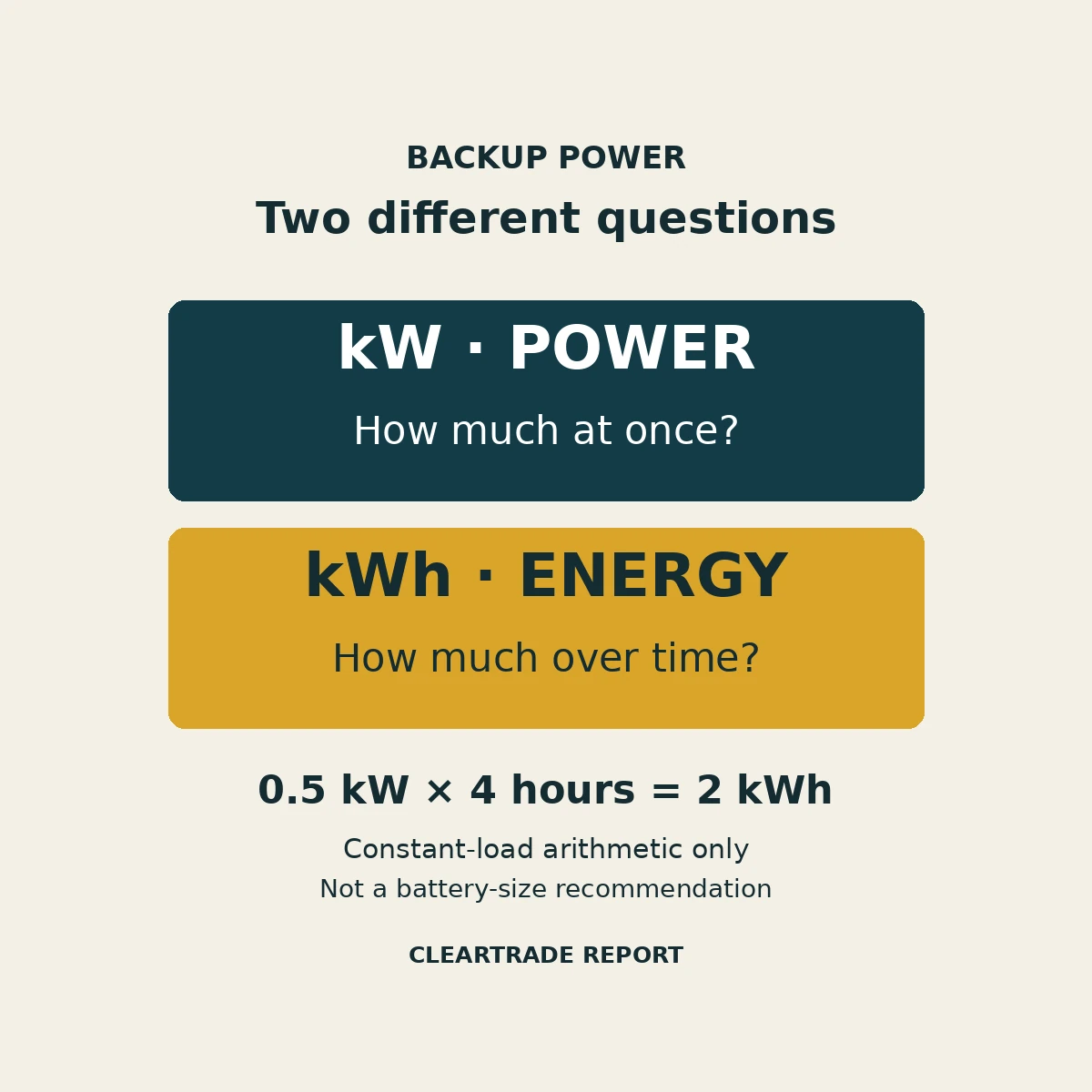
Power, commonly expressed in kilowatts, describes the rate of electricity use or delivery. Energy, expressed in kilowatt-hours, describes an amount used or stored over time.
For an illustrative constant load, 0.5 kW running for four hours uses 2 kWh. That arithmetic does not establish battery size: real equipment cycles, system losses and reserve settings matter, and the equipment must be able to supply the load in the first place.
Use the manufacturer’s usable-energy and output specifications rather than treating nominal storage capacity as the amount always available to the house.
Write the outage mission
Identify what must operate and for how long. Separate essential functions from conveniences that can be deferred.
Examples might include communications, refrigeration, selected lighting and particular pumps. Do not assume that every home needs the same list. Medical or other life-critical equipment requires its own appropriate continuity planning; a general household worksheet is not a guarantee of support.
Record what happens if the outage lasts longer than expected.
Build a load inventory
For each proposed load, record:
- Equipment identity and supply requirements.
- Running demand and any starting behavior.
- Expected operating duration or duty cycle.
- Whether it must run simultaneously with other loads.
- Whether it can be delayed or shed.
- The evidence behind the estimate.
Use measured consumption or reliable equipment documentation where possible. A monthly bill helps describe whole-house energy use but does not show every short-duration peak or the subset of loads you intend to back up.
Check the power constraints
The designer must compare the proposed loads with continuous and short-duration output limits, voltage, phase and the system’s supported configurations.
A system can have enough stored energy for a plan yet be unable to start or operate a particular load. Conversely, high output power does not establish long runtime.
Ask how large loads are managed and whether the proposed backup covers the whole service or selected circuits. Labels such as “whole-home” need a defined operating scope.
Test the duration assumptions
Estimate energy demand over the planned outage, then have the designer account for usable capacity, losses, reserves, operating conditions and equipment limitations.
Do not hide uncertain assumptions in a single runtime number. Ask for at least a normal-use case and a more demanding case, with the supported loads stated explicitly.
Battery condition and settings can change the available service over time. Keep the calculation assumptions with the equipment proposal so future changes can be evaluated.
Do not count solar recharge twice
Solar may extend backup operation, but an existing grid-connected array does not automatically prove that the proposed system can recharge during an outage.
Ask whether the exact combination supports islanded operation, charging while serving loads and recovery after the battery reaches its operating limit. Weather, season, shade and array output affect the result.
Treat an assumed sunny day as a scenario, not a guarantee. Review a low-production case before making a purchase based on multi-day autonomy.
Ask for a documented design
The proposal should identify protected loads, equipment models, usable energy, output limits, load controls, outage behavior and the recharge assumptions.
Transfer/isolation equipment, installation, permitting and utility coordination belong to qualified project design. This article does not specify wiring, protection settings or a universal capacity margin.
A narrower critical-load plan may be more useful than a broad promise with unclear limits.
For provisions made before a future installation, see solar-ready electrical planning. Readiness provisions and outage backup are separate scopes.
Related reading: battery, generator and UPS comparisons.
Before comparing battery prices, compare what each warranty actually covers. See our guide to battery warranties: throughput, retained capacity and operating restrictions.
Frequently asked questions
Is kWh the same as kW?
No. kW describes power; kWh describes energy.
Can I size a battery from my electric bill?
The bill is useful context, but the backup load list and power requirements still need separate evaluation.
Will solar recharge it in every outage?
Not necessarily. The equipment combination and operating mode must support it, and sunlight is variable.
Is the example a battery recommendation?
No. It demonstrates energy arithmetic only, not a complete system design.
Sources
Checked October 25, 2026.
- DOE: Solar Energy and Storage Basics — storage and resilience context.
- DOE: Solar and Resilience Basics — solar/storage backup conditions.
- LBNL: Solar-Plus-Storage Backup During Long Interruptions — September 2022 study; scenario dependence across building and outage conditions.
- Tesla: How Much Battery Storage Do I Need? — August 2025 manufacturer planning reference, not an endorsement or product test.
No products were tested or ranked. All numerical examples are illustrative.
Need a qualified professional?
Trusted Pros uses visible license-verification states and never ranks paid listings above unpaid listings.