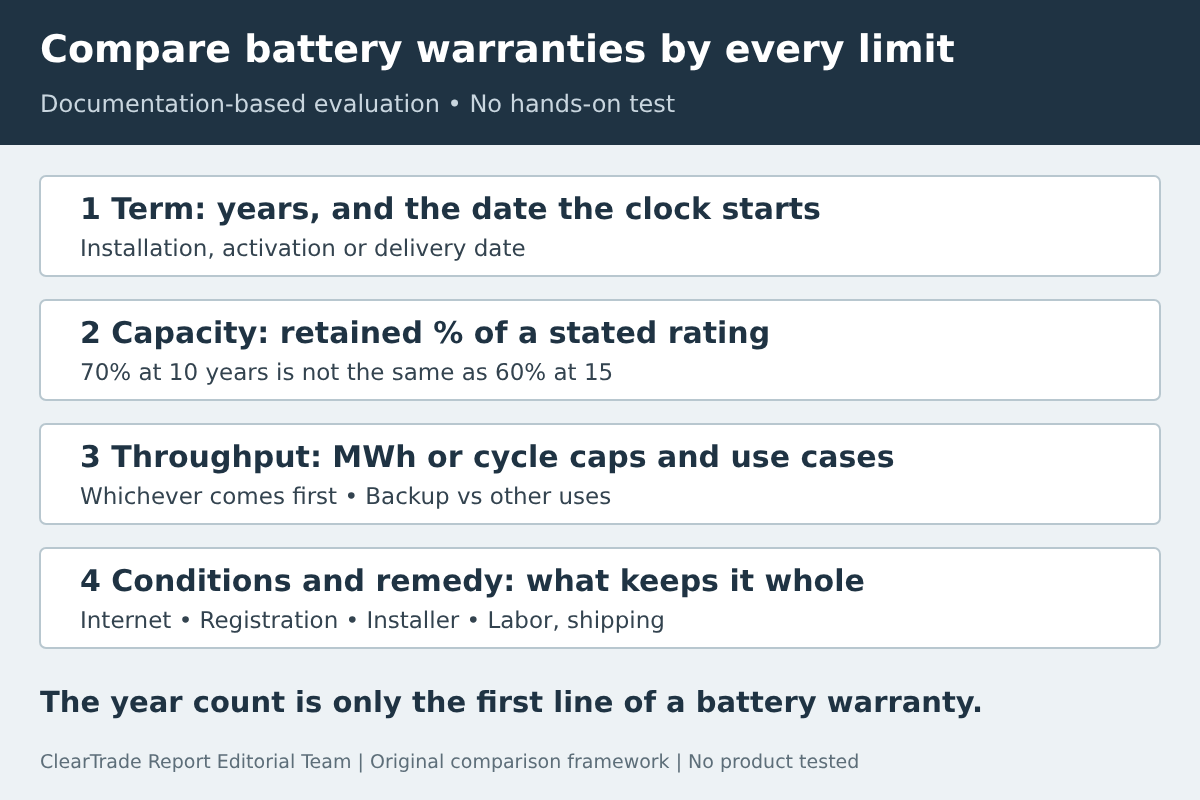
Compare battery storage warranties by every limit in the document, not by the year count: when coverage starts, how much capacity is guaranteed and at what point, any energy-throughput or cycle cap that can end coverage early, the conditions that keep the full term (such as internet connection and registration), and what the manufacturer will actually do if a claim is accepted.
Evidence label: Specification/documentation-based evaluation. ClearTrade Report Editorial Team checked manufacturers’ current US warranty documents and product pages on November 1, 2026. No hands-on testing or outside professional or legal review was performed. The named batteries below are documentation examples, not recommended purchases or a ranked shortlist. No product was supplied for this article, and this guide contains no affiliate links.
Read a battery warranty as several limits
A home battery warranty usually combines a defect warranty with a performance promise: that the battery will still hold a stated share of its rated capacity after a stated time or amount of use. The warranties we checked end coverage at the earlier of a year count or a usage limit, and some reduce the term if conditions are not met. Each limit can end or shrink coverage on its own.
Get the exact warranty for the model, version and country you are buying, with its effective date. Warranties are revised: FranklinWH’s current end-user warranty is dated October 28, 2026, while its warranty support page still showed an August 2022 version with different terms when we checked.
Find the date the clock starts
Start dates differ. Tesla’s Powerwall limited warranty runs for ten years following the initial installation date. Enphase’s IQ Battery warranty period begins on the Activation Date, which it defines as the earlier of the date the product is registered with Enphase or the date it is activated through Enphase’s installer portal; it treats a product as activated when the solar system has received permission to operate. FranklinWH’s runs from the date of initial installation or 12 months from the manufacture date, whichever comes first. Generac’s PWRcell 2 warranty says in one place that it begins when the product is first installed and in another that coverage begins upon successful registration of the unit; the document does not reconcile the two, so ask Generac or your installer which date applies.
The difference matters when equipment sits in a warehouse or waits for utility approval. A warranty that can start from the manufacture date may already be running before the system is energized.
Read retained capacity as a percentage, a base and a date
A retained-capacity promise has three parts: the percentage, the rating it is measured against, and the point in time it applies. Tesla says Powerwall will have 70% of its 13.5 kWh rated capacity at 10 years following the initial installation date. Enphase guarantees at least 70% of the IQ Battery nameplate rating at the end of the 10th year and 60% at the end of its 15-year warranty period. FranklinWH guarantees at least 70% of the rated capacity of the aPower 2 and aPower S (15 kWh) at 15 years or 60 MWh of throughput, and of the aPower X (13.6 kWh) at 12 years or 43 MWh. Generac guarantees at least 70% of nameplate rating for PWRcell 2 battery modules at the end of the warranty period.
Not every document says how capacity will be measured if you make a claim. FranklinWH states that rated capacity is measured on a new system at 77 °F and 3 kW charge and discharge power (2.5 kW for the aPower X). The Tesla, Enphase and Generac documents we checked did not state a capacity test method; Tesla’s note that figures are measured at the battery AC output is attached to its throughput cap. Ask the manufacturer or installer how a capacity claim is tested before you rely on the percentage.
Check throughput and cycle caps, and which uses trigger them
A throughput or cycle cap ends the performance warranty early if the battery moves a stated amount of energy before the year count runs out. Enphase’s IQ Battery warranty ends at the earlier of 15 years or 6,000 discharged cycles. FranklinWH uses 60 MWh of aggregate throughput for the aPower 2 and aPower S and 43 MWh for the aPower X, whichever comes first with the year count. Generac’s PWRcell 2 battery modules are covered for 10 years or 7.56 MWh of energy throughput per module, whichever comes first.
Tesla ties the cap to how the battery is used. Its warranty lists unlimited cycles for solar self-consumption or time-based control, and backup. For any application not listed, or any combination that includes one, the 70% guarantee is limited to 37.8 MWh of aggregate throughput, measured at the battery AC output. If you plan to enroll a battery in a program that uses it in other ways, ask how the program’s use fits the warranty’s categories before you sign up.
To compare caps across batteries of different sizes, divide throughput by rated capacity to get approximate full-cycle equivalents. By our arithmetic, FranklinWH’s 60 MWh on 15 kWh is about 4,000, and Tesla’s 37.8 MWh on 13.5 kWh is about 2,800 where that cap applies. These are rough comparisons, not the manufacturers’ figures.
To estimate whether you would reach a cap, start from how often the battery will cycle. Sizing for backup and daily use is covered in our home battery sizing guide.
Keep the conditions that protect the full term
Several warranties depend on the battery staying online and registered. Tesla says it requires the ability to update Powerwall through remote firmware upgrades and that, if Powerwall is not connected to the internet for an extended period or has not been registered, it may not be able to honor the full ten-year warranty, while always honoring at least four years from first installation. FranklinWH says that if the system stays disconnected from the internet for more than 90 consecutive days it will send a notification requesting reconnection, and if the connection is not restored the warranty is automatically reduced to four years from initial installation, and that unregistered systems are eligible only for a four-year warranty. Generac requires all PWRcell 2 components to stay connected to the internet and says the minimum, if the system remains offline, is at least 5 years or 3.78 MWh per battery module. Enphase says its covered products should be continuously connected to the internet during the warranty period, with an exception for interruptions outside the owner’s reasonable control.
Installer and purchase conditions also appear. FranklinWH requires installation by an installer certified by FranklinWH. Tesla’s coverage applies to products purchased from Tesla or a Tesla certified installer in the United States. Enphase requires purchase from Enphase or an Enphase-authorized reseller and asks for registration within 45 days of first installation, though its registration form says failing to register does not diminish warranty rights. Exclusions for installation environment are common: FranklinWH excludes installation outside its guidance, such as extreme temperatures, humidity or altitude, and Enphase excludes use in an unsuitable environment. None of the four warranties we read gave a numeric temperature range, so check the installation manual for that.
Know the remedy and who pays labor and shipping
An accepted claim does not always mean a new battery at no cost. Tesla may repair (with new or refurbished parts), replace with an equivalent new or refurbished product, or refund the market price of an equivalent product, and says it will not pay for labor or other service costs. Enphase may repair or replace free of charge or, in some circumstances, refund the purchase price less reasonable depreciation; it pays shipping for the repaired or replacement product on a valid claim, but excludes the labor cost of uninstalling. FranklinWH may repair, replace with an equivalent product (new or refurbished) or refund the purchase price less reasonable depreciation, and says it will not cover shipping costs. Generac lists parts, labor and limited travel for the PWRcell 2 battery cabinet, with travel capped per occurrence.
Ask your installer whether their own workmanship warranty covers the labor a manufacturer excludes, and get that answer in writing.
Separate cycle-life ratings and safety listings from warranties
Spec-sheet cycle ratings are not warranties. EcoFlow’s DELTA 3 Plus product page lists 4,000 cycles to 80+% capacity, while its US warranty policy gives the DELTA 3 Plus five years, counted from delivery to the original purchaser, and excludes normal wear and tear, including battery wear. Read the warranty, not the specification, to learn what the manufacturer will stand behind.
Safety testing is a separate question too. UL Solutions describes UL 9540A as the American and Canadian national standard for assessing fire propagation related to thermal runaway events. It addresses fire behavior, not how much capacity a battery keeps, so a safety listing does not substitute for a capacity guarantee.
Use a warranty record before comparing prices
The table below lines up the documented examples. These are documentation examples, not recommended purchases; check the current warranty for the exact model and country.
| Warranty (document date) | Term and start | Retained capacity | Throughput or cycle cap | Key conditions | Remedy, labor and shipping |
|---|---|---|---|---|---|
| Tesla Powerwall, USA (effective Aug. 21, 2023) | 10 years from initial installation | 70% of 13.5 kWh at 10 years | Unlimited cycles for self-consumption, time-based control and backup; 37.8 MWh (at AC output) for other uses | Internet and registration, or as little as 4 years; Tesla or Tesla certified installer | Repair, replace (new or refurbished) or refund market price; labor not paid |
| Enphase IQ Battery 5P (on or after Sept. 1, 2025) | 15 years from Activation Date (earlier of registration or activation at permission to operate) | 70% at end of year 10; 60% at end of term | Earlier of 15 years or 6,000 discharged cycles | Continuous internet connection; authorized reseller; register within 45 days | Repair, replace or depreciated refund; uninstall labor excluded; return shipping paid on valid claims |
| FranklinWH aPower 2 / aPower S (effective Oct. 28, 2026) | 15 years from installation, or 12 months after manufacture if earlier | 70% of 15 kWh (measured new at 77 °F, 3 kW) | 60 MWh, whichever comes first | Offline over 90 days and not reconnected after notice, or unregistered: 4 years; FranklinWH-certified installer | Repair, replace or depreciated refund; shipping not covered |
| Generac PWRcell 2 (Rev. B, 06/2025) | 10 years; document cites both first installation and successful registration | 70% of nameplate | 7.56 MWh per battery module, whichever comes first | Internet connection; registration; offline minimum 5 years or 3.78 MWh per module | Repair or replace; cabinet covers parts, labor and limited travel |
Before signing, add your own row: expected cycles per year, any program enrollment, how the system will stay online, who registers it, and who pays labor on a claim. A cap or condition you cannot meet shortens the warranty you are actually buying.
Know the limits of this guide
Evidence label: specification and documentation-based evaluation. ClearTrade Report Editorial Team checked the documents below on November 1, 2026. We did not test any battery, and this is not legal advice on how a warranty would be applied to a claim. Warranty documents are revised; the version that applies to you is usually the one in effect for your purchase or installation date. State law may give rights a warranty does not describe.
Primary references checked November 1, 2026: Tesla Powerwall Limited Warranty (USA), Rev. 1.0, effective August 21, 2023; Enphase Energy Limited Warranty – Storage Systems for IQ Battery 5P (on or after September 1, 2025) and IQ Battery 10C (on or after March 15, 2025); FranklinWH System Limited Warranty for End Users, effective October 28, 2026, and the FranklinWH warranty support page; Generac Limited Warranty for PWRcell 2, Part No. A0007339797 Revision B (06/2025); EcoFlow Limited Warranty Policy – United States and DELTA 3 Plus product page; UL Solutions, UL 9540A test method page.
Frequently asked questions
Does a 10-year battery warranty always last 10 years?
Not necessarily. Several warranties end at the earlier of the year count or a throughput or cycle limit, and some shorten the term if the battery is offline or unregistered. FranklinWH, for example, reduces coverage to four years if the system stays offline for more than 90 consecutive days and the connection is not restored after its reconnection notice.
What does 70% retained capacity mean in a battery warranty?
It is the share of a stated rating the manufacturer promises the battery will still hold at a stated point. Tesla promises 70% of Powerwall’s 13.5 kWh rated capacity at 10 years. Check the base rating and the point in time for each warranty.
Can using a battery for grid programs affect the warranty?
It can. Tesla lists unlimited cycles only for solar self-consumption, time-based control and backup; any other application is limited to 37.8 MWh of throughput. Ask how a program’s use fits the warranty’s categories before enrolling.
Is a portable power station’s cycle rating a warranty?
No. EcoFlow’s DELTA 3 Plus product page lists 4,000 cycles to 80+% capacity, but its US warranty policy gives five years and excludes normal battery wear. The warranty, not the specification, describes what the manufacturer covers.
Disclaimer: This guide is general information based on manufacturer documentation, not legal, electrical, financial or purchasing advice for a specific installation. Read the full warranty for your exact product and date, follow the manufacturer’s instructions and applicable codes, and use a qualified professional for installation. AI tools assisted with drafting. ClearTrade Report Editorial Team checked the cited sources and edited this guide. No hands-on testing was performed.
Need a qualified professional?
Trusted Pros uses visible license-verification states and never ranks paid listings above unpaid listings.