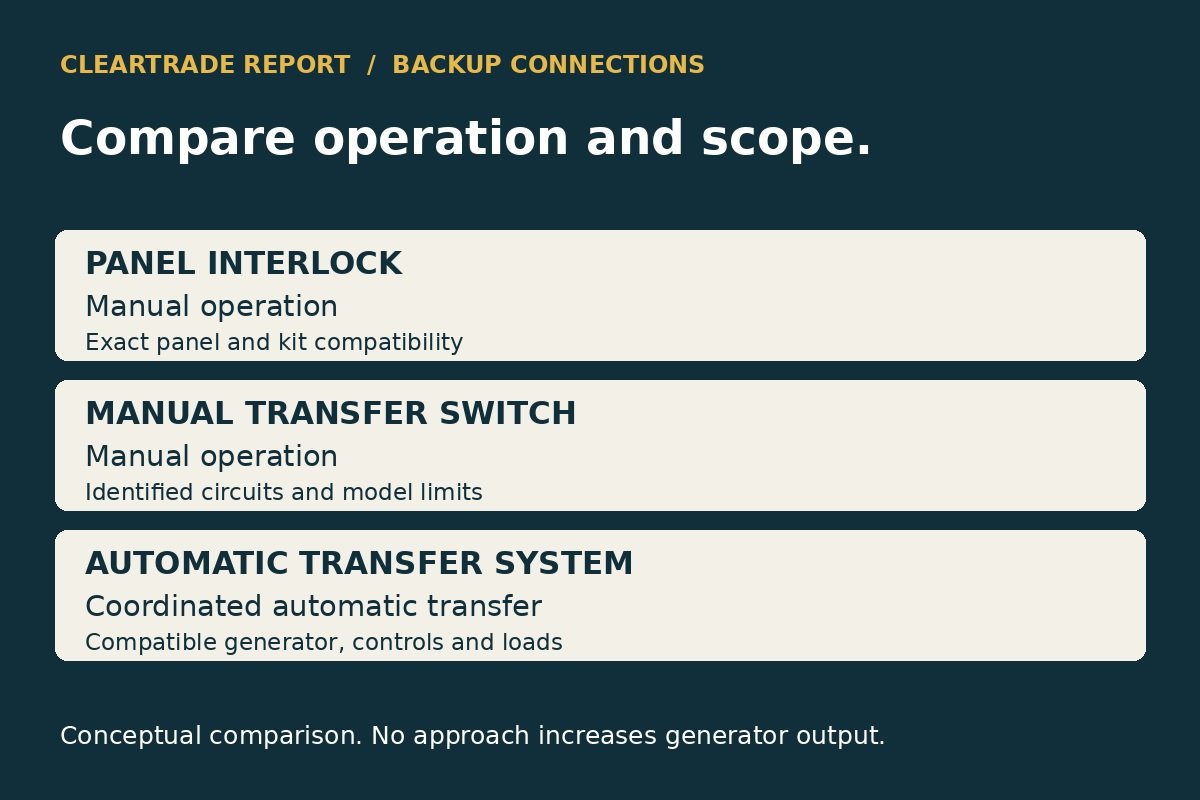
A panel interlock can be an option when compatible equipment is available and someone can operate the system manually. A selected-circuit manual transfer switch can organize backup around identified circuits. An automatic transfer system addresses a different need: transferring the supported loads without someone manually making that change.
The right choice depends on the existing installation, generator, loads and operating plan. None of these devices increases a generator’s output or makes every household load suitable to run at once.
This is a documentation-based comparison of approaches. ClearTrade has not tested or ranked specific products for this guide.
Compare three approaches
| Approach | What it organizes | Main question before choosing |
|---|---|---|
| Compatible panel interlock | A manual arrangement interlocking the normal-supply and generator-supply breakers | Is an identified kit suitable for the exact panel configuration, and can the operator manage the loads? |
| Selected-circuit manual transfer switch | Manual source selection for the circuits included in the installation | Which circuits are included, and will the selected equipment support their characteristics? |
| Automatic transfer system | Automatic transfer between sources as part of a compatible generator/control system | What starts and transfers automatically, which loads are supported, and what still needs user attention? |
These are common configurations, not an exhaustive equipment catalog. Transfer switches also exist in other arrangements; “transfer switch” does not necessarily mean a small selected-circuit unit.
Schneider’s QO guidance identifies interlock kits by panel series, enclosure and main-breaker configuration. Reliance’s Pro/Tran2 instructions address selected circuits and model-dependent limits. Generac describes automatic transfer as a coordinated function of the standby generator and transfer equipment. Schneider compatibility guidance · Reliance manual · Generac explanation
Compatibility comes before accessory price
An interlock that resembles your panel is not enough. Ask the installer to document the panel identity, applicable kit and any limitations. Schneider’s guidance includes specific exclusions, illustrating why a broad brand name cannot establish fit.
For a transfer switch, ask the same question at the system level. Identify the generator, transfer equipment, inlet and applicable instructions. The installer should evaluate the actual circuits and the generator’s neutral/grounding arrangement. This article does not prescribe neutral switching or a bonding change.
Reliance’s instructions specifically distinguish circuit arrangements and warn that parts on the line side of the main remain live. Those are reasons to have the installation evaluated and completed by a qualified electrician—not to copy a generic wiring diagram.
Define the loads before the connection
List what you want available during an outage: refrigeration, lighting, communications, heating equipment, pumps or other priorities. Then ask the installer to identify the circuits and operating demands behind that list.
Separate three categories:
- Loads that must operate.
- Loads you can operate at different times.
- Loads intentionally excluded from backup.
Having access to a circuit is different from having enough generator capacity to operate it with everything else. Ask for the operating limits in writing, including which combinations to avoid and whether load management is part of the design.
Also describe who will be home. A manually operated system should be chosen with the actual user’s access, mobility and ability to follow the manufacturer’s instructions in mind. If nobody will be available, say that before a manual option is quoted.
Automatic operation also needs a clear scope. Ask whether the proposal includes generator starting, transfer, load management and return to utility power, and what maintenance or fault response remains your responsibility.
Plan a safe portable-generator location
Portable-generator siting is a separate safety requirement from the transfer equipment. CPSC says to operate a portable generator outside, at least 20 feet from homes and buildings, with exhaust directed away from windows, doors and vents. A garage or shed is not an acceptable substitute, even with doors open. CPSC May 2026 guidance
Have the installer assess the inlet location and connection arrangement around that operating location. Do not move the generator closer to the building merely because a cord is short.
Never use a male-to-male cord to feed a household receptacle. CPSC warns that these products create electrocution and fire hazards. CPSC warning
Compare complete proposals
Ask each contractor to identify the supported loads, equipment, permit and inspection scope, connection location, installation work, operating instructions and testing. Request any exclusions and assumptions explicitly.
A kit-only price cannot be compared directly with a complete installed system. Likewise, “whole-panel access” should not be interpreted as a promise that a portable generator can run the whole house simultaneously.
For the handover, request a labeled circuit schedule, manuals and a demonstration appropriate to the installed system. Ask how you will know the system has been tested under the agreed conditions. A generator running by itself is not the same as a demonstrated transfer of the intended loads.
Next step: Send the installer your generator model, existing panel information available without opening it, and a prioritized load list. Ask for a documented compatibility and operating plan before buying transfer equipment.
Frequently asked questions
Does an interlock make my generator powerful enough for the whole house?
No. Generator output and the loads operating together still limit what can be powered.
Is every transfer switch automatic?
No. Manual and automatic arrangements exist. Confirm the operating method of the proposed system.
Can I buy an interlock by matching the panel brand?
Brand alone is insufficient. The exact panel configuration and the kit’s documented application need to match.
Can I use a male-to-male cord instead?
No. Do not use these cords to energize household wiring; CPSC warns of serious electrical and fire hazards.
Sources and scope
Schneider QO compatibility FAQ; Reliance Pro/Tran2 installation/operating instructions; Generac automatic-transfer explanation; CPSC portable-generator and male-to-male-cord warnings. Checked October 26, 2026. No hands-on comparison, universal compatibility approval or installation design is claimed.
Related: Battery backup, generators and UPS systems compared.
Before choosing an outage scenario, learn what utility reliability averages can and cannot tell you. A state annual average is not a required generator runtime.
AI tools assisted with drafting. ClearTrade Report Editorial Team checked the cited official sources and edited this comparison.
Need a qualified professional?
Trusted Pros uses visible license-verification states and never ranks paid listings above unpaid listings.