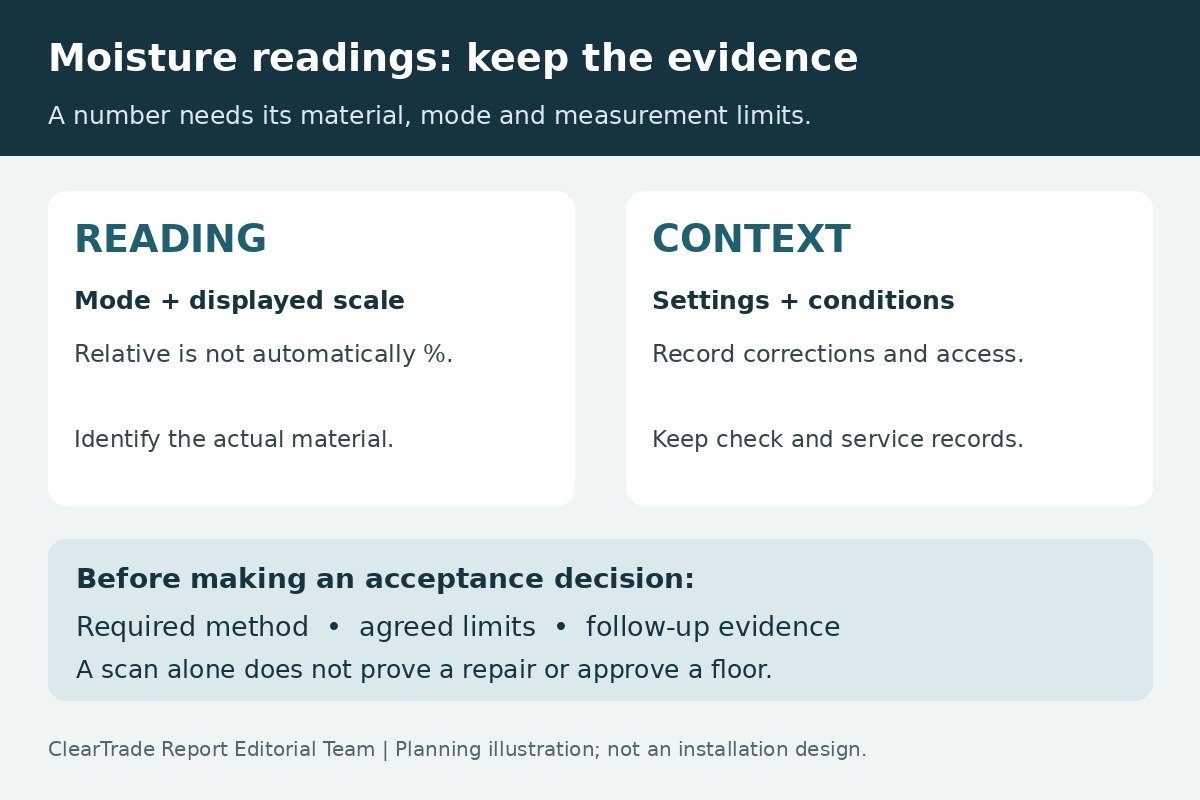
A moisture meter is useful only when the reading is tied to the material, measurement mode and instrument instructions. A relative scan is not automatically a percentage of water in a wall, and a wood-calibrated result is not automatically a moisture-content result for concrete or drywall. Choose the meter around the decision you need to make, then document what its scale actually means.
Evidence label: specification/documentation-based evaluation. ClearTrade reviewed manufacturer instructions and published method scope; no hands-on test or outside professional review was performed. The named instrument illustrates documentation differences and is not a purchase recommendation. Sources were checked October 27, 2026.
Start with the question, not the display color
Separate three questions: where might moisture be elevated, what does a material-specific measurement indicate, and what evidence is required before accepting a repair or installing a finish? A meter suitable for the first question may not settle the third.
For example, a facilities team comparing locations after a reported leak needs repeatable location records and an investigation plan. A contractor seeking approval for a flooring installation needs the specified acceptance method and limits. A green indicator or a low number cannot replace that agreement.
Before buying or commissioning a survey, write down the material, its finish or covering, the accessible surfaces and the intended action. Ask the supplier to identify the exact mode and scale that support that action. If the answer is only “it measures moisture,” the scope remains incomplete.
Pin and pinless readings answer different questions
Protimeter’s explanation of meter principles describes pin-type measurement through electrical resistance between probes and non-invasive readings as qualitative. It also identifies metal and salts as potential influences on readings. This is why a high value needs context rather than immediate translation into a repair diagnosis.
Pins are not a universal guarantee of actual moisture percentage. The material calibration still matters. Pinless operation is not a universal guarantee of a particular depth or an unaffected reading through every covering. The exact instrument instructions define those boundaries.
Ask how the selected equipment handles the surfaces you will encounter. Where contact, access or the material prevents a valid reading, document the limitation. A missing measurement should remain missing; it should not be replaced with a number taken on a different assembly and labeled as equivalent.
Read the scale before interpreting the number
The Protimeter MMS3 manual, INS9800 Rev B, September 2024, provides a useful example. Section 4.1 distinguishes actual moisture-content readings in wood from wood moisture equivalent readings in other applicable non-conductive solid materials. Section 4.2 describes a relative scale in pinless mode. Those are different interpretations within one instrument.
That manual also qualifies contact conditions and the influence of coverings: its pinless discussion warns that readings through low-density coverings may not represent the substrate’s moisture level. Do not turn a nominal sensing depth into proof of the condition of every layer behind a finished wall.
In a report, record the displayed value together with the exact mode, unit or scale and material setting. Write “relative reading” when that is what the instrument provides. Do not add a percent sign merely because another mode on the same meter uses one. Ask what the number represents before comparing it with a published threshold.
Material corrections belong to the measurement
Delmhorst’s correction guidance explains that its wood calibrations use Douglas fir as the reference and that species affect electrical characteristics. It provides model- and electrode-dependent correction information, including temperature and pin considerations. That does not authorize applying a Delmhorst correction table to another manufacturer’s meter.
The manufacturer’s FAQ also notes the influence of specific gravity on pinless wood readings and the potential effect of conductive glue in plywood. A reading on a composite or layered material needs the relevant instructions, not an assumed solid-wood interpretation.
Record any built-in correction and any manual correction applied. Ask whether a table is intended for the actual electrode or pins in use. Avoid double-correcting a value when the instrument has already applied the relevant setting. If the material or setting is unknown, retain that uncertainty in the finding instead of reporting unsupported precision.
Use this selection and reporting worksheet
Compare instruments by the evidence needed for your work. A combination meter may offer useful modes, but more modes do not remove the need to identify the one used for each result.
| Decision | Evidence to request | What to record in the job file |
|---|---|---|
| Material and purpose | Supported material, mode and intended use | Survey question and limits of the conclusion |
| Scale interpretation | Actual moisture content, wood moisture equivalent or relative scale | Value, displayed scale and material setting |
| Surface and access | Contact requirements, coverings and measurement limitations | Finish, location, access restrictions and relevant assembly details |
| Corrections and checks | Applicable correction instructions and instrument check/service requirements | Settings, correction basis, check result and instrument identity |
| Acceptance decision | Project method, limits and responsible decision-maker | Required follow-up and the evidence still missing |
A useful buying comparison includes access to manuals, replacement probes or accessories, service support and exportable records where needed. Obtain current price and warranty documents for the intended use rather than assuming a general product page covers every configuration. This guide does not rank instruments or verify warranty entitlement.
Build a repeatable survey record
Use a marked sketch or photographs to identify each reading location. Keep the instrument identity, mode, settings, date and relevant conditions with the readings. When comparing locations or repeat visits, document what remained comparable and what changed.
Treat a comparison location as a documented reference, not a declaration that it is certainly dry. Explain why its material and construction are relevant. Comparing a relative number on painted drywall with a number on exposed timber does not create a common moisture-content scale.
If values change after work, separate the observation from the cause. “The recorded reading decreased at this location under these conditions” is more defensible than “the leak is fixed” when the survey did not establish the source or examine concealed construction. The next action may be further investigation rather than immediate closure.
Plan access before invasive work. This guide does not authorize probing concealed assemblies or provide procedures for opening walls. Have appropriate personnel assess site hazards, access permissions and the investigation method. A meter reading is not clearance to disturb wiring, plumbing or potentially hazardous materials.
Verification checks are not universal accuracy proof
The MMS3 manual distinguishes pin-mode calibration verification from non-invasive offset calibration and contains an instrument-specific recalibration requirement. Follow the actual manual and service instructions for the equipment in use; do not apply a generic interval or improvised check to every meter.
Ask what the recorded check establishes. A successful instrument check does not identify an unknown material, correct an unsuitable mode or validate a reading through an unsupported covering. Preserve the check date, result and any service record alongside the survey rather than simply writing “calibrated” without context.
Before purchasing, ask the manufacturer how the proposed instrument and accessories are verified and serviced. For an existing instrument with unclear history, resolve that history before using its readings for a consequential acceptance decision. ClearTrade has not verified the calibration or performance of any individual unit.
A floor scan is not flooring acceptance
ASTM’s published scope for F2659-23 describes preliminary comparative evaluation with a non-destructive electronic meter. Section 1.7 explicitly excludes using the guide’s results as quantitative acceptance evidence for installing moisture-sensitive flooring finishes. The scope identifies F1869 or F2170 as methods providing quantitative information for applicable limits.
That distinction matters even when a device offers a concrete setting. Confirm the project specification, finish-system requirements, applicable method and responsible acceptance authority. Do not convert a preliminary survey into a flooring approval by copying a number into a pass/fail form.
ClearTrade reviewed the public scope, not the full paid standard, and does not prescribe a test procedure or acceptance threshold here. This article also does not diagnose mold, establish occupant health conditions or determine structural soundness.
Put the finding into the wider investigation
A moisture survey can help organize questions about an assembly, but it should remain connected to the reported event, visible conditions and follow-up evidence. Our roof-to-wall flashing guide explains why the source and path of water deserve their own investigation. A meter value alone does not identify a failed flashing detail.
For retaining settings, observations and service records, use the approach in our building handover checklist. Keep the raw readings and limitations with the final finding so another person can understand how the conclusion was reached.
For the ASTM test methods and product moisture limits that flooring and adhesive documents name before a concrete slab is accepted, see our guide to concrete slab moisture testing before flooring acceptance.
Frequently asked questions
Is a pinless reading a moisture percentage?
Not automatically. Some modes provide a relative scale, while others use material-specific calibration. Read the exact instrument instructions and record the mode, scale and material setting with the value.
Does using pins make every reading actual moisture content?
No. Interpretation depends on the material and calibration. The cited MMS3 manual distinguishes wood moisture content from wood moisture equivalent readings in other applicable materials.
Can I use a meter scan alone to approve a floor for installation?
Do not substitute a preliminary comparative scan for the specified acceptance method. ASTM F2659-23’s public scope excludes its results as quantitative acceptance evidence for moisture-sensitive flooring finishes.
Does a lower reading prove a leak is repaired?
No. It records a change under the measurement conditions. Repair confirmation also requires evidence addressing the source, relevant assembly and agreed acceptance criteria.
Sources, commercial status and limitations
Primary references checked October 27, 2026: Protimeter MMS3 INS9800 Rev B, September 2024, sections 4.1, 4.2 and calibration guidance; Protimeter measurement-principles guidance; Delmhorst FAQ and correction tables; ASTM F2659-23 public scope. References are linked in the relevant sections. The MMS3 is a documentation example, not a ranked or recommended product.
No product samples, loans, sponsored access or hands-on tests were used for this guide. Links are ordinary source references, not affiliate purchase links. No recall clearance, certification claim, product availability, property diagnosis or outside professional review is asserted. The original ClearTrade Report Editorial Team graphic is a conceptual reading-evidence checklist, not a product photograph or measurement result.
AI tools assisted with drafting. ClearTrade Report Editorial Team checked the cited sources and edited this guide. No hands-on inspection or testing was performed.
Need a qualified professional?
Trusted Pros uses visible license-verification states and never ranks paid listings above unpaid listings.