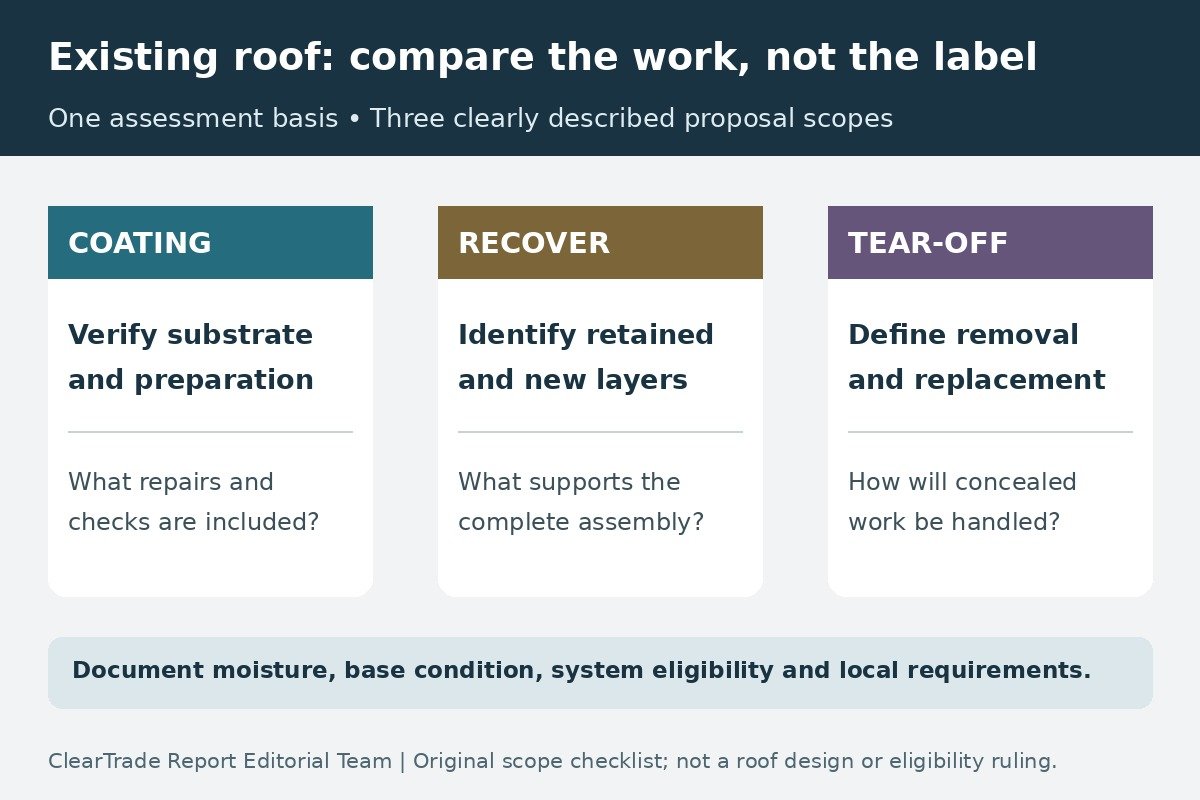
Choose an intervention for an existing low-slope roof by comparing documented conditions and complete scopes. Before ranking prices, ask what is wet, deteriorated or unverified; what each proposal retains; and what evidence supports the proposed new assembly. A coating, a membrane recover and a tear-off can represent substantially different work even when all three quotes promise a “new roof.”
This guide gives commercial owners and HOAs a way to compare those proposals. It does not diagnose a particular roof or prescribe a system. The objective is a decision record that connects observed conditions, the selected specification, unresolved assumptions and the work included in the price.
Define the work behind the label
For this comparison, a coating proposal applies a specified liquid-applied system over a prepared existing surface, a membrane-recover proposal adds a new membrane assembly while retaining identified existing components, and a tear-off proposal removes identified roofing layers before replacement. Repairs may be needed within any of these scopes.
Those are practical comparison labels, not three universal code classifications. GAF’s recover overview includes both membranes and appropriate coatings within its recover discussion. Ask each bidder to state exactly what will remain, what will be removed and what will be added. Do not assume that “restoration,” “recover” or “reroof” means the same thing in every quote.
| Proposed intervention | What the scope should identify | Evidence to request before comparing price |
|---|---|---|
| Coating system | Existing surface retained, repairs, preparation and complete coating specification | Substrate suitability, moisture assessment and specified adhesion checks |
| Membrane recover | Retained layers, separation or cover board, new membrane and attachment | Existing assembly condition and compatibility with the specified system |
| Tear-off and replacement | Removal limits, deck assessment, replacement layers and details | Existing-condition findings, concealed-work process and replacement design |
Our roofing-materials comparison explains covering classes. Here, the question is what work is appropriate to an existing assembly, rather than which material name sounds best in the abstract.
Establish what is beneath the surface
GAF’s recover overview identifies a structurally sound roof without significant moisture or deterioration issues as a candidate and recommends core cuts to assess existing components. That supports a basic purchasing question: what investigation was performed before the bidder decided the existing roof could stay?
Request a dated roof plan showing inspected areas, identified layers, observed defects, reported wet areas and locations of any sampling. Ask who performed the assessment, which method was used, what conditions affected it and how its findings were checked. Keep observations and conclusions distinguishable. An inaccessible area belongs on the record as a limitation, not a presumed dry area.
For a fictional example, a report might mark two zones as “suspected moisture” and identify separate verification locations. A quote that converts the whole marked area to “confirmed wet insulation” should explain the evidence for that change. Conversely, excluding those zones from the repair quantity should also be explained. The example illustrates documentation, not a moisture-testing procedure or a conclusion about any building.
Ask how the proposed scope handles the transition from investigation to construction: who approves removal limits, what photographs or measurements are retained, and how newly discovered conditions change the work. The decision should remain traceable when a crew opens the assembly and finds something different from the initial estimate.
A dry-looking surface is not the whole eligibility test
The GAF Liquid-Applied Roofing Manual, cover version 2.2, discusses substrate preparation and moisture surveys on printed page 18. It calls for wet insulation to be removed and replaced before coating. For eligibility for its Liquid-Applied NDL Diamond Pledge guarantee, it requires a moisture survey and states that a complete tear-off is required when the survey finds moisture in 25% or more of the roof area.
That percentage is specific to the cited manufacturer program. It is not a universal code limit or approval for every roof below it. Request the exact system and program requirements.
Keep separate entries for moisture assessment, repairs and adhesion checks. The report should say what each result establishes and what remains unknown.
Read the preparation requirements with the performance claims
As a product-specific example, the GAF Unisil data sheet, COMCO706-PDF-0626, describes protection against leaks due to ponding water. Its preparation instructions still call for positive drainage, a clean and dry roof with no trapped moisture, repairs to damaged membrane and details, and adhesion test patches. It also directs the reader to further requirements for priming.
A performance claim does not erase the preparation instructions beside it. Ask the proposal to identify how drainage, existing leaks, substrate defects and compatibility will be addressed before application. This is a documentation example, not a recommendation of that product or an installation recipe.
The NRCA’s July 14, 2026 announcement confirms a 2026 update to its roof-coatings guidelines, including preparation and on-site quality control topics. We reviewed the public announcement, not the paid technical publication. A bid citing “NRCA guidelines” should identify the actual edition and provisions on which it relies.
Verify the complete recover assembly
Matching a new membrane’s name to an existing membrane’s name is not the whole system selection. Carlisle’s Commercial Roofing Recover Options brochure presents different combinations of membrane, insulation or cover board and attachment for different existing roof types. Its matrix includes unavailable combinations and directs users to specifications for full requirements.
Use that as an example of the level of specificity to request. The bidder should identify the retained substrate, new layers, attachment approach, relevant details and the manufacturer documentation supporting the combination. A list of individually familiar products does not establish approval of their proposed combination on your roof.
Ask the designer to identify any required structural, wind, fire, drainage or energy-code review and the project documents supporting it. If roof-mounted equipment, edge conditions or penetrations are outside the quoted scope, name the responsible party. These are coordination questions, not a claim that every project requires the same test or approval.
Separate local requirements from sales shorthand
Code requirements and manufacturer eligibility need separate entries in the decision record. Ask which jurisdiction, adopted edition, building type, permit scope and local amendments apply. Have the designer or code official explain how the existing number and condition of coverings affect the proposed intervention.
For a bounded terminology example, New York City’s published BC 1511.3 roof-replacement section describes removing existing covering layers to the deck and includes an exception for an adhered ice-barrier membrane. That local provision is not a national recover rule or a determination of what your roof must undergo. It shows why a quotation should identify removal limits and the governing basis precisely.
Do not infer a permit exemption, an allowable extra layer or an insulation-upgrade exemption solely from a coating or recover label. Request the project-specific basis and keep it with the proposal. A manufacturer’s marketing overview is useful context; it is not a substitute for that determination.
Normalize the proposals before voting or signing
The following original worksheet keeps the scope comparable. Ask bidders to complete it against the same roof plan and report revision. Record an exclusion as an exclusion, rather than treating the missing item as included work.
| Comparison item | Record for every proposal | Clarification that may be needed |
|---|---|---|
| Existing-condition basis | Survey date, method, plan and limitations | Which conclusions remain unverified? |
| Removal and repairs | Quantities, boundaries and included materials | Who authorizes additional concealed work? |
| New system | Exact specification, layers and details | What supports the complete combination? |
| Drainage and interfaces | Included work at drains, edges, walls and equipment | Which trade handles excluded interfaces? |
| Quality and closeout | Required checks, records, responsible party and disposition | What must be provided before acceptance? |
| Commercial terms | Base scope, unit rates or allowances, exclusions and maintenance | Which assumptions change the final cost? |
Avoid comparing one bid’s fully included repair quantity with another bid’s unpriced allowance as though their totals cover identical work. For uncertain quantities, request the same measurement basis, approval process and pricing structure from each bidder. That lets the board or owner see both the base commitment and the unresolved exposure without inventing a universal cost per square foot.
Have any promised warranty or guarantee identified by issuer, document and scope. Keep a proposed term separate from a document actually issued after the work. This article does not rank warranty products; the point is to avoid counting an unspecified promise as evidence that the intervention is eligible or complete.
Compare the written warranty separately from the proposed roof intervention. Our roof warranty document guide explains how product, workmanship and enhanced coverage can differ in responsible party, remedy and eligibility. The shingle-form examples do not establish coverage for a coating or low-slope membrane system.
Close with the evidence that supports the chosen scope
An owner’s decision record can state: “Selected option based on this assessment and specification; retained components identified; repairs and concealed-condition process agreed; local requirements documented; completion evidence assigned.” Attach the supporting documents and list remaining conditions with an owner and deadline.
At handover, reconcile the actual removal and repair areas with the final roof plan. Request the specified quality records, details of approved changes, maintenance instructions and any issued warranty documents. If the installed work differs from the original assessment, retain the reason and approval rather than rewriting the history as though the change was always planned.
When standing water is part of the concern, build the drainage evidence before choosing the assembly response. The low-slope roof ponding documentation guide separates event history, drainage findings, unresolved structural questions and the agreed result check.
Frequently asked questions
Can a coating substitute for assessing wet insulation?
A coating proposal should include the assessment and repair scope supporting substrate suitability. Request the report, method, limitations and specified follow-up; a new surface is not a concealed-condition report.
Does a roof with less than 25% moisture automatically qualify for coating?
No. A manufacturer-program threshold does not replace the selected specification or project assessment. Ask the bidder to document all eligibility conditions and required repairs.
Does recover always mean a new membrane?
No. Terminology varies; GAF’s overview includes appropriate coatings in its recover discussion. Ask the proposal to identify exactly what is retained, removed and added, along with the governing specification and local requirements.
What makes two intervention bids comparable?
They need a common assessment and roof-plan basis, explicit removal and repair quantities, complete system specifications, included interfaces, completion evidence and clear treatment of uncertain work. A matching headline price or warranty term does not establish matching scope.
Sources and review scope
Sources checked October 27, 2026: GAF recover overview, Liquid-Applied Roofing Manual cover version 2.2 and Unisil sheet COMCO706-PDF-0626; Carlisle Commercial Roofing Recover Options brochure; NRCA’s July 14, 2026 public update notice; and the published NYC BC 1511.3 local example. Manufacturer examples are bounded to their documents and programs. No roof inspection, moisture survey, adhesion test, design approval, product endorsement or outside professional review was performed for this article.
AI tools assisted with drafting. ClearTrade Report Editorial Team checked the cited sources and edited this guide. No hands-on inspection or testing was performed.
Need a qualified professional?
Trusted Pros uses visible license-verification states and never ranks paid listings above unpaid listings.