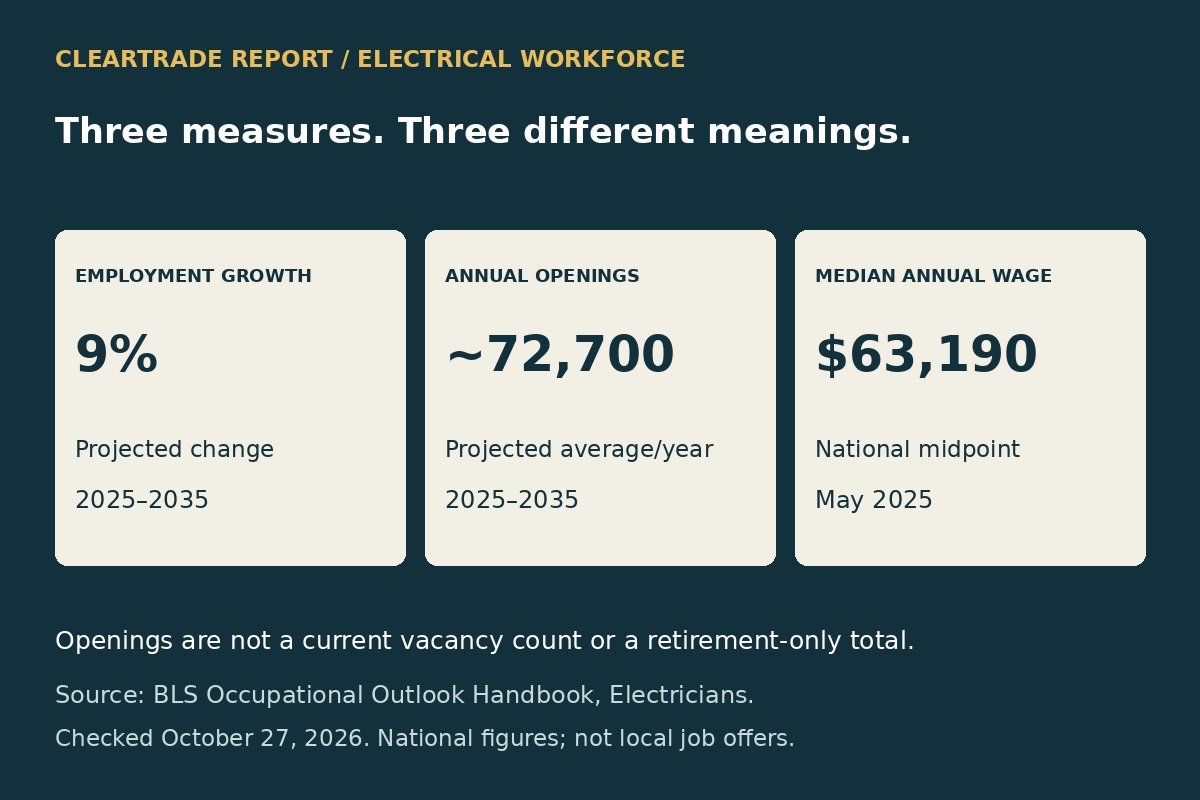
The national outlook points to growth in electrician employment, but it does not tell a contractor how quickly a local job will fill or guarantee a new entrant a position. Use the national figures to understand the direction of the occupation, then check local employment, wages, training requirements and actual opportunities.
The practical distinction is between three different questions: how much the occupation may grow, how many workers may need replacing, and what employers in your area are offering now.
The national snapshot
The Bureau of Labor Statistics reports the following figures for electricians:
| Measure | Current published figure | Reference period |
|---|---|---|
| Projected employment growth | 9% | 2025–2035 |
| Average projected openings per year | About 72,700 | 2025–2035 |
| Median annual wage | $63,190 | May 2025 |
Source: BLS Occupational Outlook Handbook, Electricians, checked October 27, 2026. These are national figures with different reference periods; they are not a count of jobs advertised today.
BLS explains that projected openings include replacement needs when workers change occupations or leave the workforce, including retirement. The annual openings figure is therefore not all new positions, and it is not a measured shortage. The cited summary does not provide a retirement-only share.
Keep the measures separate
A useful way to read workforce reporting is to ask what each number is counting.
Employment growth compares the size of the occupation over a forecast period. Openings account for opportunities arising through more than growth alone. An employer’s current vacancy is a specific unfilled position with a location, requirements and compensation.
Do not add a ten-year growth percentage to an annual openings total. Do not turn every projected opening into a retiring electrician. And do not multiply openings by a wage figure and call the result lost revenue.
For a contractor, the relevant next question is operational: which skill or credential is difficult to hire, at what offered compensation, and for which work? For a prospective electrician, it is whether a suitable employer or training program is accepting applications.
Apprenticeship is a training commitment
The U.S. Department of Labor describes Registered Apprenticeship as paid employment combining structured workplace learning, mentorship, related instruction, progressive wages and an industry credential. Registration is through DOL or a state apprenticeship agency. Program framework
Before enrolling, ask the sponsor for its actual requirements and schedule. Confirm the application process, work territory, wage progression, instructional costs and who provides the employment component. Ask how previous experience is evaluated and what documentation you will receive.
A program credential and permission to work in a particular jurisdiction are separate questions. BLS notes that most states require electrician licensing. Verify the applicable licensing or certification pathway with the relevant authority before assuming a school certificate or work history is sufficient.
For employers, a training plan should identify who will mentor the apprentice and which work will support the required learning. Treat supervision and instruction as planned capacity. A new entrant should not be counted as an immediate replacement for the person expected to teach them.
Check the local evidence
Before using a national wage number in an offer or career budget, build a local comparison with consistent definitions.
| Local check | What to record |
|---|---|
| Occupation | Electrician category and the specialty or role actually needed |
| Geography | State, metro area or local work territory |
| Measure | Median versus mean, hourly versus annual, wage versus total compensation |
| Date | Survey reference year and when the source was checked |
| Credential | Required license, certification, apprenticeship status or experience |
| Offer conditions | Benefits, travel, schedule, overtime assumptions and training costs |
The BLS Occupational Employment and Wage Statistics overview describes a federal-state survey of wage and salary workers in nonfarm establishments. It excludes the self-employed, owners and partners in unincorporated firms, household workers and unpaid family workers. Estimates are published annually with a May reference date, including national, state and local-area measures.
That is a reason to check the population behind a statistic. An employee wage estimate cannot simply be relabeled as a business owner’s income or a contractor’s hourly billing rate. If a local value is missing, report it as missing instead of substituting the national number and presenting it as local.
This article does not provide a Seattle wage estimate or rank regions by shortage. Those conclusions would require a separate, consistently defined local dataset.
Turn the outlook into a hiring plan
ClearTrade recommends testing a hiring decision against the business’s own evidence:
- Identify the work the hire must be able to complete and the credentials that work requires.
- Separate a current production need from a long-term training position.
- Compare the full compensation and schedule with relevant local offers.
- Record applications, qualified candidates, interviews, acceptances and time to fill.
- Match the start date to committed work, available supervision and cash capacity.
This is a management checklist, not a BLS forecast. Its purpose is to reveal whether a recruiting problem concerns compensation, the role, the schedule, the candidate pool or the business’s readiness to train.
For someone considering the trade, the parallel task is to compare actual programs and employers. Ask about the work, progression, travel and support—not just the headline pay figure.
Next step: Choose one local role or apprenticeship pathway and gather its current requirements. Use national projections as context and the local evidence to decide what to do next.
Frequently asked questions
Are projected openings the same as unfilled electrician jobs?
No. Projected openings describe expected opportunities over a forecast period. They are not a current vacancy count.
Does the openings figure tell us how many electricians will retire?
No. Replacement demand includes more than retirement, and the cited national summary does not give a retirement-only share.
Is the national median wage a starting wage?
No. It is a national statistical midpoint for the measured occupation, not a starting offer or a guaranteed local wage.
Does apprenticeship completion automatically authorize electrical work everywhere?
Do not assume that. Check the licensing or certification requirements of the jurisdiction where the person will work.
Sources and methodology
Sources checked October 27, 2026: BLS Occupational Outlook Handbook; U.S. Department of Labor Registered Apprenticeship framework; BLS OEWS overview. Wages are dated May 2025, while projections cover 2025–2035. No employer survey, recruiter interview or independent labor-shortage measurement was conducted for this article.
Related planning
For a project-level example of local electrical planning, read why data centers change local infrastructure decisions. A project announcement is not a measure of national electrician vacancies.
AI tools assisted with drafting. ClearTrade Report Editorial Team checked the cited sources and edited this guide. No hands-on inspection or testing was performed.
Need a qualified professional?
Trusted Pros uses visible license-verification states and never ranks paid listings above unpaid listings.