On this page
Data-center growth connects computing plans to physical infrastructure: electricity supply, delivery capacity, cooling and the timing of construction. But a national demand forecast cannot tell you whether a particular community can serve a proposed facility—or who should pay for the work.
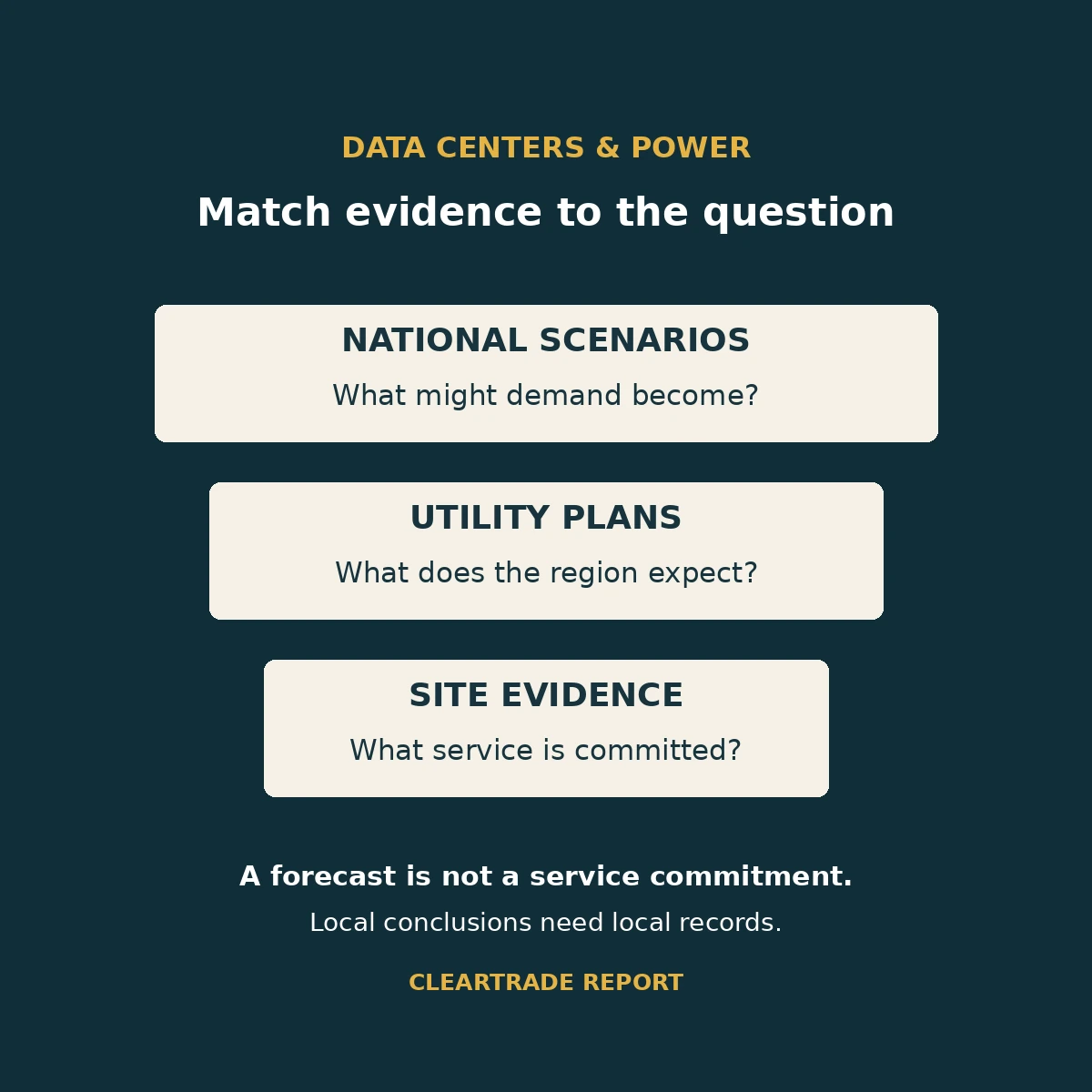
Read the evidence at the scale of the decision.
Keep forecasts separate from commitments
EIA’s 2026 outlook models growing server electricity consumption under different assumptions. Those cases describe possible futures, not guaranteed construction or a service commitment to a particular site.
EIA also distinguishes server demand from associated uses such as cooling. Check what a headline includes before comparing it with a utility’s project figure.
The AEO2026 analysis generally considers laws and regulations as of December 2025. Its publication in 2026 does not mean every later policy change is reflected.
Ask what the project load represents
A proposed capacity figure can mean an ultimate campus buildout, one phase, an equipment rating or an expected operating demand. Those are not interchangeable.
Ask the project or utility record to define the figure and its timing. Separate current operation, contracted future service and an application still being evaluated.
This distinction matters when a project grows in stages. A distant buildout target should not be described as electricity already being consumed.
Local infrastructure needs local evidence
A region can have significant generation and still face a project-specific delivery constraint. Conversely, a national warning about demand does not prove that a particular feeder or substation is inadequate.
For local conclusions, look for the utility’s published planning material, applicable regulatory docket and actual project service documents. Do not infer capacity from the size of nearby equipment or a map photograph.
Engineering conclusions require the relevant studies and qualified review.
Read cooling and backup claims separately
The server load is not necessarily the entire facility load. Cooling and other supporting equipment belong in the project’s own documented demand.
Likewise, onsite backup equipment does not automatically establish continuous off-grid operation or eliminate the need for utility service. Ask what operating role is proposed and what permissions and limits apply.
Do not convert an equipment inventory into a claim about actual emissions, water use or outage support without the appropriate evidence.
Ask who bears the cost and risk
For a major project, useful public questions include:
- Which infrastructure is required for the committed phase?
- Which costs are assigned to the customer and which enter utility rates?
- What happens if the project is delayed or smaller than planned?
- Which approvals and milestones remain?
- What is the source date and confidence of the load forecast?
The answers are jurisdiction- and contract-specific. This article makes no claim that a particular data center raised a reader’s bill.
Use the information for your own project
Building owners planning other large loads should ask utilities about their actual service process early. Do not assume that a national data-center story determines the schedule for an unrelated building.
Keep utility coordination distinct from equipment installation. ClearTrade’s panel replacement versus service upgrade guide explains why related electrical scopes can follow different paths.
Workforce claims need the same distinction between national projections and local evidence. See the electrical workforce outlook for growth, replacement openings and hiring checks.
Related reading: 2026 NEC references and local adoption.
Frequently asked questions
Does a national forecast prove local capacity is unavailable?
No. Local service capability requires local utility and engineering evidence.
Does a proposed campus rating equal current consumption?
No. Establish what the figure describes and when it applies.
Does server electricity include all cooling?
Not necessarily. Read the dataset’s definitions.
Can a backup generator remove every grid-planning issue?
No. Its actual operating role and permissions must be established.
Sources
Checked October 25, 2026.
- EIA: Data-Center Server Energy Use, May 19, 2026 — scenario, scope and policy-cutoff limitations.
- DOE: Data-Center Electricity Demand Resources — August 2024 infrastructure/resource context, not a current promise of funding.
- DOE: Resources to Meet Data-Center Electricity Demand — historical 2024 planning context; not a statement of current funding or policy.
No local capacity, tariff effect or project engineering conclusion is asserted.
Need a qualified professional?
Trusted Pros uses visible license-verification states and never ranks paid listings above unpaid listings.